Beauty Tips for Beginners: 50+ Tips for Skin, Makeup, Hair and Nails
Starting a beauty routine from scratch can feel overwhelming. There are thousands of products, endless tutorials, and everyone seems to have a ten-step routine perfected — except you. Here’s the truth: you don’t need any of that to start. Beauty basics are simpler than the internet makes them look.
This guide collects 50+ beginner-friendly beauty tips covering skincare, makeup, hair, and nails — plus the lifestyle habits and money-saving tricks that make the biggest difference. No jargon, no expensive product lists, no gatekeeping. Whether you’re a teenager building your first routine or an adult finally ready to take skincare seriously, start here.

Skincare Tips for Beginners
Skincare is the foundation of everything. Healthy skin needs less makeup, photographs better, and honestly just feels better day to day. The good news: an effective beginner routine has only three steps.
1. Start with the basics: cleanser, moisturizer, sunscreen
You do not need a serum for every concern on day one. A gentle cleanser, a basic moisturizer, and a broad-spectrum sunscreen SPF 30 or higher cover roughly 90% of what your skin needs. Dermatologists widely agree that sunscreen is the single most impactful anti-aging product that exists — more than any expensive cream. Build the habit first; add targeted treatments later.
2. Know your skin type before buying anything
Products are formulated for specific skin types, and using the wrong one causes most beginner frustration. Here’s the quick test: wash your face with a gentle cleanser, pat dry, and wait one hour without applying anything. If your skin feels tight, it’s dry. If your T-zone (forehead, nose, chin) looks shiny but cheeks feel normal, it’s combination. If everything looks shiny, it’s oily. If it feels comfortable, it’s normal. Sensitive skin usually reveals itself through redness or stinging — and if that’s you, choose fragrance-free formulas.
3. Patch test every new product
Before putting a new product all over your face, dab a small amount behind your ear or on your inner forearm and wait 24 hours. If there’s no redness, itching, or irritation, you’re good to go. This one habit prevents the vast majority of bad reactions, and it takes almost no effort.
4. Introduce only one new product at a time
When something irritates your skin, you need to know which product caused it. If you start five new products in one week and break out, you’re back to square one. Add one product, use it for one to two weeks, then add the next. Slow is fast in skincare.
5. Moisturize while skin is slightly damp
Moisturizer works by sealing in water. Applying it to slightly damp skin (right after cleansing or misting) locks in significantly more hydration than applying it to fully dry skin. This single technique can make a basic moisturizer perform like a much more expensive one.
6. Don’t skip moisturizer if you’re oily
Oily skin still needs moisture. When oily skin is dehydrated, it often produces more oil to compensate. Choose a lightweight, gel-based or oil-free moisturizer instead of skipping the step entirely. Many people find their oiliness actually decreases once their skin is properly hydrated.
7. Wear sunscreen every single day
UV damage happens through windows, on cloudy days, and during a ten-minute walk. Daily sunscreen is the closest thing to a magic anti-aging product — it prevents dark spots, fine lines, and uneven tone from forming in the first place. Use about a nickel-sized amount for your face, and reapply if you’re outdoors for extended periods. best sunscreens for oily, acne-prone skin
8. Take your makeup off before bed — every time
Sleeping in makeup clogs pores, and clogged pores lead to breakouts and dullness. Keep micellar water and cotton pads on your nightstand for the nights you’re too tired for a full cleanse. It’s not perfect, but it’s infinitely better than nothing.
9. Be gentle — your skin is not a kitchen counter
Scrubbing harder doesn’t clean better. It damages your moisture barrier, causing redness, sensitivity, and breakouts. Use gentle, circular motions with your fingertips. If you’re using exfoliating products, chemical exfoliants (like AHAs and BHAs) are generally gentler and more even than harsh physical scrubs.
10. Give products time to work
Most skincare products need four to six weeks of consistent use before you can judge results. Skin cells renew roughly every 28 days (longer as we age), so a product can’t transform your skin overnight. The exception: if something burns, stings persistently, or causes a rash, stop immediately — that’s not “purging,” that’s irritation. how to repair a damaged skin barrier
Makeup Tips for Beginners
Makeup should be fun, not stressful. The beginner goal isn’t a full glam face — it’s learning a few techniques that make you feel polished in ten minutes.
11. Less is more when you’re learning
A common beginner mistake is buying a full face of products and trying to use them all at once. Start with three or four items: tinted moisturizer or light foundation, concealer, mascara, and a lip product. Master those, then expand. You’ll look more polished with four well-applied products than twelve poorly blended ones.
12. Match foundation to your jawline, not your hand
Your hand is almost never the same shade as your face. Test foundation along your jawline in natural daylight, and choose the shade that disappears into your skin. The right shade should look like nothing — if you can see where it starts and stops, it’s wrong.
13. Blend downward past your jawline
Even with a good shade match, an unblended foundation line along the jaw is the classic beginner giveaway. Always blend foundation down onto your neck slightly so there’s no visible line. A damp makeup sponge makes this nearly foolproof.
14. A damp sponge beats fingers for foundation
Beauty sponges (used damp, squeezed out well) press product into skin for a natural, skin-like finish. Fingers can work, but they tend to leave streaks and move product around rather than blending it. If your foundation ever looks cakey, switching application method is the first thing to try. why foundation looks cakey and how to fix it
15. Concealer goes on after foundation, not before
Foundation evens out most of your skin tone, so you need far less concealer than you think. Apply foundation first, then dot concealer only where you still need coverage — under eyes, around the nose, on blemishes. This prevents the heavy, cakey look.
16. Set oily areas with a light powder
If your T-zone gets shiny by midday, a light dusting of translucent powder on the forehead, nose, and chin keeps makeup in place for hours longer. Use a fluffy brush and a light hand — too much powder is what creates that dry, cakey appearance.
17. Curl your lashes before mascara
An eyelash curler makes the single biggest difference to how awake your eyes look — more than any mascara. Curl at the base of the lashes, hold for ten seconds, then apply mascara. It opens up the eyes instantly, even with no other eye makeup.
18. One coat of mascara is enough to start
Two or three coats look great once you have the technique down, but beginners often end up with clumps. One careful coat, wiggling the wand at the base of the lashes and pulling through to the tips, gives defined lashes without the spider-leg effect.
19. Start with neutral eyeshadow shades
Browns, taupes, and soft golds are forgiving — blending mistakes are nearly invisible. Bold colors show every error. A simple wash of one neutral shade across the lid with a fluffy brush looks polished and takes thirty seconds.
20. Blot lipstick for a natural stain
Full-coverage lipstick can feel like a lot when you’re not used to wearing makeup. Apply it, then blot once with a tissue. You get a soft stain of color that looks effortless and doesn’t require constant mirror checks.
21. Remove waterproof makeup with oil first
Waterproof mascara and long-wear foundation don’t dissolve with regular cleanser. Massage an oil cleanser or micellar water over the area first to break the product down, then follow with your normal cleanser. Rubbing and tugging at the delicate eye area causes premature fine lines.
Hair Tips for Beginners
Healthy hair is mostly about what you stop doing rather than what you add. Most hair damage comes from heat, harsh handling, and overwashing.
22. Wash your hair less often
Most hair types do best washed two to three times per week, not daily. Daily washing strips natural oils, leaving hair dry and your scalp overproducing oil to compensate. If your hair feels greasy on day two, dry shampoo at the roots buys you another day. It takes two to three weeks for your scalp to adjust — push through the transition.
23. Focus shampoo on the scalp, conditioner on the ends
Shampoo is for cleaning the scalp where oil and buildup accumulate. Conditioner is for the mid-lengths and ends where hair is oldest and driest. Putting conditioner on your scalp weighs hair down and can cause greasiness; putting shampoo through your ends dries them out.
24. Turn down the heat tools
Flat irons and curling wands at maximum temperature fry hair over time. Most hair types style perfectly well at medium heat (around 300–350°F / 150–175°C). If your hair smells burnt after straightening, the temperature is too high — and that smell means real damage is happening. why hair smells burnt after straightening
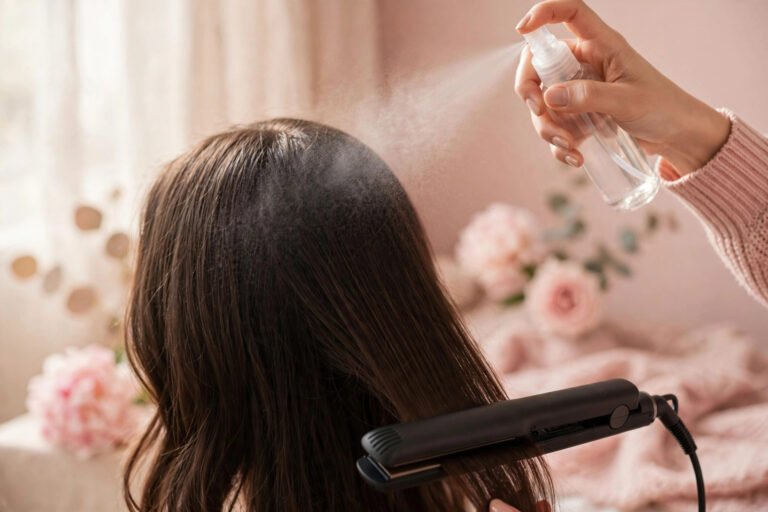
25. Always use heat protectant
If you use any heat tool, a heat protectant spray is non-negotiable. It forms a barrier that significantly reduces moisture loss and protein damage. Apply to damp or dry hair before styling, focusing on the lengths and ends.
26. Don’t brush wet hair with a regular brush
Wet hair stretches and breaks far more easily than dry hair. Use a wide-tooth comb or a brush specifically designed for wet hair, and start detangling from the ends, working your way up to the roots. Starting at the roots and ripping down is how most breakage happens.
27. Sleep on silk or satin pillowcases
Cotton pillowcases create friction that causes frizz, tangles, and breakage overnight. Silk or satin pillowcases let hair glide, so you wake up with smoother hair — and they benefit your skin too, since there’s less tugging on your face. A satin bonnet or loose braid works similarly if you don’t want to change pillowcases.
28. Get trims before your ends get bad
Split ends travel upward, so waiting too long between trims means losing more length later. A small trim every 8–12 weeks keeps ends healthy. If you’re growing your hair out, trims feel counterproductive, but they prevent the breakage that keeps hair stuck at the same length.
29. Deep condition once a week
A weekly deep conditioning treatment (or even just leaving regular conditioner on for 10–15 minutes under a shower cap) makes a visible difference in softness and shine, especially for dry, curly, or color-treated hair. It’s the highest-impact, lowest-effort hair treatment that exists.
30. Rinse with cool water at the end
A cool rinse at the end of your shower smooths the hair cuticle, which means more shine and less frizz. It doesn’t need to be ice cold — just cooler than your shower temperature for the last 30 seconds.
Nail Tips for Beginners
You don’t need salon visits for nice-looking nails. Basic nail care at home takes minutes and makes a bigger difference than most people expect.
31. Keep nails short while you’re learning
Long nails chip, break, and make polish application much harder. Start with a short, practical length. You’ll have far fewer frustrations, and short, well-shaped nails look just as polished as long ones.
32. File in one direction, not back and forth
Sawing back and forth with a nail file creates microscopic tears that lead to peeling and breakage. File in one direction with smooth strokes. It takes slightly longer but your nails will be dramatically stronger. A glass or crystal file is gentlest of all.
33. Push back cuticles — don’t cut them
Cuticles protect the nail bed from infection. Cutting them (especially with non-sterile tools) risks painful infections and ragged regrowth. Instead, soften cuticles with oil or warm water, then gently push them back with an orangewood stick or cuticle pusher.
34. Always use a base coat
Base coat prevents polish from staining your nails yellow, helps color adhere better, and makes removal easier. Skipping it is the main reason nails look stained after dark polish. One thin layer is all you need.
35. Apply polish in thin coats
Thick coats take forever to dry, bubble, and dent at the slightest touch. Two to three thin coats dry faster and last longer than one thick glob. If your polish keeps bubbling, thin coats are almost always the fix. why nail polish bubbles and how to prevent it
36. Cap the free edge
After each coat (base, color, top), run the brush lightly along the tip of the nail. This “caps” the edge and is the professional secret to preventing chips. It takes five extra seconds per nail and doubles how long a manicure lasts.
37. Moisturize your cuticles daily
Dry, ragged cuticles make even a perfect manicure look unkempt. A drop of cuticle oil (or even olive oil or vitamin E) massaged in daily keeps them soft and healthy. Keep a pen-style oil in your bag for on-the-go touch-ups.
38. Give nails a break between manicures
Constant polish — especially gel — can leave nails thin and dehydrated. If your nails are peeling in layers or feel paper-thin, take a one to two week break with just cuticle oil and a strengthening treatment. why nails peel in layers
Lifestyle Tips That Show on Your Skin and Hair
Here’s what the beauty industry doesn’t advertise: the biggest “glow up” factors aren’t products. They’re habits.
39. Sleep 7–9 hours — it’s called beauty sleep for a reason
During deep sleep, your body produces growth hormone that repairs skin cells and builds collagen. Chronic sleep deprivation shows up as dark circles, dull skin, and breakouts. No serum compensates for four hours of sleep. If you change one lifestyle habit, make it this one.
40. Drink water consistently through the day
You don’t need to chug gallons, but steady hydration supports skin elasticity and helps flush out the waste products that contribute to dullness. Keep a water bottle visible — most people drink significantly more when water is within arm’s reach. Herbal tea counts too.
41. Eat colorful fruits and vegetables
Skin is built from nutrients. Vitamin C (citrus, bell peppers) supports collagen production. Beta-carotene (carrots, sweet potatoes) contributes to a healthy skin tone. Omega-3 fatty acids (salmon, walnuts, flaxseed) help maintain the skin barrier. You don’t need a perfect diet — just add more color to what you already eat.
42. Manage stress — it shows on your face
Stress triggers cortisol, which increases oil production and inflammation. That’s why breakouts often arrive before big events. You can’t eliminate stress, but even ten minutes of walking, deep breathing, or any activity you enjoy helps regulate it. Your skin keeps score.
43. Change your pillowcase twice a week
Pillowcases collect oil, sweat, dead skin, and product residue. Sleeping on a dirty pillowcase night after night is like pressing all of that into your skin for eight hours. Two pillowcases in rotation make this effortless.
44. Don’t touch your face during the day
Your hands pick up bacteria from phones, keyboards, and door handles. Touching your face transfers all of it to your skin, contributing to breakouts — especially along the jawline and cheeks. It’s a hard habit to break, but it makes a real difference.
Money-Saving Beauty Tips
Good beauty doesn’t require a big budget. Some of the most effective approaches cost almost nothing.
45. Drugstore products often match high-end formulas
Many drugstore and luxury products share parent companies and even manufacturing facilities. The main differences are often packaging and fragrance, not performance. For basics like cleansers, moisturizers, and sunscreens, affordable options perform excellently. Save your money for the one or two products where formula genuinely matters to you.
46. Buy minis before committing to full sizes
Most prestige brands sell travel or trial sizes. Testing a $12 mini for two weeks beats discovering you hate a $60 full-size product. This applies especially to foundation (shade and formula) and skincare actives.
47. Multi-use products stretch your budget
A tinted moisturizer replaces foundation and moisturizer. A lip-and-cheek tint covers two steps. Coconut oil (used carefully — it can clog pores for some skin types) works as a body moisturizer and hair mask. Fewer products means less money spent and a simpler routine you’ll actually maintain.
48. DIY treatments for pampering, not problems
Homemade masks and scrubs are fun for self-care evenings — honey, oatmeal, and yogurt all have genuine skin-soothing properties. But DIY isn’t a substitute for treating real concerns like acne or hyperpigmentation, where formulated products with tested concentrations work better. Enjoy DIY for relaxation; use proper products for problems. turmeric face mask guide
49. Wait 48 hours before buying
Impulse beauty purchases are how drawers fill with half-used products. When you want something, wait two days. If you still want it and can name exactly what gap it fills in your routine, buy it. Most urges fade — and your wallet stays fuller.
50. Finish products before buying replacements
It’s tempting to buy the new launch while you still have three open moisturizers. But opened products expire, and layering multiple similar products causes irritation. The “one in, one out” rule keeps your routine streamlined and your spending sane.
Common Beginner Mistakes to Avoid
Knowing what not to do saves you months of frustration:
- Doing too much too fast. The ten-step routine can wait. Master the basics first.
- Chasing trends over fundamentals. Slugging, skin cycling, and every viral hack matter less than consistent cleansing, moisturizing, and sunscreen.
- Ignoring your neck and hands. These age visibly too. Extend your skincare down — it takes five seconds.
- Using expired products. Mascara lasts about three months; liquid foundation about a year. Old products harbor bacteria and underperform. When in doubt, check for changes in smell, texture, or color.
- Comparing your bare face to filtered photos. Social media beauty content is lit, angled, edited, and often filtered. Your real skin with texture and pores is normal.
- Skipping sunscreen because makeup has SPF. Makeup SPF is tested at far thicker application than anyone actually wears. It doesn’t replace dedicated sunscreen.
- Over-exfoliating. Exfoliation is great two to three times a week. Daily exfoliation destroys your barrier and causes the exact dullness you’re trying to fix.
- Sleeping in makeup “just this once.” It becomes a habit. Keep micellar water by the bed.
Frequently Asked Questions
What is the most basic beauty routine for a complete beginner?
Cleanser, moisturizer, and sunscreen in the morning; cleanser and moisturizer at night. That’s it. Once that’s automatic (usually two to three weeks), add one targeted product for your main concern — like a vitamin C serum for dullness or a BHA for clogged pores. how to layer vitamin C and niacinamide
How long does it take to see results from a new skincare routine?
Plan on four to six weeks of consistent use before judging a product. Skin renews itself roughly every 28 days, so ingredients need at least one full cycle to show visible change. Hydration improvements appear faster (days), while concerns like dark spots and fine lines take two to three months.
Do expensive beauty products work better than cheap ones?
Not necessarily. Price often reflects packaging, marketing, and brand positioning more than formula quality. Some expensive products are genuinely superior (complex formulations, patented ingredients), but many drugstore basics perform just as well as luxury versions. Focus on ingredients and reviews, not price tags.
How do I know my skin type?
Wash your face, wait one hour without applying products, then observe. Tight feeling means dry; shine only on forehead/nose/chin means combination; shine everywhere means oily; comfortable means normal. Redness or stinging with new products suggests sensitive skin. When in doubt, choose gentle, fragrance-free products — they suit nearly everyone.
Can I wear makeup every day without damaging my skin?
Yes, provided you remove it thoroughly every night and your skin tolerates the formulas. Modern makeup is far less comedogenic than older formulations. The damage comes from sleeping in it, not wearing it. If you break out, check whether a specific product is the trigger rather than blaming makeup in general.
What’s the one beauty habit with the biggest payoff?
Daily sunscreen. It prevents the majority of visible aging — dark spots, wrinkles, and uneven texture are overwhelmingly sun-caused. No other single habit comes close in long-term impact, and it costs less than almost any other step.
Key Takeaways
- Start simple: Cleanser, moisturizer, and sunscreen are the only essentials. Everything else is optional until the basics are habit.
- Technique beats products: How you apply matters more than what you buy — damp sponges, thin polish coats, and gentle handling outperform expensive formulas applied poorly.
- Consistency beats intensity: A simple routine done daily outperforms an elaborate routine done sporadically. Four to six weeks of patience reveals what actually works.
- Habits matter most: Sleep, hydration, and sun protection influence your appearance more than any product. They’re also free.
- Go slow with new products: One at a time, patch test first, and give each product weeks — not days — to prove itself.
- Budget smart: Drugstore basics perform excellently. Spend strategically on the few products where formula truly matters to you, and use minis to test before committing.
Beauty isn’t about perfection or owning every product. It’s about a few consistent habits that help you look and feel like the best version of yourself. Start with three steps, be patient with the process, and enjoy learning what works for you — that’s the whole secret.
Love this? Pin it for later!