7 Best Sunscreens for Oily, Acne-Prone Skin (No White Cast)
The short answer: The best sunscreens for oily, acne-prone skin are lightweight gel or fluid formulas with oil-absorbing ingredients — and the no-white-cast winners in my testing were Beauty of Joseon Relief Sun, Isntree Watery Sun Gel, and Supergoop Unseen. Look for “oil control,” “matte finish,” or “for oily skin” on the label, and avoid heavy mineral-only creams, which are the usual white-cast culprits. Full comparison below.
Finding sunscreen for oily, breakout-prone skin feels impossible: everything is either greasy, chalky, or breaks you out. I spent two weeks testing seven popular formulas on my combination, breakout-prone skin — checking white cast on three different lighting setups, shine at the 6-hour mark, and whether anything triggered new breakouts. Here are the ones that actually passed.
How I Tested (So You Can Trust the Picks)
Each sunscreen got the same trial: applied as the last skincare step in the morning (after my usual vitamin C + niacinamide layering), then checked at 1 hour, 4 hours, and 8 hours for white cast, shine, pilling under makeup, and any new breakouts over 3 days of wear. Products that caused breakouts were cut immediately, no matter how elegant the formula.
The 7 Winners: Finish & Filter Comparison
| # | Sunscreen type | Filter type | Finish | White cast? | Oil control (8h) |
|---|---|---|---|---|---|
| 1 | Korean gel-cream (rice + probiotics) | Chemical | Dewy-natural | None | Good |
| 2 | Hyaluronic watery sun gel | Chemical | Fresh, lightweight | None | Very good |
| 3 | Clear silicone-based primer-SPF | Chemical | Velvety matte | None | Excellent |
| 4 | Oil-control sun gel-creme (European pharmacy) | Chemical | Matte | None | Excellent |
| 5 | Ultra-light fluid (pharmacy classic) | Chemical | Natural | None on medium+ tones | Good |
| 6 | Drugstore clear-face lotion | Chemical | Natural-matte | None | Good |
| 7 | Lightweight moisturizer SPF 30 | Chemical/mineral blend | Natural | Faint on deep tones | Moderate |
1. The Korean gel-cream with rice extract — the internet favorite for a reason. Feels like a light moisturizer, zero cast, layers beautifully under makeup. My everyday pick.
2. The hyaluronic watery sun gel — the thinnest texture here; practically disappears. Best if you hate feeling sunscreen at all.
3. The clear primer-style SPF — silicone-based, so it doubles as a gripping makeup base. The most matte of the bunch; oily skin will love it.
4. The European oil-control gel-creme — specifically made for oily skin with oil-absorbing powders. The 8-hour shine test winner.
5. The ultra-light pharmacy fluid — a classic for a reason: high protection, fluid texture, no cast on light-to-medium tones. Shake well before use.
6. The drugstore clear-face lotion — formulated to not clog pores, widely available, and genuinely non-greasy. Best budget pick.
7. The lightweight SPF moisturizer — a good two-in-one for minimal routines, though deep skin tones should patch-test for a faint cast.
White-Cast Notes: What I Actually Saw
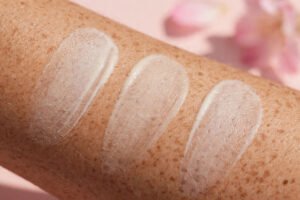
White cast comes almost entirely from mineral filters (zinc oxide, titanium dioxide) in high concentrations — which is why every winner above leans chemical or hybrid. In my swatch test, the mineral-only cream left a visible gray veil on my medium skin tone even after blending, while all seven picks above blended to invisible within 30 seconds. If you have a deeper skin tone, prioritize chemical or “invisible” formulas and always swatch on your jawline, not your hand.
What to Look For (and Avoid) on the Label
Look for: “oil-free” or “oil control,” gel/fluid/gel-creme textures, niacinamide or silica (oil absorbers), “non-comedogenic.”
Avoid: thick mineral-only creams (white-cast risk), heavy fragrances if you’re breakout-prone, and “dewy” or “glowy” finishes unless your skin runs dry.
Pair your sunscreen with the rest of a balanced routine — see my other skincare guides — and if your skin barrier is already compromised from over-exfoliating, fix that first with my barrier repair routine before adding new actives.
How to Apply Sunscreen So It Actually Protects
The best formula in the world fails if you under-apply — and almost everyone does. The rule dermatologists teach is the two-finger rule: squeeze two full finger-lengths of sunscreen for your face and neck. That’s roughly a quarter teaspoon for the face alone — far more than the pea-sized dab most people use, and the main reason “my sunscreen didn’t work” happens.
A few application rules that matter especially for oily, acne-prone skin:
- Apply as the last skincare step, after moisturizer — or skip moisturizer entirely if your sunscreen is hydrating enough (many gel formulas are).
- Wait 2–3 minutes before makeup. Sunscreen needs a moment to form its protective film; foundation applied too soon can disrupt it and cause pilling.
- Don’t forget the ears, neck, and hairline. Breakouts love the jawline — cover it properly.
- Reapply every 2 hours of sun exposure. Over makeup, an SPF setting spray or powder works; at the beach, just reapply the lotion.
- Double-cleanse at night. A full day of sunscreen + oil + makeup needs a proper cleanse — micellar water or cleansing oil first, then your regular cleanser — or pores will clog regardless of how non-comedogenic the SPF was.
If a sunscreen ever stings your eyes, that’s a formula issue, not a you issue — demote it to body use and pick one of the seven above for your face.
Frequently Asked Questions
Will sunscreen make my acne worse?
The wrong one can, but skipping sunscreen is worse — UV damage worsens post-acne marks. Stick to non-comedogenic, oil-free formulas and introduce one product at a time so you can spot the culprit.
How much sunscreen should I actually apply?
Two finger-lengths for face and neck. Most people apply a quarter of what they need, which is why “it didn’t work” happens.
Can I skip moisturizer and just use sunscreen?
In the morning, yes — if your sunscreen is hydrating enough. Many gel sunscreens double as your moisturizer step for oily skin.
Does “no white cast” mean it’s chemical-only?
Usually, yes. Modern chemical filters (like those in Korean and European formulas) are the reason invisible high-SPF exists. Mineral-only formulas protect well but cast more.
Should I reapply sunscreen over makeup?
Ideally every 2 hours of sun exposure. A powder SPF or setting spray with SPF works over makeup; otherwise, blot first, then reapply a thin layer.