How to Prevent Foundation Marks from Glasses
You do your base makeup perfectly in the morning — smooth, even, flawless. Then a few hours later, you take off your glasses and there they are: two pale dents on the bridge of your nose where the nose pads have carved through your foundation, sometimes with a matching smudge on each cheek where the frames rest. It’s one of the most universal complaints among glasses-wearing makeup lovers, and the good news is that it’s entirely preventable. With the right products in the right order, your foundation can hold up under your frames all day.

Key Takeaways
- Foundation marks happen because glasses press into soft, unset base makeup — the fix is making your base grip harder before your frames go on.
- A silicone-based primer plus a long-wear foundation formula creates a base that resists the pressure of nose pads.
- Targeted setting powder on the nose bridge and contact points is the highest-impact single step.
- Setting spray applied in layers — before and after powder — locks everything down like a sealant.
- Frame fit matters too: nose pads adjusted correctly distribute pressure instead of digging in.
Why Glasses Leave Marks on Foundation
To fix the problem, it helps to understand the mechanics. Glasses marks are caused by a combination of pressure, friction, and movement:
- Pressure. Nose pads press into the skin with the full weight of the frames. If your foundation layer is soft and emollient, it displaces under that pressure — exactly like a fingerprint in soft clay.
- Friction. Every time you push your glasses up, take them off, or your face moves while you talk, the pads and frame edges shift slightly against the skin, rubbing product away.
- Oil and heat. The skin on the nose is one of the oiliest areas of the face. As the day goes on, natural oils break down foundation from beneath, making the pressed-in areas show as pale or shiny dents.
- Humidity. Sweat and humidity soften base makeup throughout the day, making the pressed areas worse by afternoon.
Knowing this, the strategy becomes clear: make the foundation layer as tough, dry, and well-bonded as possible before the frames ever touch it.
8 Tips That Really Hold
1. Start with a gripping primer
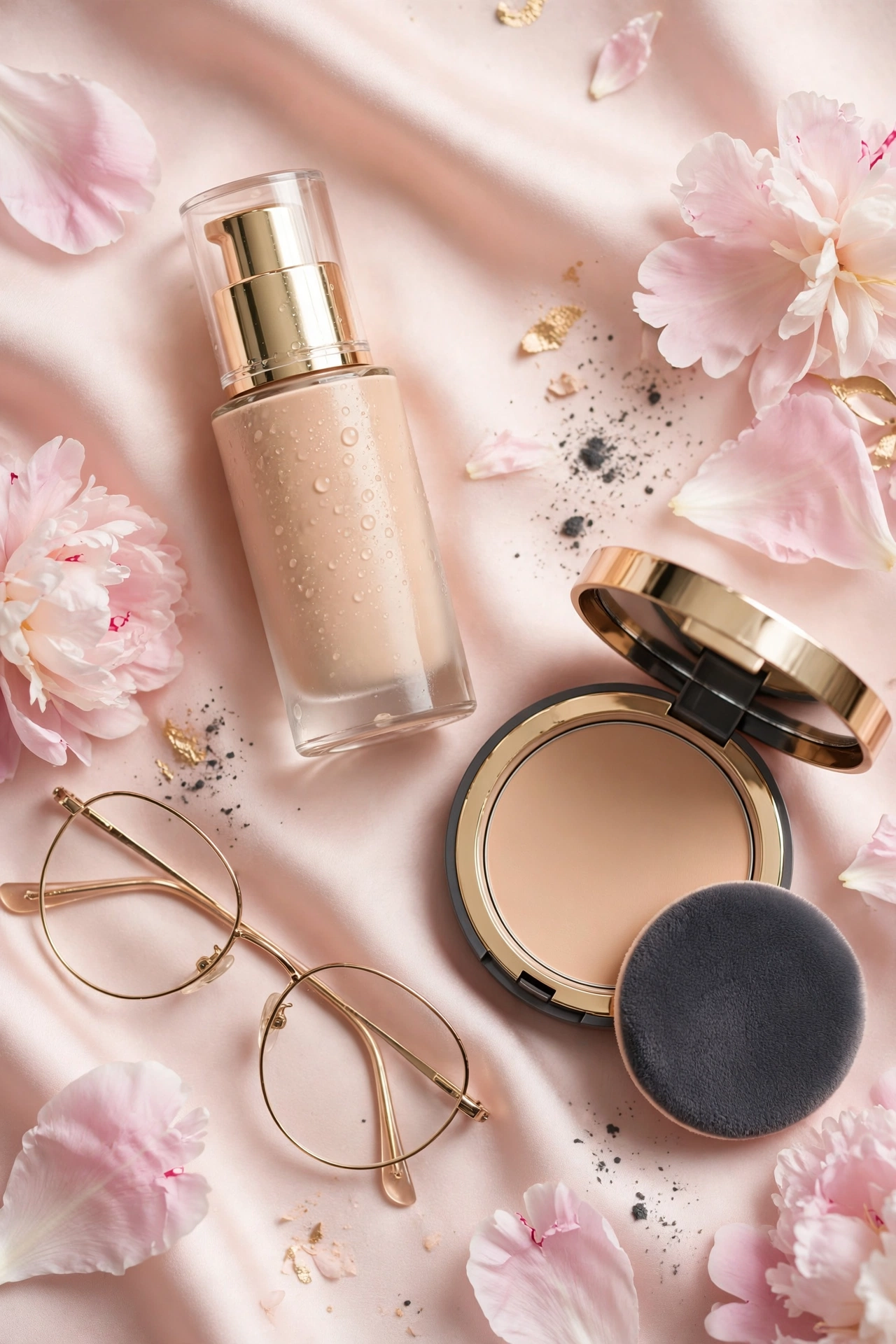
Primer is the foundation’s foundation — it’s the layer that determines whether everything above it slides around or stays put. For glasses wearers, a silicone-based (dimethicone-containing) primer works like a dry adhesive: it creates a smooth, slightly tacky surface that foundation bonds to, and it fills in the tiny texture on the nose where pads press hardest. Apply a little extra on the bridge of the nose and anywhere the frames make contact. Let the primer set for a full minute before foundation goes on; rushing this step is one of the most common reasons base makeup fails by midday.
2. Choose a long-wear foundation formula
Not all foundations are equal under pressure. Long-wear, transfer-resistant formulas are designed to form a flexible film on the skin rather than sitting as a soft cream layer — and that film is exactly what resists the digging of nose pads. Look for foundations marketed as long-wear, 24-hour, or transfer-proof, particularly in matte or natural-matte finishes. Dewy, luminous foundations look beautiful but are softer and more mobile, which makes them the first to dent.
For help choosing between the many options, the complete guide to choosing the right foundation formula for your skin type walks through how to match formula to skin type without the guesswork.
3. Apply thinner layers on the nose
One of the simplest fixes is also one of the most overlooked: use less product where your glasses sit. A thick layer of foundation on the nose bridge is soft, slow to set, and easy to displace. Instead, apply your normal amount everywhere else and use only a sheer, well-blended layer on the nose and the areas where frames touch. Thin layers dry down faster, bond tighter to the skin, and leave less product for the nose pads to push aside.
4. Set the contact points with powder
This is the highest-impact single step in the whole routine. After foundation, press (don’t sweep) a finely milled translucent setting powder onto the bridge of the nose, the sides of the nose where pads sit, and any other frame contact points. Pressing — with a powder puff or a dense brush — packs the powder into the foundation layer and absorbs the surface oils that would otherwise keep it soft. Bake for a few minutes if your skin tolerates it: letting the powder sit before dusting off excess gives an even more locked-down finish on the nose.
5. Use setting spray in layers
Setting spray works best as a sandwich, not a topcoat. Mist your face lightly after primer (this helps foundation grip), apply your base, powder the contact points, and mist again to finish. The spray melts the powder into the foundation so it doesn’t look cakey, while forming a flexible seal over everything. For glasses wearers, a light extra mist directed at the nose area after everything else gives the highest-pressure zone its own protective layer. If you’re choosing between products, the breakdown of setting spray versus setting powder explains how each one works and when to use both.
6. Blot oil before it breaks down your base
Oil breakthrough is the slow-motion enemy of a glasses-proof base. Carry blotting papers or a clean powder puff and press (never rub) the nose area once or twice during the day. Blotting removes the oil that’s softening your foundation before it can turn the nose-pad area into a shiny, sliding mess. If you need a touch-up, a tiny amount of powder pressed over the area restores the matte finish without disturbing the base underneath.
7. Match your formula to your skin type
Oily skin breaks down foundation fastest, which means glasses marks appear earliest and deepest on oily noses. If your skin runs oily, a mattifying primer plus an oil-free, long-wear foundation makes a dramatic difference. Dry skin, on the other hand, needs a hydrating primer to prevent the powder-heavy routine from looking cakey — the trick is hydrating everywhere else while still keeping the contact points set and dry. Combination skin benefits from zone-specific prep: mattifying products on the nose, hydrating ones elsewhere.
For oily skin specifically, the guide to the best foundation for oily skin and long wear covers the formulas that hold up best under pressure and shine.
8. Get your nose pads adjusted
Sometimes the best makeup fix isn’t makeup at all. Nose pads that are too tight dig in and displace product; pads that are too loose let the frames slide, creating friction marks. An optician can adjust pad angle, spacing, and arm tension in a few minutes — often at no charge — so the weight of the frames distributes evenly instead of pressing into two hard points. Wider, softer silicone pads also spread pressure better than small hard ones. If your marks are deep even with a locked-down base, fit is almost certainly part of the problem.
The Glasses-Proof Base Routine, Step by Step
Put the tips together and the ideal morning routine looks like this:
- Skincare: Moisturize, then wait five minutes. Foundation applied over damp skincare slides — this waiting step is non-negotiable for longevity.
- Primer: Silicone-based primer all over, extra on the nose bridge. Wait one full minute.
- Setting spray (layer one): A light mist to help foundation bond.
- Foundation: Long-wear formula, normal coverage everywhere, sheer on the nose and contact points. Blend thoroughly.
- Concealer: Only where needed; keep it away from the nose-pad zone if possible.
- Powder: Press translucent powder firmly onto the nose bridge, pad contact points, and anywhere frames touch. Bake briefly if desired.
- Setting spray (layer two): Mist to seal, with an extra pass over the nose.
- Glasses on last. Give everything at least two minutes to fully set before your frames touch your face.
For a complete routine that coordinates base, eyes, and brows around your frames, the complete makeup guide for glasses wearers brings all the pieces together in one place.
Touch-Up Kit for Your Bag
Even a perfect morning routine benefits from a small midday kit. Keep these in your bag:
- Blotting papers — for oil breakthrough on the nose
- A mini translucent powder and puff — to re-press the contact points
- A microfiber lens cloth — because clean lenses make the whole face look sharper
- A small concealer — for the rare occasion a mark needs covering rather than preventing
The touch-up should take under a minute: blot, press powder, done. Resist rubbing or adding liquid foundation over the area — that re-softens everything and makes the next mark worse.
Frequently Asked Questions
Why do my glasses leave red marks as well as foundation marks?
Red marks come from pressure and friction on the skin itself, not just the makeup. If the redness is strong, your frames are likely too tight or the pads too small. An optician adjustment is the real fix — makeup can hide the cosmetic dent, but only fit changes the pressure causing the redness.
Should I skip foundation on my nose entirely?
Some glasses wearers do, and it works surprisingly well — bare, well-moisturized skin with a little powder shows no marks at all. The trade-off is uneven tone if your nose is redder or oilier than the rest of your face. A middle ground: sheer foundation plus thorough powder, which gives coverage without the thick, dentable layer.
Does mineral or powder foundation resist glasses marks better?
Often, yes. Powder and mineral foundations contain no emollients to stay soft, so they set dry and resist pressure well. They’re a strong option for the nose area specifically — some people use liquid foundation everywhere else and a powder foundation just on the nose bridge. The downside is coverage: powder foundations offer less coverage than liquids, which matters if you need to even out redness.
How do I stop my glasses from sliding and smudging my foundation?
Sliding is usually a fit issue (loose temples, wrong bridge width) or an oil issue (sweat breaking the grip). Nose pad grips, silicone pad covers, and anti-slip temple hooks all help. On the makeup side, a mattifying primer on the nose and a thorough powder set give the frames a drier surface to rest on.
Will setting spray alone stop foundation marks?
Setting spray helps, but it’s not enough on its own for the pressure of nose pads. It works best as part of the layered routine — primer, thin long-wear foundation, pressed powder on contact points, then spray to seal. Each layer handles a different part of the problem: grip, coverage, dryness, and sealing.
Conclusion
Preventing foundation marks from glasses comes down to one principle: make your base tough before your frames touch it. A gripping primer, a long-wear foundation applied thinly on the nose, powder pressed into every contact point, and setting spray layered through the routine will carry most glasses wearers through a full day with barely a dent. Add daytime blotting and a well-adjusted pair of frames, and the pale nose-pad marks become a thing of the past. Your glasses are part of your look — your base makeup should be built to live with them, not fight them.
Love this? Pin it for later!