Cellulite and Stretch Marks: The Honest Guide
Cellulite and stretch marks are two of the most common skin concerns on the planet — and two of the most misunderstood. Depending on estimates, cellulite affects 80–90% of women at some point in their lives, and stretch marks appear on most people who go through puberty, pregnancy, or significant weight changes. They are, in other words, normal human skin doing normal human things.
And yet the beauty industry treats them like emergencies. Creams promise to “melt” cellulite in weeks. Oils claim to erase stretch marks. Before-and-after photos suggest transformations that rarely survive scrutiny. This guide takes a different approach: the honest one. What cellulite and stretch marks actually are, why they happen, which treatments have genuine scientific evidence behind them, which are expensive placebos, and how to build a body skincare routine that keeps your skin healthy regardless. If you want the short version of the cream question first, our evidence review of cellulite creams goes deep on that single topic.
Key Takeaways
- Cellulite is a structural feature of how fat, connective tissue, and skin interact — not a toxin buildup, and not a sign of poor health.
- Stretch marks are a form of dermal scarring from rapid skin stretching; genetics largely determine who gets them.
- No topical cream has strong evidence for eliminating either concern — some ingredients show modest improvement at best.
- In-office treatments (laser, radiofrequency, subcision, microneedling) have the best evidence, but results are improvement, not erasure, and maintenance is required.
- Prevention (gradual weight changes, hydration, sun protection) helps more than most “cures.”
- A consistent body skincare routine does more for how your skin looks and feels than any single miracle product.
Part 1: Cellulite, Explained
What cellulite actually is
Cellulite is the dimpled, “orange peel” or “cottage cheese” texture that appears most commonly on the thighs, buttocks, hips, and abdomen. It forms because of the architecture beneath your skin: fat cells push upward against the skin while fibrous connective tissue bands (called septae) pull downward, tethering the skin at points. The result is the characteristic uneven surface — peaks where fat pushes up, valleys where the bands hold tight.
This is primarily a structural and anatomical phenomenon. Women’s connective tissue bands run vertically (perpendicular to the skin surface), which makes dimpling more visible; men’s bands run in a crisscross pattern, which is why cellulite is far less common in men. Hormones — particularly estrogen — influence fat distribution and connective tissue behavior, which is why cellulite often appears or worsens during puberty, pregnancy, and menopause.
What causes cellulite (and what doesn’t)
The honest list of contributing factors: genetics (the strongest predictor — if your mother has visible cellulite, you likely will too), hormones, age (skin thins and loses elasticity over time, making dimpling more visible), body fat percentage, and skin thickness. Lifestyle factors like diet and exercise influence it at the margins — building muscle can smooth the appearance by firming the tissue underneath, and excess body fat makes it more prominent — but they don’t determine whether you have it.
Now the myths. Cellulite is not caused by “toxins” accumulating in fat — there is no scientific basis for the toxin theory, and “detox” treatments targeting cellulite are marketing fiction. It’s not caused by poor circulation in any primary sense, though poor lymphatic drainage can worsen its appearance. It’s not a sign of being unhealthy or unfit; elite athletes have cellulite. And no, drinking more water doesn’t flush it away, though hydrated skin always looks better.
Cellulite grades: knowing what you’re working with
Dermatologists often describe cellulite in grades, which helps set realistic expectations:
- Grade 0: no dimpling, even when the skin is pinched.
- Grade 1: smooth when standing, dimpling appears when skin is pinched.
- Grade 2: dimpling visible when standing, but not when lying down.
- Grade 3: dimpling visible when standing and lying down.
Most treatments show the most noticeable improvement on grades 1–2. Grade 3 cellulite is the hardest to improve and the most likely to need in-office procedures for visible change. Knowing your grade prevents disappointment: a cream that modestly smooths grade-1 dimpling was never going to transform grade-3 texture.
Part 2: Stretch Marks, Explained
What stretch marks actually are
Stretch marks (striae) are a form of dermal scarring. When skin stretches rapidly — during puberty growth spurts, pregnancy, rapid weight gain or loss, or muscle building — the dermis (the middle layer of skin) can tear. The body repairs these tears with scar tissue, which initially appears as red, purple, or dark brown streaks (striae rubra) and gradually fades to silvery-white lines (striae alba) over months to years.
Like cellulite, genetics play the dominant role. If your mother developed stretch marks during pregnancy, your odds are significantly higher regardless of what you apply. Hormonal factors matter too: elevated cortisone levels (from stress, certain medications, or Cushing’s syndrome) weaken the skin’s elastic fibers and make tearing more likely. This is also why prolonged use of topical corticosteroids can cause stretch marks as a side effect.
Where and when they appear
Common sites: abdomen, breasts, hips, thighs, buttocks, upper arms, and lower back. Timing clusters around life events — puberty (hips, thighs, breasts), pregnancy (abdomen and breasts, typically in the second and third trimesters), and periods of rapid weight change. They can also appear from rapid muscle gain in bodybuilders (shoulders, biceps) and from medical conditions or medications that affect skin elasticity.
Can stretch marks be prevented?
This is the question behind a billion-dollar industry, and the honest answer is: partially, maybe, with caveats. The factors you can influence:
- Gradual weight changes beat rapid ones — skin adapts better to slow stretching.
- Hydrated, moisturized skin is more pliable. While no cream has been proven to prevent stretch marks definitively, keeping skin supple is sensible and harmless. For pregnancy specifically, our guide to preventing stretch marks during pregnancy covers the evidence-based strategies.
- Nutrition supporting collagen production — adequate protein, vitamin C, zinc — gives skin its best raw materials, though no diet prevents stretch marks outright.
- Sun protection on new (red/purple) stretch marks prevents them from darkening and becoming more noticeable.
What the research actually says about prevention creams and oils is sobering: large reviews have found no high-quality evidence that any topical product reliably prevents stretch marks. Some small studies show modest benefits for certain formulations (particularly those with hyaluronic acid or Centella asiatica), but the evidence is weak and inconsistent. Moisturizing during pregnancy is still worth doing — for comfort, itch relief, and skin health — just don’t expect guarantees. If you’re choosing oils, our roundup of body oils for stretch marks compares the options honestly.
Part 3: Treatments With Real Evidence
Let’s separate what works from what sells. Treatments are graded here by the strength of their evidence.
For cellulite
Topical creams (weak to modest evidence): The most-studied topical ingredients are caffeine (which temporarily dehydrates fat cells and tightens skin, reducing the appearance of dimpling for hours), retinoids (which thicken the dermis over months of use, modestly improving texture), and various botanical extracts with mild evidence. The key word is appearance and modest: no cream restructures the fibrous bands that cause cellulite. Expect subtle, temporary smoothing — not transformation.
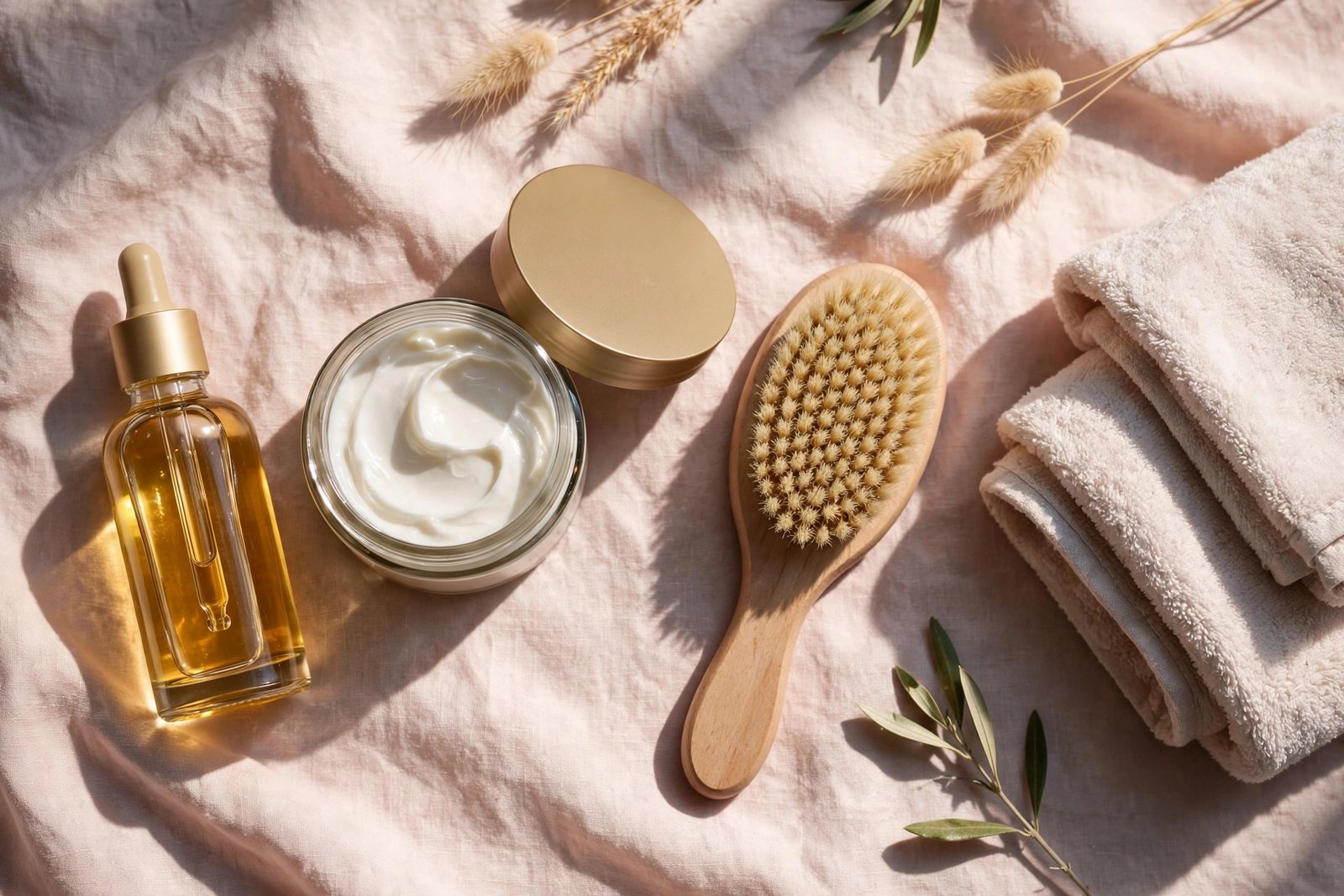
Dry brushing (weak evidence): Enthusiasts claim dry brushing “breaks up” cellulite and boosts lymphatic drainage. The reality: there’s no clinical evidence it reduces cellulite structurally, but the vigorous exfoliation temporarily increases blood flow, which can make skin look smoother for a short time. It’s inexpensive and makes skin feel nice — just don’t expect structural change. For the technique itself, see our dry brushing guide.
Massage and mechanical treatments (modest evidence): Endermologie (LPG) — deep mechanical massage with motorized rollers — has some clinical evidence for temporary improvement in cellulite appearance, likely through fluid redistribution and increased blood flow. Results require ongoing sessions and fade without maintenance. At-home massage tools and fascia blasters lack meaningful clinical evidence.
Radiofrequency (moderate evidence): Devices that heat the dermis with radiofrequency energy stimulate collagen production and can tighten skin over a series of treatments. Multiple studies show modest, measurable improvement in cellulite appearance. It’s non-invasive, but requires multiple sessions and maintenance treatments.
Laser treatments (moderate evidence): Cellulaze, a minimally invasive laser treatment, works by cutting the fibrous septae bands beneath the skin — addressing the actual structural cause. Clinical studies show improvement lasting a year or more in many patients. It’s the closest thing to a structural fix, but it’s expensive, involves downtime, and results vary.
Subcision (moderate evidence): A dermatologist inserts a needle or blade under the skin to sever the tethering bands. Similar in principle to Cellulaze, with good evidence for visible improvement. Newer devices (like Avéli) have refined the technique. Again: improvement, not elimination, and it addresses dimpling specifically.
Acoustic wave therapy (modest evidence): Shockwave treatments applied to the skin show some evidence for improving cellulite appearance, possibly by disrupting fibrous tissue and stimulating collagen. Evidence is promising but less extensive than for laser or subcision.
For stretch marks
Topical retinoids (modest evidence, best for new marks): Tretinoin (prescription) has the best evidence of any topical for stretch marks — but primarily for new, red stretch marks (striae rubra), where studies show it can improve appearance over several months. It does little for old, white stretch marks. Note: retinoids are not safe during pregnancy or breastfeeding, which rules them out during the highest-risk window.
Hyaluronic acid (modest evidence): Some studies suggest topical hyaluronic acid formulations may improve the appearance of stretch marks, possibly by supporting dermal hydration and elasticity. Evidence is limited but the ingredient is low-risk.
Laser therapy (moderate evidence): Fractional lasers and pulsed dye lasers have the strongest evidence for improving stretch mark appearance. Pulsed dye laser works best on red, new marks (targeting the blood vessels); fractional lasers stimulate collagen remodeling in both new and older marks. Multiple sessions are needed, and improvement — not erasure — is the realistic outcome.
Microneedling (modest to moderate evidence): Creating controlled micro-injuries stimulates collagen production, and studies show it can improve the texture and appearance of stretch marks, particularly older white ones. Often combined with topical treatments or radiofrequency for enhanced effect.
Chemical peels and microdermabrasion (weak evidence): These exfoliate the surface and may slightly improve texture, but they don’t reach the dermal scarring where stretch marks live. Expect minimal change.
Oils, cocoa butter, vitamin E (weak evidence): The beloved home remedies. Large, well-designed studies have repeatedly failed to show that cocoa butter, olive oil, almond oil, or vitamin E prevent or significantly reduce stretch marks beyond what plain moisturizer does. They keep skin comfortable and hydrated — worthwhile for that alone — but they’re not treatments in the clinical sense. Our honest comparison of body oils for stretch marks ranks them by what they actually do.
Part 4: Setting Realistic Expectations
Here’s the truth the industry won’t print on a jar: neither cellulite nor stretch marks can be completely eliminated by any currently available treatment. What treatments offer is improvement — smoother texture, less visible dimpling, faded color, softer edges. The degree of improvement depends on severity, skin type, age of the marks, genetics, and the treatment chosen.
A few grounding facts worth internalizing:
- Time fades stretch marks significantly on its own. New red or purple marks typically fade to silvery-white within 6–24 months without any treatment. Much of what “miracle” products claim credit for is simply time.
- Cellulite fluctuates. Hydration, salt intake, hormonal cycle phase, and even lighting change how visible it is day to day. Judging a treatment by a single mirror check is unreliable.
- Photos lie. Before-and-after images in advertising use different lighting, poses, tans, and sometimes digital retouching. Clinical study photos under controlled conditions tell a far more modest story.
- Maintenance is forever. Even effective in-office treatments require upkeep. Cellulite’s structural causes don’t disappear; collagen stimulated by today’s laser treatment ages like all collagen.
- Your baseline matters. Someone with grade-1 cellulite or fresh, red stretch marks will see more dramatic improvement from any intervention than someone with long-standing, severe concerns — because there’s less to fix.
None of this means you shouldn’t treat these concerns if they bother you. It means you should spend money proportional to realistic outcomes: a $20 cream with modest temporary effects is a reasonable purchase if you understand what it does; a $3,000 procedure deserves a thorough consultation about expected results, risks, and maintenance costs.
Part 5: The Body Skincare Routine That Actually Helps
While no routine erases cellulite or stretch marks, consistent body skincare genuinely improves how skin looks and feels — firmer, smoother, more even-toned — which changes the visual context these concerns sit in. Think of it as optimizing everything around the concern.
Cleanse gently. Body skin doesn’t need harsh scrubbing. A gentle body wash preserves the skin barrier; over-exfoliating or using stripping soaps leaves skin duller and more textured.
Exfoliate regularly (2–3 times weekly). Chemical exfoliants (AHAs like glycolic or lactic acid in body lotions) smooth rough texture and improve product absorption more effectively than physical scrubs, with less irritation risk. This is the single highest-impact step for overall skin smoothness.
Moisturize daily, ideally on damp skin. Well-hydrated skin looks plumper and more even — dimpling and fine lines are literally less visible on moisturized skin. Layer a hydrating serum or oil under a cream or lotion for maximum effect.
Target concerns strategically. If using a retinoid body product or caffeine cream, apply it consistently (results take 8–12 weeks minimum) and manage expectations per the evidence above.
Protect from the sun. UV breaks down collagen and elastin — the exact fibers whose weakness makes both cellulite and stretch marks worse. Sunscreen on exposed body skin, especially over new stretch marks (which darken easily), is non-negotiable.
Support from the inside. Strength training builds the muscle that smooths cellulite’s appearance from beneath. Adequate protein and vitamin C support collagen synthesis. Staying hydrated keeps skin functioning well. None of these are cures; all of them shift the baseline in your favor.
For the complete step-by-step routine, our full body skincare routine guide lays it out morning and night.
Frequently Asked Questions
Does losing weight get rid of cellulite?
Not reliably. Weight loss can reduce the prominence of cellulite by shrinking fat cells, but it can also make it more visible if skin loses elasticity, and many lean people have cellulite. Building muscle tends to improve appearance more consistently than weight loss alone, because firm tissue underneath smooths the surface. Genetics remain the dominant factor regardless of weight.
Are stretch marks permanent?
In the sense that the dermal scarring doesn’t fully disappear, yes — but their appearance changes dramatically. New red or purple stretch marks typically fade to faint silvery lines within 6–24 months on their own. Treatments can accelerate fading and improve texture, but no treatment returns skin to its exact pre-mark state.
Do cellulite creams actually work?
They can modestly and temporarily improve the appearance of cellulite — caffeine-based formulas tighten skin for hours, and retinoid formulas may thicken the dermis over months. But no cream restructures the fibrous bands that cause cellulite, so no cream eliminates it. Our detailed evidence review breaks down the clinical studies.
Can men get cellulite and stretch marks?
Yes to both, though cellulite is much less common in men due to the crisscross pattern of male connective tissue. Men absolutely get stretch marks from growth spurts, weight changes, and muscle building — the mechanism is identical.
Is dry brushing effective for cellulite?
There’s no clinical evidence that dry brushing reduces cellulite structurally. It does exfoliate and temporarily boost blood flow, which can make skin look smoother briefly. It’s a pleasant, inexpensive ritual for skin texture — just don’t expect it to address the underlying fibrous bands.
When should I see a dermatologist about stretch marks?
See a dermatologist if stretch marks appear suddenly without an obvious cause (rapid weight change, growth, pregnancy), if they’re accompanied by other symptoms like easy bruising or weight gain in the face and torso (which can rarely signal hormonal conditions), or if you want to discuss prescription options like tretinoin or in-office treatments. For cosmetic concerns alone, a consultation helps set realistic expectations before you spend money.
The Honest Bottom Line
Cellulite and stretch marks are normal features of human skin, shaped overwhelmingly by genetics and life events rather than anything you did wrong. Some treatments genuinely help — retinoids for new stretch marks, laser and subcision for cellulite, consistent exfoliation and moisturizing for overall skin quality — but every honest assessment ends in the same place: improvement, not erasure.
The most powerful shift isn’t a product. It’s recalibrating what you expect your skin to look like. The beauty industry sells the idea that smooth, unmarked skin is the default and everything else is a problem to fix; biology says the opposite. Care for your skin well — cleanse gently, exfoliate, moisturize, protect from the sun, and treat concerns with evidence-based options at budgets that match realistic outcomes — and let the rest be what it is: proof that your body has lived a life.
Love this? Pin it for later!