Faux Locs Care Guide for Beginners (Keep Them Fresh)
Faux locs are one of the most striking protective styles you can wear — the look of mature, beautiful locs without the permanent commitment. Done right, they last six to eight weeks and turn heads the entire time. Done wrong, they unravel early, frizz beyond recognition, or worse, damage the hair underneath.
The difference between faux locs that look fresh at week six and ones that look tired at week three comes down to care, not luck. This beginner’s guide covers the full routine: what to do before installation, how to wash and moisturize while wearing them, how to control frizz and unraveling, and how to take them down without breakage. If you’re still deciding whether faux locs are right for you, start with the beginner’s guide to protective styles for natural hair.
Key Takeaways
- Proper prep (cleanse, deep condition, detangle) determines how your faux locs age.
- Wash your scalp every 1 to 2 weeks — clean locs last longer and itch less.
- Moisturize the hair underneath, not just the locs themselves.
- Never keep faux locs past 8 weeks; matting risk rises sharply after that.
Before Installation: Setting Yourself Up for Success
Faux locs wrap your natural hair inside synthetic or human-blend hair, and whatever condition your hair is in at installation is what you’re working with for the next two months.
Start with a thorough cleanse. Double-shampoo to remove all buildup. Product residue trapped under locs for weeks causes itching and odor that’s hard to fix mid-wear.
Deep condition for 20 to 30 minutes. Your hair is about to go weeks with limited direct moisture access. Front-load the hydration now.
Detangle completely. Every knot left in your hair before wrapping becomes exponentially harder to remove at takedown. Work through each section with conditioner and a wide-tooth comb.
Moisturize and seal. Leave-in conditioner plus a light oil or butter gives your hair a moisture foundation for the weeks ahead.
Consider your hair type and the loc method. The three main methods — crochet, wrapping, and braid-and-wrap — suit different textures and budgets. Crochet locs (pre-made locs looped onto cornrows) are fastest to install and easiest to take down, making them the most beginner-friendly. Wrapping (hair wrapped around your own braided or twisted hair) looks the most natural but takes longer. Discuss with your stylist which suits your hair density and lifestyle.
Protect your edges from day one. Faux locs are heavier than twists or braids, so edge tension is a real concern. If your hairline is fragile, ask for lighter, smaller sections around the perimeter and read how to care for edges and hairline under protective styles.
Washing Faux Locs: Yes, You Really Should
The biggest beginner myth about faux locs is that you can’t wash them. You absolutely can — and should. A clean scalp itches less, smells better, and keeps the style looking fresh far longer.
How often: Every 1 to 2 weeks, depending on how oily your scalp gets and how active you are.
How to wash:
- Dilute your shampoo with water in an applicator bottle (about 1 part shampoo to 3 parts water). This lets you target the scalp without soaking the locs in thick lather.
- Apply directly to the scalp between locs, and gently massage with your fingertips — never your nails.
- Let the suds run down the locs as you rinse; don’t scrub the locs themselves.
- Rinse thoroughly. Residue left in locs causes buildup and dullness.
- Follow with a diluted apple cider vinegar rinse (1 part ACV to 3 parts water) if you like — it clarifies and reduces itch.
Drying is critical. This is the step beginners skip, and it’s the most important one. Damp locs that stay wet develop mildew — a musty smell that’s nearly impossible to remove. After washing, squeeze locs gently with a microfiber towel, then sit under a hooded dryer or use a blow dryer on medium heat until the locs are completely dry to the touch, including the insides. In a pinch, air-dry in direct sunlight with good airflow — but never go to bed with damp locs.
Moisturizing: Feeding the Hair Underneath
Your natural hair is wrapped inside the locs, and it still needs moisture. The challenge is getting moisture past the wrapping hair to your actual strands.
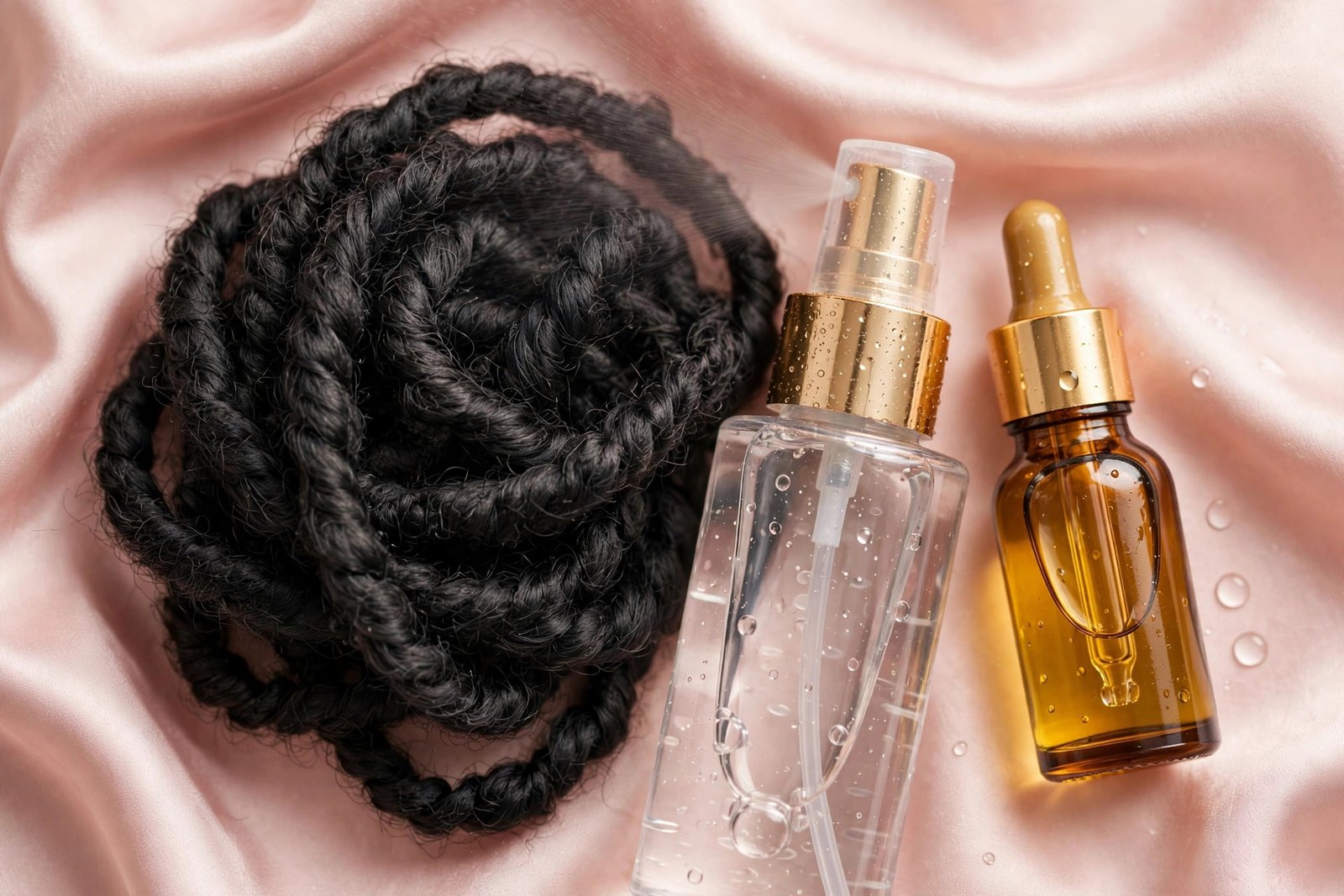
Spritz 2 to 3 times per week with a light, water-based moisturizer — plain water with a little leave-in conditioner in a spray bottle works beautifully. Focus the spray at the roots and along the loc where your hair sits, not just the decorative outer layer.
Seal lightly with oil. After spritzing, smooth a small amount of lightweight oil (jojoba, grapeseed, or sweet almond) over the locs. This locks in the moisture and adds sheen. Avoid heavy butters and greases — they build up on synthetic wrapping hair and attract lint.
Don’t forget your scalp. A light oil massaged into the scalp once or twice a week relieves dryness and itching. If itching persists despite washing and oiling, a diluted tea tree oil or witch hazel applied to the scalp often helps.
For a broader comparison of moisturizing approaches across protective styles, the techniques overlap significantly with braids — see the beginner’s braids guide and with the full routine for keeping natural hair moisturized.
Frizz Control: Keeping Locs Looking New
Some frizz is inevitable — it’s part of the lived-in charm of locs. But excessive frizz ages the style prematurely. Here’s how to keep it in check:
Wrap at night, every night. A satin bonnet or silk scarf is non-negotiable. Cotton pillowcases create friction that frizzes locs overnight. For extra protection, loosely pineapple the locs on top of your head before bonneting.
Smooth flyaways with mousse. A lightweight foam mousse smoothed over frizzy locs, then tied down with a silk scarf for 15 to 20 minutes, lays flyaways flat beautifully. This trick works wonders before events or photos.
Use a crochet needle for maintenance. Loose wrapping hair can be tucked back into the loc with a small crochet hook — a five-minute fix that makes locs look freshly done. Many stylists will show you this technique at installation; ask.
Trim stragglers carefully. If individual synthetic hairs stick out, trim them close with sharp scissors — never pull them, which unravels the wrap.
Refresh the roots if needed. Around week four or five, new growth at the roots can look fuzzy. A stylist can re-wrap or palm-roll the roots to refresh the style for a few more weeks. Don’t attempt major root re-wrapping yourself unless you’ve learned the technique — uneven tension causes breakage.
Dealing With Common Faux Loc Problems
Itching. Usually means the scalp needs washing. If washing doesn’t help, it may be sensitivity to the synthetic hair — an ACV soak of the braiding hair before installation prevents this, but mid-wear, diluted witch hazel on the scalp calms irritation.
Unraveling. Individual locs loosening at the ends is normal; re-wrap them or secure with a small rubber band (not too tight). If many locs unravel at once, the installation method may not suit your hair texture — consult your stylist.
Heaviness and neck pain. Faux locs are heavy, especially long ones. If you develop neck or scalp pain, the style is too heavy for you — consider removing some locs, switching to a shorter length next time, or choosing a lighter method like crochet locs.
Lint and buildup. Synthetic hair attracts lint. A lint roller run gently over locs picks it up. Prevent buildup by avoiding heavy products and washing on schedule.
Mildew smell. Means locs weren’t dried fully after washing. Unfortunately, once mildew sets in deep, it’s very hard to remove — prevention (thorough drying) is everything. If it happens, an ACV soak followed by complete drying may help, but replacement is sometimes the only fix.
How Long to Keep Them In
Six to eight weeks is the maximum for faux locs. Beyond that, your new growth starts to tangle and mat with the wrapped hair, and takedown becomes a breakage risk. Thinner or finer natural hair should lean toward the six-week mark; the weight of the locs strains fine strands over time.
Set your takedown date when you install. “Just one more week” is how protective styles turn damaging.
If you’re weighing faux locs against other options for your next style, twists vs braids compares longevity, cost, and maintenance — useful context even though locs aren’t in the title, since the maintenance principles transfer.
Safe Takedown Without Breakage
Takedown day is where all your careful wear pays off — or gets undone. Never rush it; budget a full afternoon or evening.
- Cut the extension hair first. Cut the wrapping hair several inches below where your natural hair ends. Cut conservatively — you can always cut more, but you can’t undo cutting your own hair.
- Unwrap slowly. Undo each loc gently, working from the end upward. If you hit resistance, add oil or conditioner and wait — don’t pull.
- Detangle each section immediately. As each loc comes out, finger-detangle the freed hair before moving to the next. Shed hair that’s been trapped for weeks will come out in clumps — this is normal.
- Soak stubborn sections. For sections that resist, saturate with conditioner, cover with a plastic cap for 15 minutes, then try again.
- Full wash day after. Once all locs are out, clarify, deep condition, and detangle thoroughly with a wide-tooth comb from ends to roots.
- Rest before reinstalling. Give your hair at least a week of rest — wear it in a simple low-manipulation style or leave it free — before the next install.
Frequently Asked Questions
Are faux locs good for beginners?
Crochet faux locs are quite beginner-friendly — fast install, easy takedown, and no wrapping skill needed. Wrapped methods are better left to experienced stylists for your first time. Either way, the care routine in this guide is the same.
Can I swim with faux locs?
Yes, but rinse them with clean water immediately after, and dry them completely. Chlorine and salt water dry out both the wrapping hair and your natural hair underneath. A swim cap adds protection if you’ll be in the water often.
How do I stop my scalp from itching with faux locs?
Wash on schedule (every 1 to 2 weeks), dry thoroughly, and oil the scalp lightly between washes. Persistent itching despite clean habits may signal sensitivity to the synthetic hair — an ACV pre-soak of the hair before installation usually prevents this next time.
Will faux locs damage my natural hair?
Not when installed, maintained, and removed correctly. Damage comes from the usual suspects: too-tight installation, keeping them in too long, skipping moisture, and rushed takedown. Follow this guide and your hair should come out healthy.
How many packs of hair do I need for faux locs?
It depends on length, fullness, and method — typically 5 to 8 packs for a full head of mid-back locs. Your stylist can advise based on the specific hair brand and your head size. Buying one extra pack is always smarter than running short mid-install.
Conclusion
Faux locs reward the effort you put into their care many times over — six to eight weeks of a stunning, low-manipulation style that protects your natural hair while it grows. Wash on schedule, dry thoroughly, moisturize the hair underneath, wrap up at night, and take them down gently and on time. Master this routine once and every protective style after it gets easier. Ready to explore the wider world of protective styling? Start with the beginner’s guide to protective styles for natural hair to plan your hair journey.
Love this? Pin it for later!