TSA-Friendly Beauty Kit: How to Pack It Right
Every traveler has watched it happen: someone’s full-size shampoo gets confiscated at the security bin while the line sighs behind them. It’s avoidable. TSA-friendly beauty packing is a solved problem — a small set of rules, a few smart product swaps, and a packing order that gets you through the checkpoint without repacking on the folding table.
This guide is the practical companion to the broader travel beauty essentials packing system. Where that guide covers what to pack, this one covers how to pack it so security is a non-event.
Key Takeaways
- The 3-1-1 rule means containers of 3.4 oz (100 ml) or less, all inside one quart-sized clear bag, one bag per passenger.
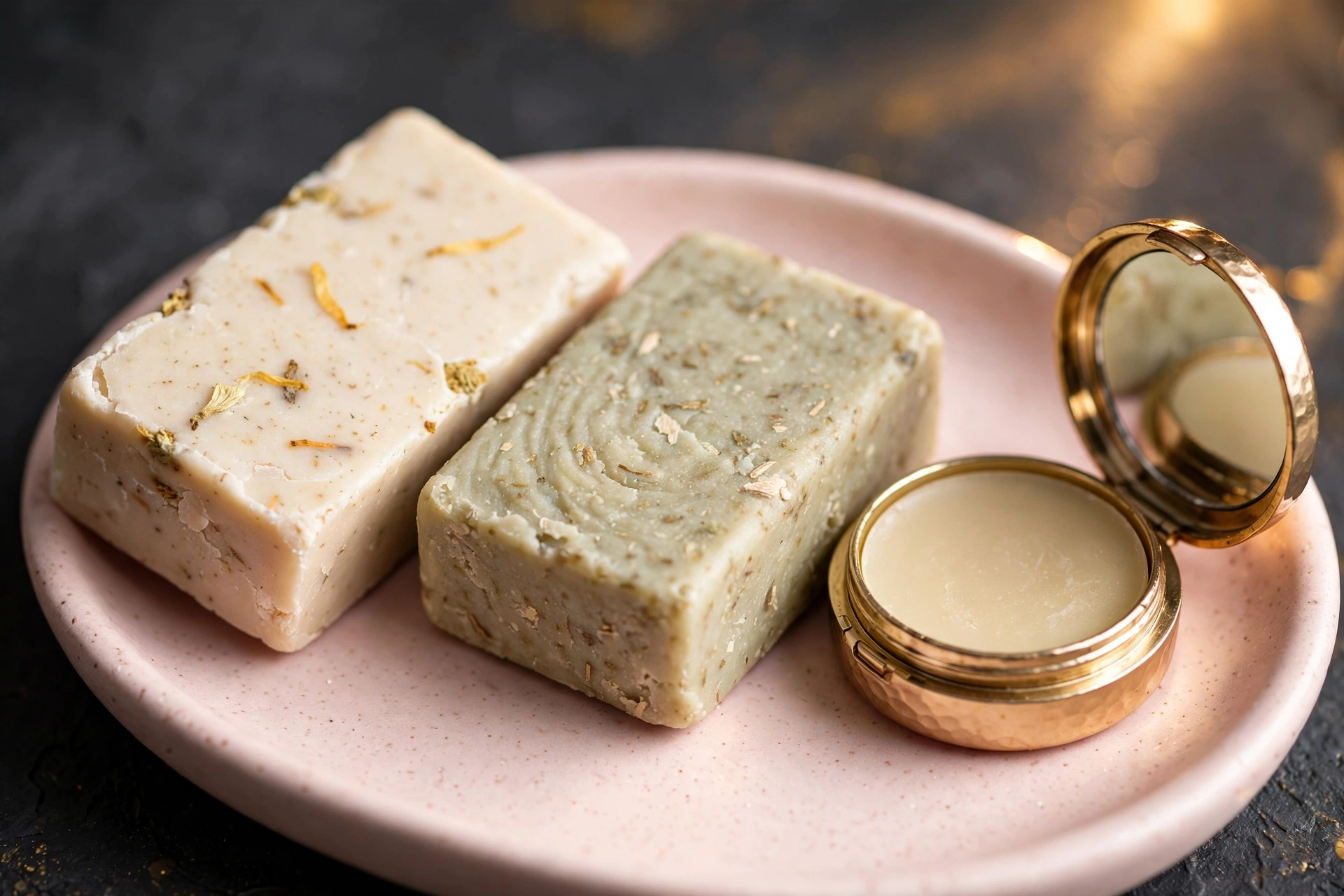
- Solid products (bars, sticks, powders) skip the liquids rule entirely — they’re the easiest way to free up quart-bag space.
- Decanting your own products into travel containers beats buying travel sizes on cost, waste, and using products your skin already trusts.
- Pack the quart bag last and most accessibly — it comes out at the checkpoint, so it should be the first thing you can grab.
- Medically necessary liquids (including some skincare) have exceptions, but they must be declared — know the rule before you rely on it.
The 3-1-1 Rule, Fully Decoded
What counts as a “liquid”
TSA’s definition is broader than you’d think: liquids, gels, aerosols, creams, and pastes all count. That covers shampoo, conditioner, liquid foundation, moisturizer, sunscreen, toothpaste, mascara, lip gloss, hair gel, and aerosol dry shampoo. If it squeezes, pumps, sprays, or smears, it goes in the quart bag.
The 3.4-ounce container rule
Each container must be 3.4 ounces (100 ml) or smaller — and it’s the container size that matters, not how much is left inside. A half-empty 6 oz bottle is still a 6 oz bottle, and it will still be confiscated. This is the rule people break most often, usually with sunscreen or shampoo they’ve “almost finished.”
One quart bag per passenger
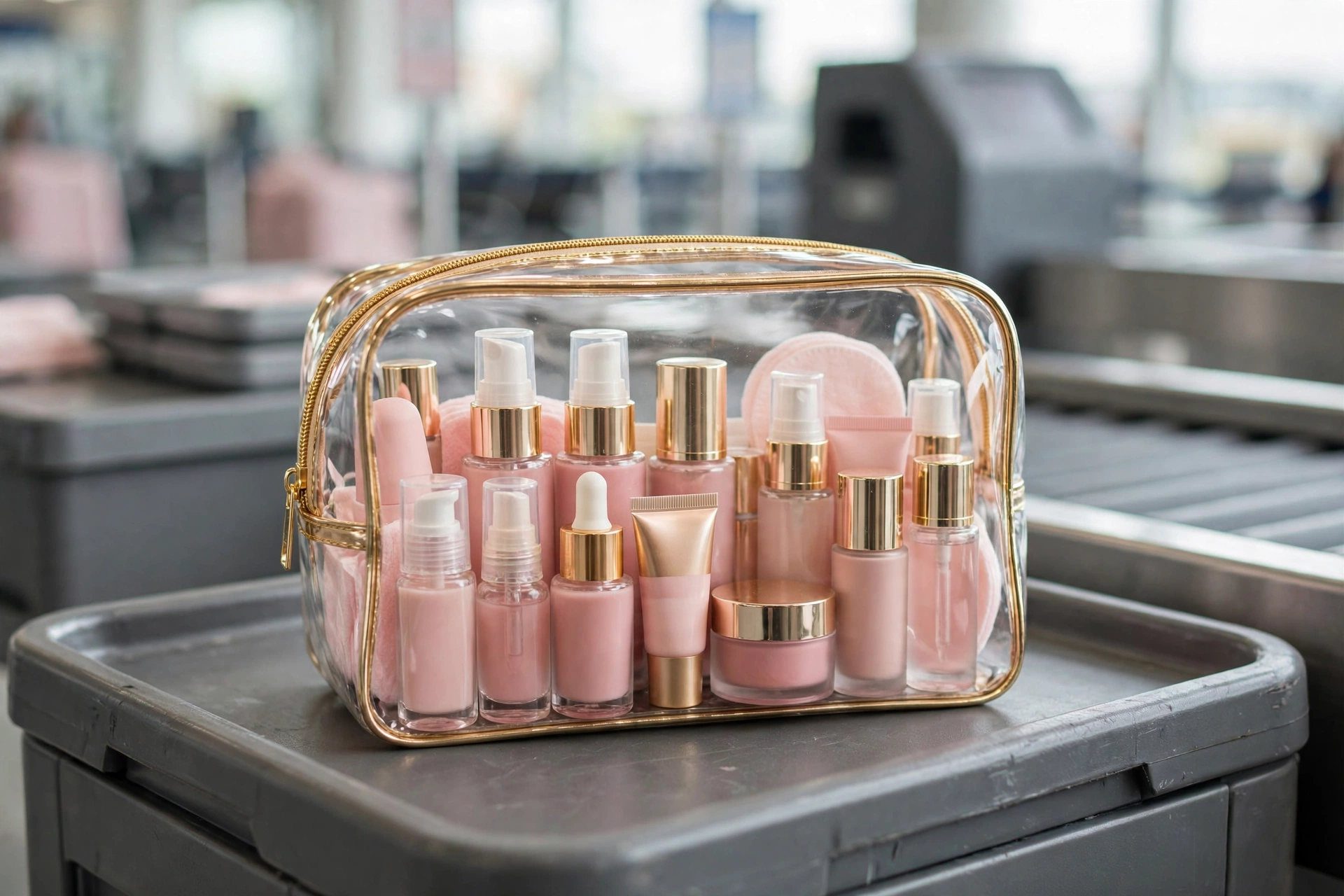
All of those small containers must fit inside one quart-sized, clear, resealable bag, and the bag must close. One bag per person — you can’t bring two half-full bags. The bag needs to be clear enough that an agent can see the contents, and it must actually seal shut; an overstuffed bag that won’t close is as non-compliant as no bag at all.
Where the rule applies
3-1-1 applies to carry-on bags only. Checked luggage has no quart-bag requirement (though airlines have their own limits on certain aerosols and alcohol-based products). International travel generally follows similar rules — most countries use the same 100 ml container limit — but always check the specific airport’s guidance if you’re connecting through countries with stricter screening.
The Solid Swap Strategy
Why solids are the cheat code
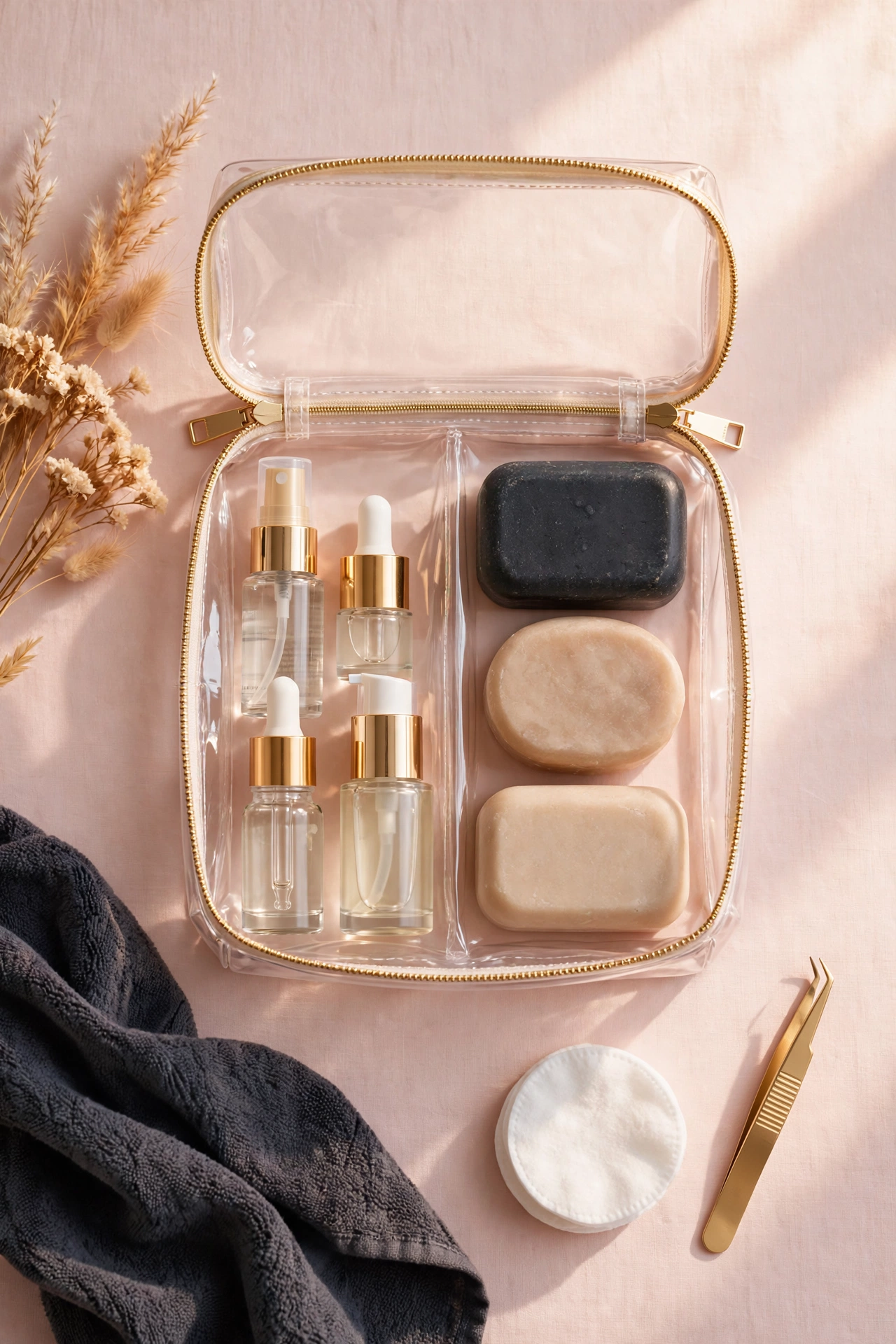
Solid-format products aren’t liquids, gels, or aerosols, so the 3-1-1 rule doesn’t apply to them at all. They ride outside the quart bag, they can’t leak under cabin pressure, and they’re usually more compact than their liquid equivalents. Converting three or four products to solid format can single-handedly solve an overstuffed quart bag.
The highest-impact solid swaps
- Shampoo bars replace liquid shampoo — modern formulas lather well and suit most hair types.
- Conditioner bars replace liquid conditioner — pair with the shampoo bar from the same line.
- Solid deodorant replaces gel or spray deodorant.
- Solid perfume replaces liquid fragrance — no leak risk, no breakage risk. (See the beginner’s guide to solid perfumes for how to choose one.)
- Powder or stick foundation used without liquid — mineral powder foundation skips the bag entirely.
- Blush sticks, lipstick bullets, and powder bronzers — color products that were never liquid to begin with.
What doesn’t swap well
Some products resist the solid format. Liquid foundation with specific coverage needs, tubing mascara, and most serums don’t have true solid equivalents that perform the same way. Don’t force it — keep the products that genuinely need to be liquid in the quart bag, and convert everything else. The goal is a quart bag with breathing room, not a quart bag that’s empty as a point of pride.
Decanting: Your Own Products, Travel Size
Why decanting beats travel sizes
Travel-size versions of your products cost more per ounce, generate more packaging waste, and — most importantly — often aren’t available for the specific products your skin already trusts. Decanting means you travel with your actual routine in smaller containers. Buy a set of reusable silicone tubes and small jars once, and they pay for themselves within a couple of trips.
How to decant cleanly
Work over a sink or a towel. Use a small funnel or a syringe-style filler for thin liquids; for thick creams, a small spatula or even a clean fingertip works. Fill containers about 80% full — product expands slightly with temperature changes, and overfilled tubes burp product when opened. Label every container immediately (painter’s tape + pen), because three unlabeled white creams are indistinguishable at 6 AM in a hotel.
How much to decant
For a week-long trip, most people need far less than they think:
| Product | ~Amount for 7 days |
|---|---|
| Cleanser | 1–1.5 oz |
| Moisturizer | 0.5–1 oz |
| Sunscreen (face) | 1–1.5 oz |
| Shampoo | 2–3 oz (less for short hair) |
| Conditioner | 2–3 oz |
| Foundation | 0.25–0.5 oz |
These are generous estimates. When in doubt, decant for the trip length plus two buffer days — running out on day six is worse than carrying an extra half-ounce.
Keeping decanted products fresh
Decanted products have a shorter safe life than sealed originals, because you’ve introduced air and potential contaminants. Decant only what you’ll use on the trip, wash containers between trips with hot soapy water, and let them dry fully before refilling. Don’t decant six months of product “for later” — decant per trip.
Building the Quart Bag
Step 1: Lay out every liquid
Before anything goes in the bag, lay every liquid, gel, cream, paste, and aerosol on the counter. This is your full liquids inventory. Anything you forgot at this stage is something you’ll be repacking at security.
Step 2: Convert what you can to solid
Go through the lineup and pull out everything you’ve converted to solid format. Those go in a separate pouch — not the quart bag. Watch the liquids pile shrink. This is usually the moment people realize the quart bag was never the problem; the product selection was.
Step 3: Shrink with multipurpose products
Now look for consolidation. Can the tinted moisturizer replace both foundation and daytime moisturizer? Can micellar water replace both cleanser and makeup remover? Every product that does two jobs removes one container from the bag. The best multipurpose beauty products roundup is built for exactly this step.
Step 4: Pack the bag strategically
Heaviest, least-fragile items on the bottom; anything with a pump or a flip-cap positioned so it won’t get crushed open. Stand tubes upright when possible. Leave a little air in the bag — a bag packed so tight it bulges is harder to reseal after inspection, and agents do occasionally want a second look.
The Packing Order That Survives Security
Quart bag goes last, on top
Pack your bag in reverse order of need at the airport. The quart bag comes out at the checkpoint (unless you’re in a line with newer CT scanners — more on that below), so it should be the last thing packed and the first thing reachable. Burying it under clothes means unpacking half your bag at the bin while the line waits.
The checkpoint routine
- Before the line: make sure the quart bag is in an outer pocket or on top.
- At the bins: quart bag goes in its own bin, separate from the carry-on.
- Laptops and large electronics go separately per the airport’s instructions.
- After screening: repack immediately at the recomposure area, not at the belt — keep the line moving.
Newer scanners
Some airports now use CT scanners that let you leave liquids in your bag. Don’t count on it — the rollout is uneven, the rules change by terminal, and the safe default is still to have the quart bag packed and accessible. If the agent says leave everything in, great; if not, you’re ready.
If something gets flagged
Stay calm and let the agent handle it. If a product is over the limit, you’ll typically have the option to surrender it, take it back to check the bag (if time allows), or in some airports, mail it to yourself from a kiosk. Arguing has never once saved a bottle of shampoo. The prevention — right-size containers, packed accessibly — is the whole game.
Exceptions and Edge Cases
Medically necessary liquids
Prescription skincare, medically necessary liquids, and similar items are exempt from the 3.4 oz limit in reasonable quantities — but you must declare them to the agent before screening, and they’re subject to additional screening. “Reasonable quantities” means what you’d plausibly need, not a liter of everything. If you rely on prescription skincare, carry the prescription or a doctor’s note; it smooths the conversation considerably.
Breast milk, formula, and baby food
Exempt from 3-1-1 in reasonable quantities, declared separately. Relevant if you’re traveling with an infant — baby sunscreen and similar products for the baby’s own use fall under the same practical umbrella, though agents have discretion.
Duty-free purchases
Liquids bought duty-free in secure, tamper-evident bags are allowed through connecting security in most cases — keep the receipt and don’t open the bag until your final destination. This is the one legitimate way a full-size perfume bottle travels in a carry-on.
Contact lens solution
Standard-size contact lens solution (over 3.4 oz) is generally permitted as a medically necessary liquid — declare it. That said, a travel-size bottle in the quart bag avoids the conversation entirely, and most trips don’t need more than that.
Leak Prevention for the Flight
Why things leak in flight
Cabin pressure drops during ascent, and the air trapped in a half-full bottle expands — pushing product out past caps that were perfectly fine on the ground. This is physics, not product failure, and it happens to every liquid eventually.
The prevention checklist
- Squeeze excess air out of tubes and soft bottles before sealing.
- Cling film under the cap — unscrew, lay a small square of plastic wrap over the opening, screw the cap back on. This single trick prevents most leaks.
- Tape flip-caps shut for the flight — a strip of tape over any cap that could pop open.
- Double-bag — the quart bag inside a second sealed bag, especially if the kit rides in checked luggage where you can’t intervene.
- Store upright when possible, and never pack liquids against anything that stains.
If something leaks anyway
This is why the quart bag exists — it contains the damage. If a leak happens mid-trip, rinse the affected products, wipe down the bag, and re-seal. Pack a couple of extra small ziplock bags in your kit for exactly this scenario; they weigh nothing and save the day when they’re needed.
What Stays Home (Security Edition)
Some items cause more checkpoint friction than they’re worth:
- Full-size anything in a carry-on — it will be confiscated; there is no appeal.
- Aerosols you’re unsure about — most personal-care aerosols (dry shampoo, hairspray under the limit) are fine, but oversized or flammable-labeled ones invite questions. When in doubt, go non-aerosol.
- Sharp tools — tweezers are fine; nail scissors with blades under 4 inches are technically allowed but frequently questioned. Pack them in checked luggage or skip them.
- Anything unlabeled that looks suspicious — decanted products are fine, but an unlabeled bottle of clear liquid in a world of heightened screening is asking for a bag check. Label everything.
Frequently Asked Questions
Does the quart bag have to be a ziplock, or can I use a nice travel pouch?
It needs to be clear and resealable — a standard quart-size ziplock is the safe default. Many “TSA-approved” clear pouches work fine in practice, but strict agents at strict airports go by the letter of the rule: clear, quart-size, resealable, one per person. When in doubt, the ziplock wins.
Can I put the quart bag inside my toiletry bag?
You can pack it that way for transit, but it has to come out separately at the checkpoint (at airports still using conventional scanners). Keep it in an outer pocket so “coming out” takes five seconds, not five minutes of digging.
Do solid shampoo bars ever get questioned?
Extremely rarely. They’re unambiguously not liquids, and agents see them constantly. Keep them in a ventilated case or a small bag — mostly so they dry properly and don’t make everything else soapy, not for security reasons.
What if I’m traveling with only a personal item and no room for a quart bag?
Then the solid-swap strategy becomes mandatory, not optional. Convert everything convertible to solid, decant the rest into the smallest viable containers, and use a sandwich-size bag instead of a quart if that’s what fits — the rule specifies quart-size as the maximum, and a smaller compliant bag with compliant containers still follows the rule. Pair this with the holiday travel skincare essentials for seasonal trips if your trip is seasonal, since winter and summer kits differ.
Are makeup wipes considered liquids?
No — pre-moistened wipes (makeup wipes, cleansing wipes) are not subject to the 3-1-1 rule. They’re a legitimate way to carry cleansing outside the quart bag. The trade-off is environmental (single-use waste) and skincare (wipes are harsher than proper cleansing), so they’re better as a backup than a primary plan.
Can I bring powder sunscreen instead of liquid?
Yes — powder sunscreens, mineral powder foundations with SPF, and similar dry formats skip the liquids rule. Just be honest about coverage: powder SPF is a convenient touch-up, not a replacement for a proper base layer of sunscreen on high-exposure days.
The Pre-Flight Checklist
Run through this the night before, and security becomes boring — which is exactly what you want:
- [ ] Every liquid container is 3.4 oz / 100 ml or smaller (check the container size, not the fill level)
- [ ] All liquids fit in one clear quart-size bag, and the bag seals shut
- [ ] Solid-format products are packed separately, outside the quart bag
- [ ] Every decanted container is labeled
- [ ] Caps secured — cling film under screw caps, tape over flip-caps
- [ ] Quart bag packed last, in the most accessible pocket
- [ ] Medically necessary liquids identified and ready to declare
- [ ] Two spare ziplock bags tucked in the kit for leaks or repacking
Nail that list, and the checkpoint is a two-minute formality. The travelers getting their shampoo confiscated are the ones who packed on hope. You’re packing on a system — and systems sail through security every time.
Love this? Pin it for later!