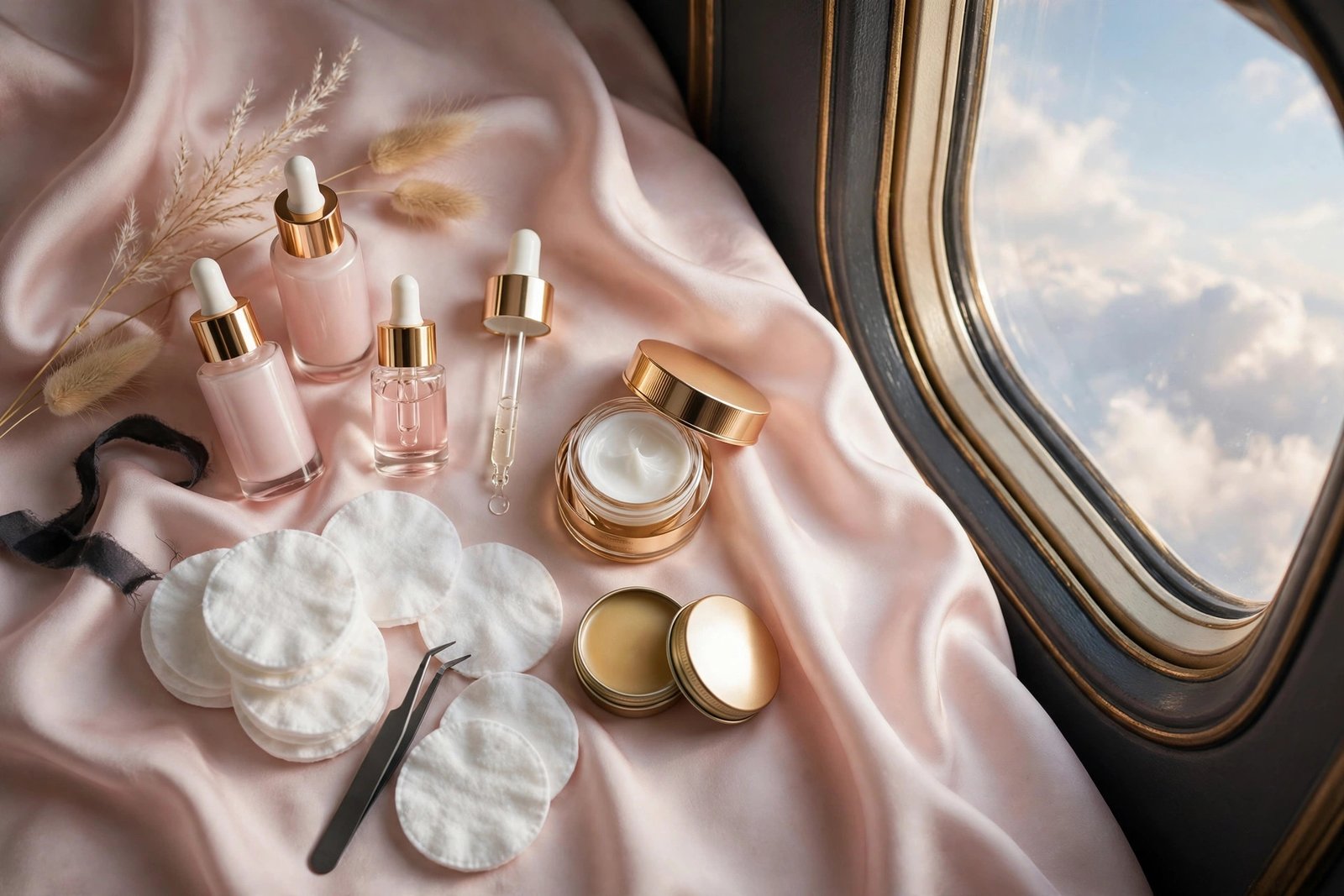
In-Flight Skincare Routine: Land Looking Fresh
There’s a special kind of exhaustion that only shows up in an airplane mirror: dull, tight skin, makeup settling into lines you didn’t know you had, and lips that feel like they’ve been through a windstorm. It’s not your imagination, and it’s not just tiredness. Airplane cabins are one of the most dehydrating environments your skin will ever face — and the good news is that a simple in-flight skincare routine can change the entire experience.
You don’t need a 12-step ritual or a bag full of products. The most effective in-flight skincare routine is short, strategic, and timed well. Four steps, done once or twice during the flight, is enough to keep your barrier intact and your skin comfortable from takeoff to touchdown. This guide walks through what cabin air actually does to your skin, the exact routine that works at 35,000 feet, what to leave in your bag until you land, and how to build a carry-on kit that makes it all effortless. Pair it with a solid travel beauty essentials packing guide and your whole trip starts off on the right foot.
Key Takeaways
- Cabin humidity drops to 10–20%, far below the 30–60% your skin prefers — that’s why skin feels tight and looks dull mid-flight.
- A 4-step routine is all you need: cleanse, hydrate, seal, and protect (lips and eyes).
- Time your routine about 30–60 minutes after takeoff and again before landing on long-haul flights.
- Skip strong actives (retinoids, exfoliating acids, high-strength vitamin C) until you’re on the ground.
- Drink water steadily, avoid touching your face, and choose cream formulas over gels for the flight.
Why Cabin Air Is So Rough on Skin
The Humidity Problem
The air inside a commercial airplane cabin is pressurized to the equivalent of about 6,000–8,000 feet above sea level, and it’s recycled constantly. The result is humidity levels that typically hover between 10% and 20%. For comparison, the Sahara Desert averages around 25% humidity — so yes, the air at cruising altitude is often literally drier than desert air.
Your skin is happiest when the surrounding air holds 30–60% humidity. Below that, water evaporates from the skin’s surface faster than your barrier can replace it. This process, called transepidermal water loss, speeds up dramatically in dry cabin air. Within an hour or two, most people notice tightness, flaking around the nose and mouth, and makeup that starts to look cakey or patchy as the skin beneath it dehydrates.
How Your Skin Responds
Here’s the part most people get wrong: when skin feels dry mid-flight, the instinct is to pile on more product. But dehydrated skin is also sensitized skin. Your barrier — the thin layer of lipids holding moisture in and irritants out — gets compromised in low humidity, which means skin becomes more reactive to fragrance, strong actives, and even products that are normally fine.
Oily and combination skin types often experience a rebound effect: the skin senses water loss and ramps up oil production to compensate, leaving you greasy in the T-zone while your cheeks still feel tight. That’s why heavy, one-size-fits-all product layering backfires. The goal of an in-flight skincare routine isn’t to drown your skin in product — it’s to give your barrier exactly what it needs to hold its ground.
The 4-Step In-Flight Skincare Routine
Timing matters as much as product choice. Do this routine once, about 30–60 minutes after takeoff (once the cabin has settled and you’ve wiped down your tray area). On flights longer than six hours, repeat the hydrate-and-seal steps once more mid-flight, and do a quick refresh about an hour before landing.
Step 1: Cleanse
Start with a clean canvas. Airport air, recycled cabin air, and everything you’ve touched since morning are sitting on your skin. But you can’t exactly do a full double cleanse in an airplane lavatory — and you shouldn’t need to.
Micellar water on a soft cotton pad is the in-flight cleansing hero. It removes sunscreen, makeup, and grime without water and without a rinse, and it doesn’t disrupt your skin’s pH. Choose a fragrance-free formula, ideally one marketed for sensitive skin. A few gentle swipes is all it takes — no scrubbing, since your barrier is already under stress.
If you boarded with a full face of makeup, you can still cleanse it off and redo a lighter version afterward. Many frequent flyers board bare-faced and do their makeup closer to landing, which is kinder to skin and honestly easier in cramped quarters.
Step 2: Hydrate
This is the step that does the heavy lifting. Hydration means water-based products — humectants that draw moisture into the skin. Look for serums or essences with hyaluronic acid, glycerin, or aloe.
One important caveat about humectants in ultra-dry air: on their own, ingredients like hyaluronic acid can actually pull moisture out of your skin when the surrounding air is drier than your skin. That’s why this step must always be followed by Step 3 — never let a hydrating serum be the last thing on your face mid-flight.
A hydrating facial mist is also lovely for comfort, but treat it as a top-up, not a standalone step. Spritz, then press a serum in, then seal. If your kit is minimal, a single well-chosen hydrating serum does more than three mediocre products. This is also where multipurpose beauty products that earn their space in your bag shine — one hydrating serum that doubles as your eye-area treatment saves precious quart-bag room.
Step 3: Seal
Sealing is the step that makes everything else work. An occlusive moisturizer — a rich cream, a facial oil, or a sleeping mask — locks the hydration from Step 2 into your skin and slows the transepidermal water loss that cabin air accelerates. Without this step, your hydrating products evaporate within the hour and you’re back to square one.
For the flight, choose the richest formula your skin tolerates. Creams beat lotions here; look for ingredients like ceramides, squalane, shea butter, or petrolatum-based ointments if your skin is very dry. Don’t be shy with the amount — a slightly generous layer is appropriate at altitude, and it will absorb as the flight wears on. Press it in gently rather than rubbing, which reduces friction on sensitized skin.
Oily skin types sometimes skip this step, fearing breakouts. Don’t. Choose a gel-cream with ceramides instead of a heavy balm — you still need the seal, just a lighter one. Skipping the seal is the single most common reason in-flight routines “don’t work.”
Step 4: Protect the Extras
Lips, eyes, and hands dehydrate fastest because their skin is thinnest. A thick layer of lip balm or lip mask — reapplied every couple of hours — prevents the cracked, flaky lips that plague long flights. Look for lanolin, shea butter, or petrolatum-based formulas rather than waxy sticks that sit on top without nourishing.
For eyes, a simple hydrating eye cream helps, but honestly your sealed moisturizer from Step 3 brought up around the orbital bone does most of the work. The bigger win for the eye area is behavioral: if you’re sleeping, use a contoured sleep mask. It blocks the harsh cabin lighting and reduces the drying effect of the overhead air vent on your face. Hands deserve a quick layer of hand cream too — cabin air cracks knuckles fast, and sanitizer makes it worse.
When to Do It: Timing for Short-Haul vs. Long-Haul
Short Flights (Under 4 Hours)
For short hops, you don’t need the full routine. Your regular morning skincare, done before you leave for the airport, plus a lip balm and a mid-flight mist will carry you through. If you land feeling dry, do the full 4-step reset at your destination instead. The exception: if your skin is very dry or sensitive to begin with, do Steps 2–4 once after takeoff anyway — it takes five minutes and prevents that parched landing feeling.
Long-Haul and Red-Eyes (6+ Hours)
This is where the routine earns its keep. The recommended schedule:
- 30–60 minutes after takeoff: Full 4-step routine (cleanse, hydrate, seal, protect). The cabin has pressurized, the meal service hasn’t started, and the lavatory lines are short.
- Mid-flight (on 8+ hour flights): Quick top-up — mist, press in a little more serum or moisturizer, reapply lip balm. No need to cleanse again unless you’ve been sleeping with your face against the seat.
- 90 minutes before landing: The pre-landing refresh. Wipe gently with micellar water, re-hydrate and re-seal lightly, then do your makeup if you wear it. You’ll step off the plane looking like you slept eight hours even if you slept two.
Red-eye flyers often ask whether they should do the routine before sleeping or after waking. The answer: do it before you sleep, so your skin is protected during the hours you’re unconscious and not reapplying anything. Sleep is when the cabin does its worst damage, precisely because you’re not intervening.
For more on making long flights comfortable from every angle, see these long-haul flight beauty tips for the full journey.
What to Skip Until You Land
Restraint is a strategy. Some products that are wonderful on the ground are actively unhelpful — or even harmful — in a pressurized cabin:
- Retinoids and exfoliating acids (AHAs, BHAs): These increase sensitivity and water loss. In low humidity, they can trigger redness, stinging, and peeling. Resume them the night after you land, not on the plane.
- High-strength vitamin C serums: L-ascorbic acid formulas can sting compromised skin and oxidize faster in cabin conditions. If you love vitamin C, use a gentle derivative or wait until you’re home.
- Clay masks: Anything that dries down and tightens is the opposite of what you want. Save detox masks for post-trip recovery.
- Heavy fragrance: Your skin is more reactive mid-flight, and your seatmate’s nose is three inches away. Keep flight skincare fragrance-free.
- Sheet masks (with a caveat): They’re popular for flights, but in ultra-dry air a sheet mask can dry out on your face and start wicking moisture back out of your skin. If you use one, don’t leave it on longer than 10 minutes and always seal with moisturizer immediately after. A hydrating serum does the same job with less fuss.
What about SPF? Cabin windows do let in UV, especially on the sunny side during daytime flights. If you’re seated by the window on a day flight, a light SPF layer under your moisturizer is sensible. Aisle seats can skip it — the exposure is negligible.
Your In-Flight Kit: What to Pack
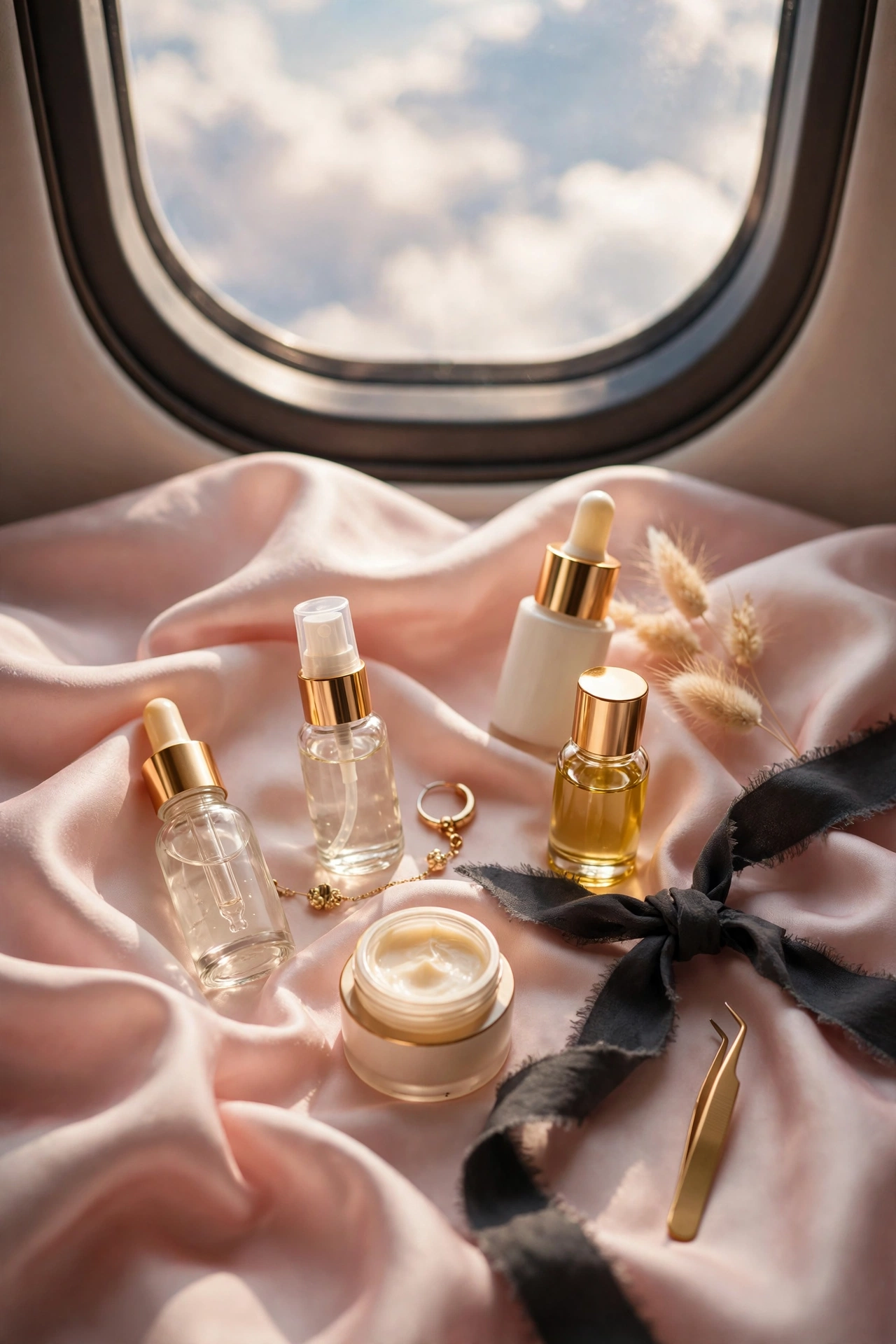
The best in-flight skincare routine is the one you’ll actually do — which means the kit has to be small, organized, and reachable without digging through the overhead bin. A clear quart-size pouch, kept in your personal item under the seat, holds everything:
| Product | Why it’s in the kit |
|---|---|
| Micellar water (travel size or decanted) + cotton pads | Waterless cleansing in your seat |
| Hydrating serum (hyaluronic acid or glycerin) | The core hydration step |
| Rich moisturizer or facial oil | Seals everything in |
| Lip balm or lip mask | Reapply every 2 hours |
| Hydrating mist (optional) | Comfort top-ups |
| Hand cream (mini) | Cabin air cracks knuckles fast |
| Sleep mask | Blocks light, shields face from air vents |
Everything here is a liquid, gel, or cream under 3.4 oz (100 ml), so it fits TSA’s 3-1-1 rule without drama. Decant full-size products into small airless pump bottles rather than buying travel sizes of everything — it’s cheaper and creates less waste. For a complete packing system, this TSA-friendly beauty kit packing guide walks through the 3-1-1 rule, solid swaps, and a packing order that survives security every time.
Small Habits That Make a Big Difference
Products matter, but behavior matters just as much at altitude:
- Drink water steadily. Cabin air dehydrates you from the inside too. Aim for a glass of water per hour; bring an empty bottle through security and fill it airside.
- Go easy on alcohol and caffeine. Both are diuretics that compound dehydration. One glass of wine won’t ruin you, but matching each drink with water is smart.
- Don’t touch your face. Airplane surfaces are germy, and compromised skin breaks out more easily. Hands off.
- Angle the air vent away from your face. That little overhead nozzle blasts dry air directly onto your skin. Point it at your chest or close it entirely.
- Remove contact lenses on long flights. Dry air plus contacts equals red, gritty eyes. Glasses are kinder — and if you wear makeup, they’re more forgiving of a mid-flight refresh.
Frequently Asked Questions
Should I wear makeup on a long flight?
It’s a personal call, but skin does better with less. A common approach: board with skincare only, sleep, then do a light makeup refresh before landing. If you prefer to wear makeup the whole flight, choose hydrating formulas (tinted moisturizer over matte foundation) and mist lightly over it mid-flight to prevent caking.
Is the “drink tons of water to hydrate your skin” advice real?
Partially. Drinking water keeps you hydrated overall, which supports skin function — but it won’t directly plump dehydrated surface skin the way topical hydration does. Do both: drink water for your body, use the 4-step routine for your skin.
Can I do my skincare routine in my seat, or should I use the lavatory?
Your seat is fine for the serum-moisturizer-balm steps — they’re quick and discreet. Use the lavatory for the micellar-water cleanse if you want privacy or need the mirror. Avoid strong scents out of courtesy to neighbors.
Do I need different products for night flights vs. day flights?
The core routine is the same. For day flights, add SPF if you’re in a window seat. For night flights, swap the mist top-ups for a sleep mask and let your skin rest — and skip makeup entirely until the pre-landing refresh.
Why does my skin break out after flying?
A combination of factors: touching your face, the rebound oil production from dehydration, heavy occlusives trapping bacteria, and stress. Minimize it by cleansing well after landing (a proper double cleanse once you’re home), not over-applying heavy balms, and keeping hands off your face during the flight.
Land Looking Fresh: Your Pre-Landing Reset
The hour before landing is your secret weapon. While the rest of the cabin is groggily blinking awake, you have a quiet window to reset. A gentle micellar cleanse, a fresh layer of serum and moisturizer, lip balm, and — if you wear it — a simple makeup refresh: tinted moisturizer, cream blush, mascara, lip color. Tidy your hair, change into something that doesn’t smell like recycled air, and walk off that plane looking intentional.
The in-flight skincare routine isn’t about vanity. It’s about arriving at your destination comfortable — no tight cheeks, no cracked lips, no regretting the mirror in the arrivals hall. Four steps, a tiny kit, and a little timing. Your future self, stepping into that new city, will thank you.
Love this? Pin it for later!