How to Build a Skincare Routine on a Budget
Here’s a truth the beauty industry doesn’t advertise: a $40 skincare routine built around the right ingredients will outperform a $400 routine built around the wrong ones. Skincare is one of the few beauty categories where price genuinely has little correlation with results — because results come from active ingredients, and those ingredients cost pennies to manufacture.
This guide shows you how to build a skincare routine on a budget: the minimal product lineup that actually works, the affordable hero ingredients to look for, and where the drugstore genuinely beats luxury. If you’re new to skincare entirely, start with the foundational beginner’s step-by-step skincare routine and use this guide to keep it affordable.
Key Takeaways
- You need only 3–4 products: cleanser, moisturizer, sunscreen (AM), and one treatment.
- Results come from active ingredients, not price tags — drugstore formulas often share the same actives as luxury.
- Niacinamide, hyaluronic acid, ceramides, and retinol are the budget hero ingredients to prioritize.
- The most expensive mistake is buying too many products; the second is skipping sunscreen.
- A complete effective routine costs $30–$50 total, not per product.
The Only 4 Products You Actually Need
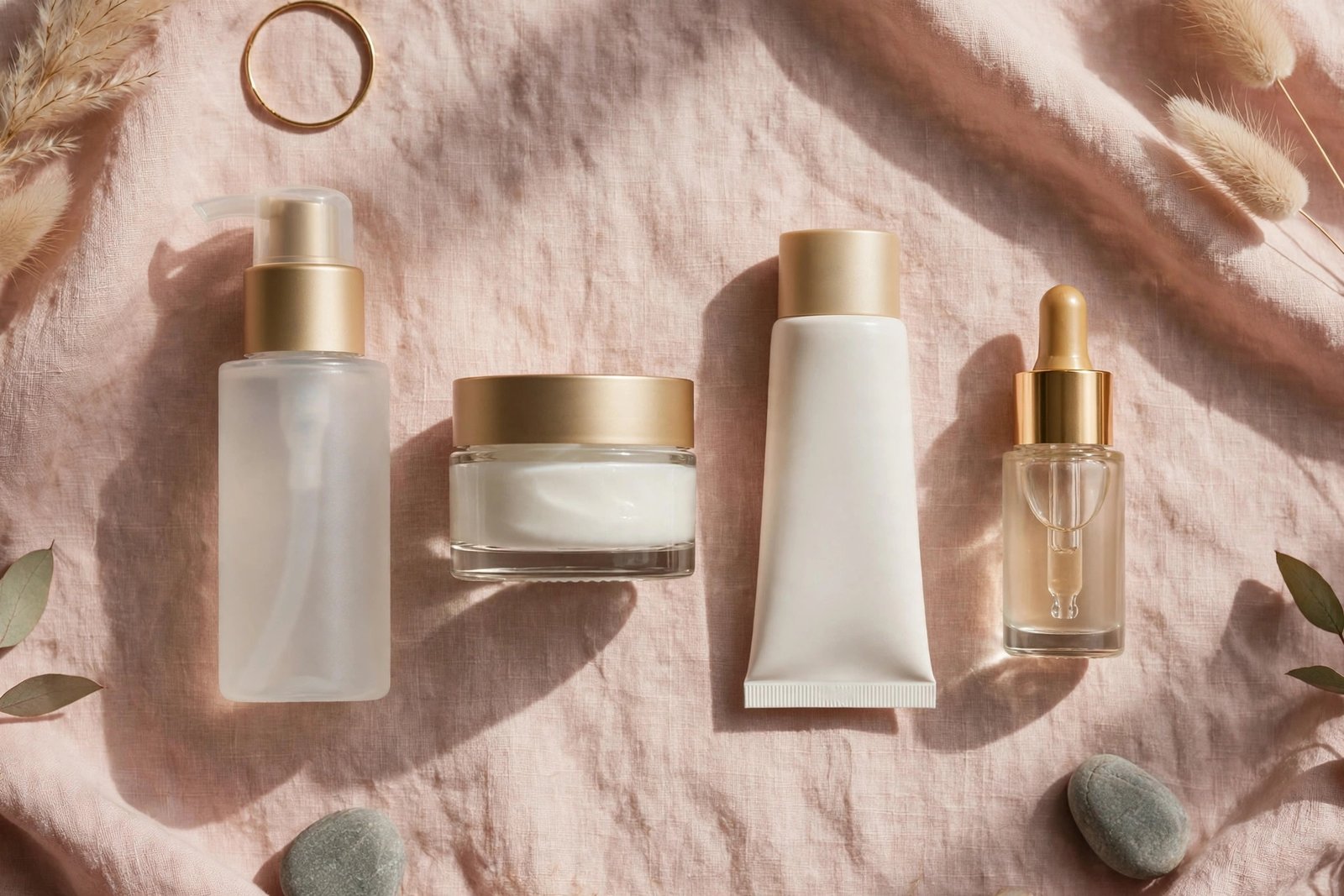
Dermatologists consistently recommend the same core routine, and it fits on one hand:
- Cleanser — removes the day without stripping.
- Moisturizer — supports the skin barrier.
- Sunscreen (AM) — the single highest-impact anti-aging product that exists.
- One treatment — chosen for your main concern (acne, dark spots, texture, or fine lines).
That’s it. Everything else — toners, essences, eye creams, mists — is optional. Serums can be wonderful, but a well-chosen treatment product covers that role. Building around these four keeps the budget tight and the routine one you’ll actually follow.
Morning Routine (3 Steps, ~5 Minutes)
Step 1: Cleanse (or rinse). If your skin is dry, a lukewarm water rinse is enough in the morning. Oily skin benefits from a gentle cleanse. A drugstore gentle cleanser — the CeraVe Hydrating Cleanser and Foaming Cleanser are the classic examples — costs under $15 and lasts months.
Step 2: Moisturize. Apply to slightly damp skin to lock in hydration. Look for ceramides, glycerin, or hyaluronic acid on the label. Drugstore moisturizers from CeraVe, Cetaphil, and Vanicream are dermatologist-recommended staples for a reason: effective barrier support at a fraction of luxury prices.
Step 3: Sunscreen. Non-negotiable. UV exposure is the primary driver of premature aging, dark spots, and skin cancer risk. A broad-spectrum SPF 30+ applied every morning does more for your skin’s future than any serum. Affordable sunscreens from Neutrogena, La Roche-Posay’s drugstore lines, and e.l.f. perform the core function — UV protection — identically to expensive ones, because SPF is SPF when properly tested.
Evening Routine (3–4 Steps, ~5 Minutes)
Step 1: Cleanse. Remove sunscreen, makeup, and the day’s buildup. If you wear long-wear makeup or waterproof sunscreen, a double cleanse (oil-based cleanser followed by water-based) prevents clogged pores — drugstore cleansing oils and balms handle this well.
Step 2: Treatment (your one active). This is where you target your main concern:
– Acne/blemishes: benzoyl peroxide (2.5–5%) or salicylic acid (2%). Affordable, extensively studied, and the same actives used in expensive acne lines.
– Texture/dullness: an AHA like glycolic or lactic acid, 1–2 times per week to start.
– Fine lines: retinol — drugstore retinol formulas (CeraVe Resurfacing Retinol, RoC) use the same gold-standard ingredient as luxury versions.
– Dark spots: niacinamide (4–5%) or vitamin C serums from affordable brands.
Step 3: Moisturize. Same moisturizer as morning, or a slightly richer one if your skin is dry. On retinol nights, moisturizer after the treatment buffers potential dryness.
The Budget Hero Ingredients (and What They Cost)
These are the ingredients worth paying attention to on labels — all widely available in drugstore formulas under $15:
| Ingredient | What it does | Budget form |
|---|---|---|
| Niacinamide | Minimizes pores, evens tone, regulates oil | Serums and moisturizers, ~$8–$12 |
| Hyaluronic acid | Draws moisture into skin | Serums, ~$7–$10 |
| Ceramides | Rebuilds the skin barrier | Moisturizers, ~$12–$15 |
| Retinol | Gold standard for fine lines and texture | Creams/serums, ~$12–$18 |
| Salicylic acid | Unclogs pores, treats breakouts | Cleansers/treatments, ~$8–$12 |
| Vitamin C | Brightens, antioxidant protection | Serums, ~$10–$15 |
| Glycerin | Simple, effective humectant | In nearly every moisturizer |
Notice what’s missing from this list: exotic botanical extracts, gold flakes, and proprietary complexes with trademarked names. Those drive up prices far more than they drive results.
Sample Budget Routines by Skin Type
These sample routines build directly on the core beginner’s step-by-step skincare routine, trimmed down to the affordable essentials for each skin type:
Oily / Acne-Prone (~$40 total)
- AM: gentle foaming cleanser → niacinamide serum → gel moisturizer → SPF 30+
- PM: foaming cleanser → salicylic acid treatment (2–3x/week) → gel moisturizer
Dry / Sensitive (~$40 total)
- AM: lukewarm rinse or hydrating cleanser → hydrating moisturizer → SPF 30+
- PM: hydrating cleanser → moisturizer (layer generously); add a hyaluronic acid serum if budget allows
Combination (~$45 total)
- AM: gentle cleanser → lightweight moisturizer → SPF 30+
- PM: cleanser → niacinamide treatment → moisturizer; retinol 2x/week for texture
Each of these totals assumes drugstore pricing and products that last 2–3 months — making the monthly cost roughly $15–$20.
Where Drugstore Beats Luxury (Almost) Every Time
Cleansers. A cleanser sits on your skin for under a minute. Paying $40 for something you rinse off is the lowest-value spend in skincare. Drugstore gentle cleansers clean identically.
Moisturizers. The barrier-supporting ingredients (ceramides, glycerin, petrolatum) are inexpensive and unpatentable. A $14 drugstore moisturizer with ceramides does the same structural job as a $60 luxury cream.
Sunscreen. UV filters are regulated and standardized. An affordable broad-spectrum SPF 30 protects the same as a luxury one — the difference is cosmetic elegance (how it feels), not protection.
Basic serums. Single-ingredient serums (niacinamide, hyaluronic acid) are commodities. The affordable versions from brands like The Ordinary and Good Molecules contain the same actives at the same concentrations as versions costing five times more.
Where It’s Worth Spending a Little More
Honesty cuts both ways. Two categories where a modest step-up can be justified:
- Vitamin C serums. L-ascorbic acid is notoriously unstable; well-formulated (often slightly pricier) versions maintain potency longer. Still, plenty of affordable options work — just check packaging (opaque, airtight) over price.
- Retinol. The ingredient is the same, but formulation affects tolerability. If a drugstore retinol irritates your skin, a mid-range encapsulated formula may be worth the extra $10.
Even here, “a little more” means $20–$25, not $80.
The Expensive Mistakes to Avoid
- Buying a 10-step routine. More products mean more chances of irritation and ingredient conflicts — and a much higher bill. Start with four.
- Chasing new launches. Your skin needs consistency over 6–8 weeks to show results from any product. Constant switching wastes money and resets progress.
- Skipping sunscreen to afford a serum. No serum outworks daily UV damage. Sunscreen first, always.
- Ignoring the drugstore return policy. Buy one product at a time, patch test, and return what doesn’t suit you.
And remember: skincare is the foundation that makes makeup look better, too. A solid budget routine pairs perfectly with affordable makeup — see how a full face of drugstore makeup under $50 builds on healthy, well-prepped skin.
Frequently Asked Questions
Can a cheap skincare routine actually work?
Yes. Dermatologists routinely recommend drugstore products because results come from active ingredients and consistency, not price. A simple routine you follow daily beats an expensive one you use sporadically.
How long before I see results from a budget routine?
Hydration improvements: days. Breakout reduction: 2–4 weeks. Texture, dark spots, and fine lines: 6–12 weeks of consistent use. This timeline is the same regardless of price point.
Should I buy everything at once?
No — introduce one new product at a time, waiting about a week between additions. This way, if something irritates your skin, you know exactly which product caused it. It also spreads the cost.
Is The Ordinary actually good, or just cheap?
The Ordinary built its reputation on single-ingredient formulas at transparent prices — the actives are legitimate and the concentrations are real. It’s a solid budget option, though some formulas are less cosmetically elegant (texture, scent) than pricier alternatives. Function over feel is the trade.
Do I need different products for morning and night?
Mostly no. Cleanser and moisturizer can be the same; the differences are sunscreen (AM only) and your treatment active (usually PM). Don’t let marketing convince you that you need separate AM/PM versions of everything.
Conclusion
Building a skincare routine on a budget isn’t about settling — it’s about spending where it counts and refusing to pay for what doesn’t matter. Four products, the right active ingredients, daily sunscreen, and eight weeks of consistency: that’s the whole formula, and it costs less than a single luxury serum. Start simple, add only what your skin asks for, and let the results — not the price tags — do the talking. For the complete starter picture, the drugstore makeup kit for beginners shows how affordable skincare and makeup work as one system.
Love this? Pin it for later!