Perfume Notes Explained: Top, Heart, and Base Notes
Every perfume description comes with a list of “notes” – bergamot, jasmine, sandalwood, vanilla – and every beginner has the same reaction: what do these actually mean, and why should I care? The answer is that notes are the single most useful tool for predicting whether you’ll like a perfume before you ever spray it. Once you understand how notes work, those cryptic ingredient lists turn into a clear preview of what a fragrance will smell like and how it will change over the hours you wear it.
This guide breaks down the three stages of a perfume’s life – top, heart, and base notes – explains the most common notes you’ll encounter, and teaches you how to read a note list like a map. No chemistry degree required.
Key Takeaways
- Perfume unfolds in three stages: top notes (first 15-30 minutes), heart notes (the core, 2-4 hours), and base notes (the long-lasting dry-down, 4+ hours).
- Top notes are bright and volatile by design – never judge a perfume by its opening alone.
- The heart reveals the fragrance’s true character; the base determines longevity and what lingers on skin and clothes.
- Base notes like woods, ambers, musks, and resins last longest; citrus and light florals evaporate fastest.
- Learn to spot your personal deal-breaker notes so you can rule out perfumes from the note list before sampling.
- A note list is a guide, not a literal recipe – perfumes are blended, and individual notes rarely smell exactly like their raw ingredient.
What Are Perfume Notes, Exactly?
A perfume note is simply an individual scent ingredient – or the impression of one – that you can detect in a fragrance. Notes can come from natural materials (rose oil, citrus peels, spices) or synthetic aroma molecules created in a lab. Most modern perfumes blend dozens of notes, both natural and synthetic, into a single composition.
The crucial thing beginners miss: you don’t experience all the notes at once. Perfume is engineered to unfold over time, like a story with a beginning, middle, and end. The lightest, most volatile molecules evaporate first (the opening), the medium-weight ones emerge next (the heart), and the heaviest linger for hours (the base). This timeline is called the fragrance pyramid, and understanding it changes how you shop – because the perfume you smell in minute five is genuinely not the same perfume you’ll be wearing in hour five.
Think of it like music: the top notes are the bright opening chord, the heart is the melody, and the base is the bass line that carries everything. A perfume is judged by the whole composition, not the first chord.
Top Notes: The First Impression
Top notes are what you smell in the first 15 to 30 minutes after spraying. They’re made of small, lightweight molecules that evaporate quickly – which is why they hit your nose immediately and brightly, then fade fast.
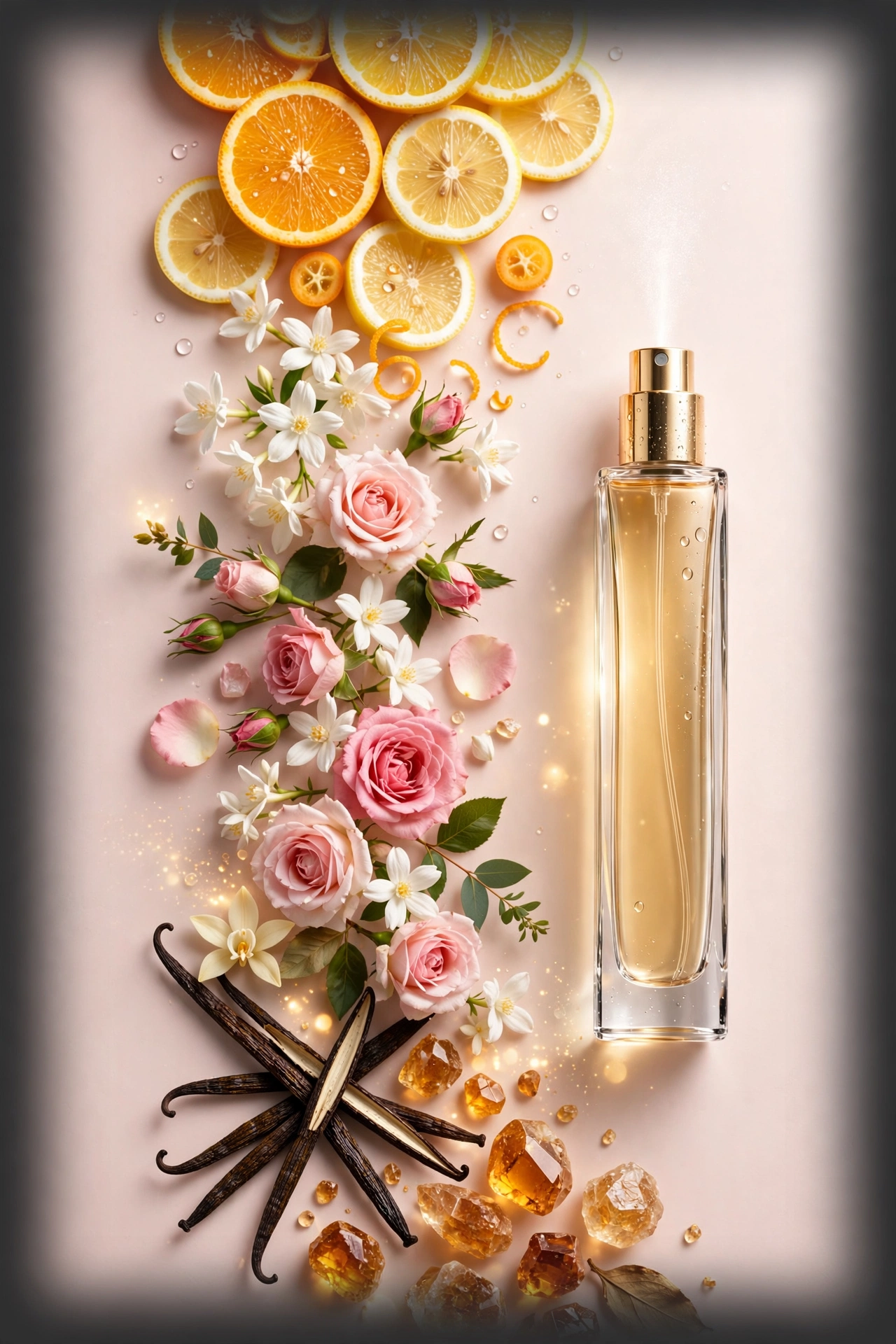
Common top notes include: bergamot, lemon, grapefruit, orange, neroli (orange blossom), green apple, pear, aldehydes (sparkling, soapy brightness), mint, eucalyptus, pink pepper, and cardamom.
Top notes serve one main purpose: to make a strong, appealing first impression. That sparkling citrus burst when you first spray a fresh fragrance? That’s the top notes doing their job. Perfumers know the opening sells the bottle at the counter, so they often make it the brightest, most crowd-pleasing part of the composition.
The beginner trap is falling in love with top notes and assuming the whole perfume will smell like that. It won’t. A gorgeous bergamot-and-neroli opening can dry down to a heavy musk base you dislike, or a sharp aldehydic blast can settle into a soft floral heart you adore. Enjoy the opening, but withhold judgment until the heart arrives – give every serious contender at least 30 to 60 minutes on skin before forming an opinion.
Heart Notes: The True Character
Heart notes – also called middle notes – emerge as the top notes fade, roughly 20 minutes to an hour after application, and they form the core personality of the fragrance for the next 2 to 4 hours. If top notes are the handshake, heart notes are the conversation. This is the stage that defines whether a perfume reads as floral, fruity, spicy, or green.
Common heart notes include: rose, jasmine, peony, lily of the valley, tuberose, ylang-ylang, lavender, geranium, cinnamon, clove, nutmeg, black pepper, plum, cherry, peach, and green tea.
The heart is where you’ll spend most of your time with a fragrance, so this is the stage to evaluate most carefully. When you’re testing on skin and the bright opening has settled, ask yourself: do I actually like this? The sparkling citrus is gone – is the floral or spicy core underneath something you want to smell for hours?
Heart notes also reveal the fragrance family most clearly. A heart dominated by rose and jasmine is unmistakably floral; one built on cinnamon, clove, and plum leans oriental-spicy; green tea and lavender signal fresh-aromatic. If you’re still learning families while choosing your first perfume, pay special attention to which heart notes keep drawing you back – they’re pointing straight at your family.
Base Notes: The Long-Lasting Dry-Down
Base notes appear 2 to 4 hours in and can linger on skin for 8+ hours – and on clothes for days. They’re built from large, heavy molecules that evaporate slowly: woods, resins, ambers, and musks. The base is the foundation everything else sits on, and it’s what people smell on you hours later, what lingers on your scarf, and what you’ll catch on your wrist the next morning.
Common base notes include: sandalwood, cedarwood, vetiver, patchouli, oakmoss, amber, benzoin, tonka bean, vanilla, white musk, suede and leather accords, oud, and incense.
The dry-down is the most honest part of a perfume – marketing can’t dress it up, and first-impression bias is gone. Many beginners discover their real preferences here: someone who thought they loved “fresh” fragrances realizes they actually love the warm sandalwood-musk base underneath, or someone drawn to sweet openings finds they dislike the powdery dry-down.
Base notes also determine longevity more than any other factor. All else equal, a perfume anchored in amber, woods, and resins will outlast one built on citrus and aquatic notes, because heavy molecules simply stick around longer. If your perfumes always seem to vanish by lunch, check the base notes – you may be choosing fragrances with light, fleeting foundations. (Concentration matters too – see this eau de parfum vs eau de toilette breakdown for how strength affects wear time.)
One more thing about bases: they’re the most personal stage of a fragrance because they mingle most deeply with your skin chemistry. Two people can wear the same perfume and have noticeably different dry-downs. This is another reason the full-day skin test matters more than any review.
How Notes Work Together: Accords and Blending
Notes rarely appear solo – perfumers blend them into “accords,” which are harmonious combinations that create an impression bigger than any single ingredient. A “white floral accord” might blend jasmine, tuberose, and orange blossom into one lush effect; a “chypre accord” traditionally combines bergamot, oakmoss, and labdanum into something earthy and elegant.
This is why a note list can be misleading if read too literally. “Leather” in a note list doesn’t mean the perfume smells like a new jacket – it might be a soft suede whisper in the background. “Oud” can range from barnyard-intense to smooth and honeyed depending on the blend. And two perfumes listing “rose, vanilla, musk” can smell completely different based on proportions and quality.
The practical takeaway: use note lists to spot patterns and deal-breakers, not to predict exact smells. If every perfume you love lists sandalwood and vanilla in the base, that’s meaningful data. If a note list is full of ingredients you’ve never liked, skip the sample. But don’t reject a fragrance just because one unfamiliar note appears – in the blend, it may be unrecognizable or even the thing that makes the composition sing.
The Most Common Notes and What They Smell Like
Here’s a quick-reference glossary of the notes you’ll see most often, grouped by character:
Fresh and bright: Bergamot (sparkling citrus, the backbone of countless classics), neroli (orange blossom – floral-citrus, clean and radiant), green tea (fresh, slightly astringent calm), aquatic and marine notes (salty, ozonic “ocean air”), aldehydes (effervescent, soapy lift – the famous Chanel No. 5 sparkle).
Floral: Rose (from dewy-fresh to jammy-rich depending on type), jasmine (heady, slightly animalic white floral – lush and sensual), peony (soft, watery, modern floral), tuberose (creamy, powerful white floral – love it or hate it), lily of the valley (delicate, green-tinged spring floral), ylang-ylang (exotic, custardy-sweet floral).
Fruity and sweet: Pear and apple (crisp, juicy freshness), peach and plum (soft, velvety sweetness), cherry (from tart to dark and syrupy), blackcurrant (tart, green-tinged berry), vanilla (warm, comforting sweetness – one of the most common base notes in perfumery).
Warm and spicy: Cinnamon (cozy, sweet spice), clove (pungent, warm spice), black pepper (sharp, dry spice lift), cardamom (aromatic, slightly sweet spice), nutmeg (warm, rounded spice).
Woody and earthy: Sandalwood (creamy, soft wood – universally flattering), cedarwood (dry, clean wood), vetiver (smoky-green, earthy grass root), patchouli (earthy, dark, chocolatey-woody – divisive), oakmoss (damp forest floor – the backbone of classic chypres).
Resinous and deep: Amber (warm, golden, slightly powdery resin glow), benzoin (sweet, vanilla-like resin), tonka bean (warm, almond-cherry coziness), incense (smoky, meditative), myrrh (dark, balsamic resin), oud (rich, complex wood – from smooth-honeyed to animalic).
Musky and skin-like: White musk (clean, soft “your skin but better”), ambroxan (warm, salty-amber radiance – the modern “expensive smell” molecule), suede (soft, powdery leather whisper).
You don’t need to memorize this list. Just notice which descriptions make you think “that sounds like me” – those are the notes to hunt for, and the ones that make you recoil are your deal-breakers.
How to Read a Note List in 60 Seconds
When you’re browsing online or reading a review, scan the note list with this quick method:
- Check the base first. The base notes tell you what you’ll actually be wearing for most of the day and how long it’ll last. Woods, ambers, musks, resins = long-lasting and warm. Citrus, aquatics, light florals = shorter-lived and fresher.
- Scan for deal-breakers. Cross-reference against your personal dislike list. Heavy patchouli? Powdery iris? Overpowering tuberose? One appearance doesn’t guarantee a problem, but two or three disliked notes in the heart or base is a strong skip signal.
- Identify the family. Multiple florals in the heart = floral fragrance. Citrus up top with woods at the base = fresh-woody. Vanilla, tonka, and amber = gourmand-oriental. The family tells you the overall vibe faster than any individual note.
- Note the concentration. An EDT built on citrus will be a light, short-lived fresh scent; a parfum with the same note list will be deeper and longer. Same notes, different experience – which is exactly why the concentration comparison matters when you’re deciding what to buy.
- Look for your loves. If your favorite samples keep featuring sandalwood, bergamot, or vanilla, actively seek those notes. Pattern-matching your own taste is the fastest path to a hit rate above 50 percent.
Finding Your Deal-Breaker Notes
Every fragrance lover eventually discovers one or two notes that ruin otherwise beautiful perfumes for them. Common culprits include powdery iris, sharp aldehydes, heavy patchouli, cloying white musk, overly sweet gourmand notes, and animalic oud. There’s nothing wrong with disliking a popular note – taste is personal, and knowing your dislikes is as valuable as knowing your loves.
To find yours, keep a simple log as you sample: perfume name, notes you noticed, and a verdict. After ten or so samples, scan for the note that appears in everything you disliked. That’s your deal-breaker. Add it to your phone notes and check every new note list against it. This single habit will save you more wasted samples than any other trick in this guide.
Frequently Asked Questions
Do I need to be able to identify individual notes to enjoy perfume?
Not at all. Plenty of fragrance lovers simply know what they like without naming notes. But learning even a handful of common notes – bergamot, rose, vanilla, sandalwood, musk – makes shopping dramatically easier, because you can read a note list and predict with reasonable accuracy whether a perfume suits you. Think of it as learning enough of a language to read a menu, not to write poetry.
Why do the same notes smell different in different perfumes?
Because context changes everything: the concentration, the quality of the ingredients, what the note is blended with, and the proportions. Rose paired with oud smells dark and opulent; rose paired with peony and musk smells soft and dewy. It’s the same reason the same spice tastes different in different dishes. Judge the composition, not the ingredient list.
What does it mean when a perfume is described as “linear”?
A linear fragrance smells roughly the same from spray to dry-down – the notes don’t evolve much over time. Many modern fresh and clean scents are linear by design. Neither linear nor evolving is better; it’s a preference. If you love a perfume’s opening and want it to stay that way, linear is your friend.
Can two perfumes have identical note lists but smell different?
Absolutely – and they usually do. Note lists are marketing summaries, not formulas. They omit dozens of supporting ingredients, don’t show proportions, and say nothing about ingredient quality. Two “rose, vanilla, musk” perfumes can smell like entirely different fragrances. The note list is a compass, not a photograph.
How long should I wait between smelling the top, heart, and base?
Roughly: top notes 0-30 minutes, heart notes 30 minutes to 3 hours, base notes 3+ hours. For a serious purchase decision, wear the fragrance for a full day. You’ll experience the complete arc, see how it performs through your routine, and know by evening whether you want to smell like that again tomorrow. These beginner beauty tips include more advice on building a smart sampling routine.
Conclusion
Perfume notes aren’t a secret code meant to intimidate beginners – they’re a practical map. Top notes give you the opening impression, heart notes reveal the true character you’ll live with for hours, and base notes determine what lingers and how long it lasts. Learn to read the base first, watch for your personal deal-breakers, and always judge a fragrance by its full arc on your skin, not its first fifteen minutes.
Once notes click for you, every perfume counter becomes less overwhelming and every online note list becomes genuinely useful. Pair this knowledge with a solid beginner’s guide to choosing perfume, and you’ll be sampling – and buying – with the confidence of someone who’s been doing it for years.
Love this? Pin it for later!