Magnetic Lashes vs Glue Lashes: Which Is Better for Beginners?
Walk into the false lash aisle (physical or digital) and you’ll face two competing systems: traditional glue-on strip lashes, and magnetic lashes that attach without adhesive. Both promise the same thing — fuller, longer lashes in minutes — but they get there through completely different mechanisms, with different learning curves, costs, and trade-offs.
This guide compares magnetic lashes and glue lashes head-to-head across every factor that matters to a beginner: how each system actually works, ease of application, how long they last on the eye and in the box, cost per wear, comfort, how natural they look, and what each means for the health of your natural lashes. By the end, you’ll know exactly which system to start with — and when it makes sense to try the other.
New to falsies entirely? Start with our beginner’s guide to applying false lashes, which walks through the full strip-lash application method step by step.
How Glue Lashes Work
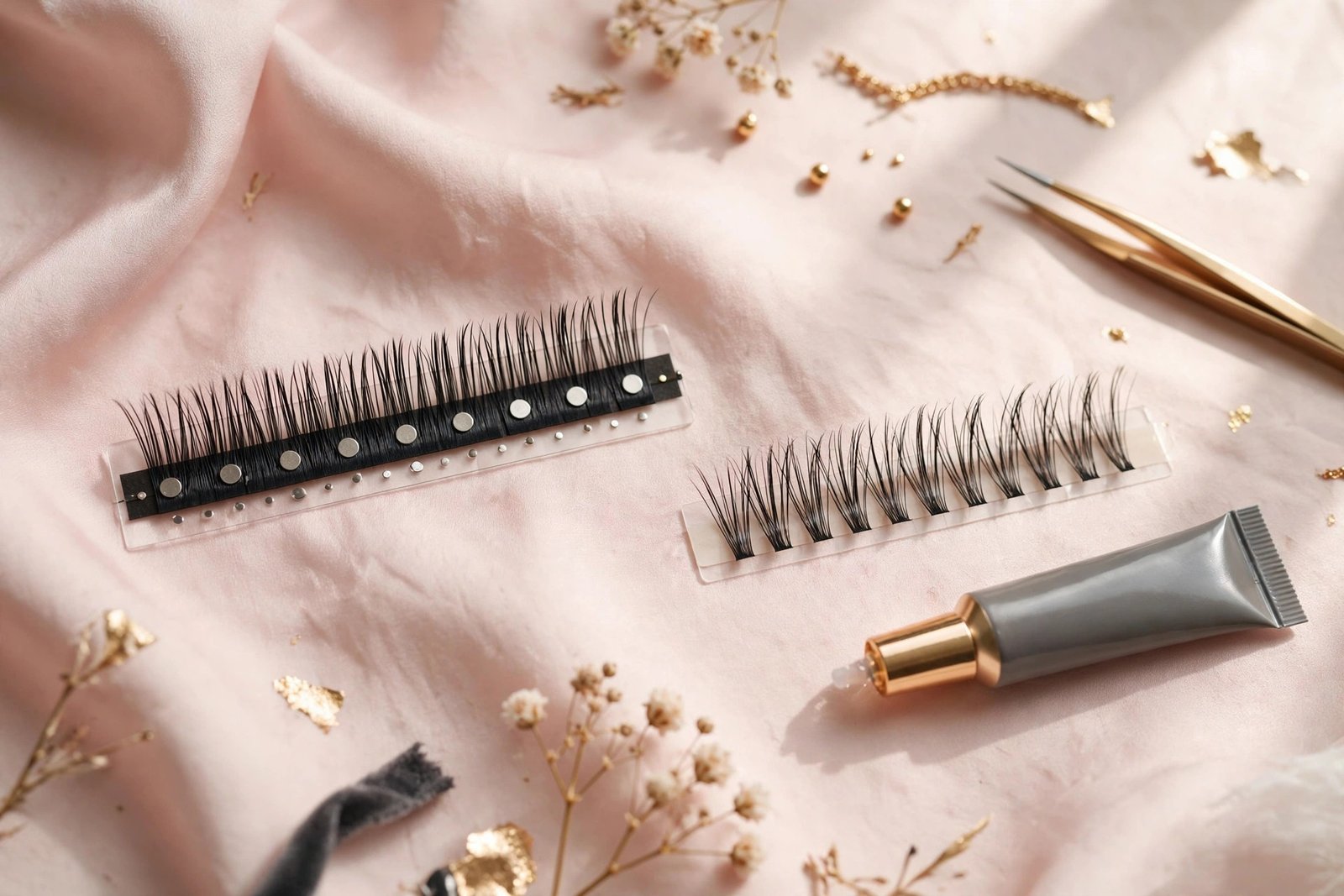
Glue lashes are the traditional system: a strip lash with a flexible band, attached to your lash line with a cosmetic adhesive. The process is measure, trim, apply a thin line of glue to the band, wait 30–45 seconds until tacky, place the band on the lash line, and press to secure. Removal means softening the adhesive with makeup remover and peeling the strip off gently.
The adhesive is the heart of the system. Most lash glues are latex-based or latex-free acrylic formulas; brush-on applicators give the most control. Good glue holds a strip securely for 8–12+ hours through normal blinking, humidity, and even light tearing. The trade-off is the mess factor: glue is sticky, it gets on fingers and lids while you’re learning, and over-application creates visible residue. But glue is also the reason these lashes are so secure and so widely available in every style imaginable — wispy, dramatic, natural, colored, feathered — at every price point from a few dollars upward.
How Magnetic Lashes Work
Magnetic lashes skip adhesive entirely. There are two subtypes, and the distinction matters:
Magnetic sandwich lashes use two strips per eye — one that sits above your natural lashes and one below — with tiny magnets along each band that click together, trapping your natural lashes between them. No glue, no liner. In theory, elegant. In practice, aligning two separate strips with your natural lashes sandwiched precisely between them is genuinely fiddly, and many beginners find this the harder system to learn despite the “no glue” promise.
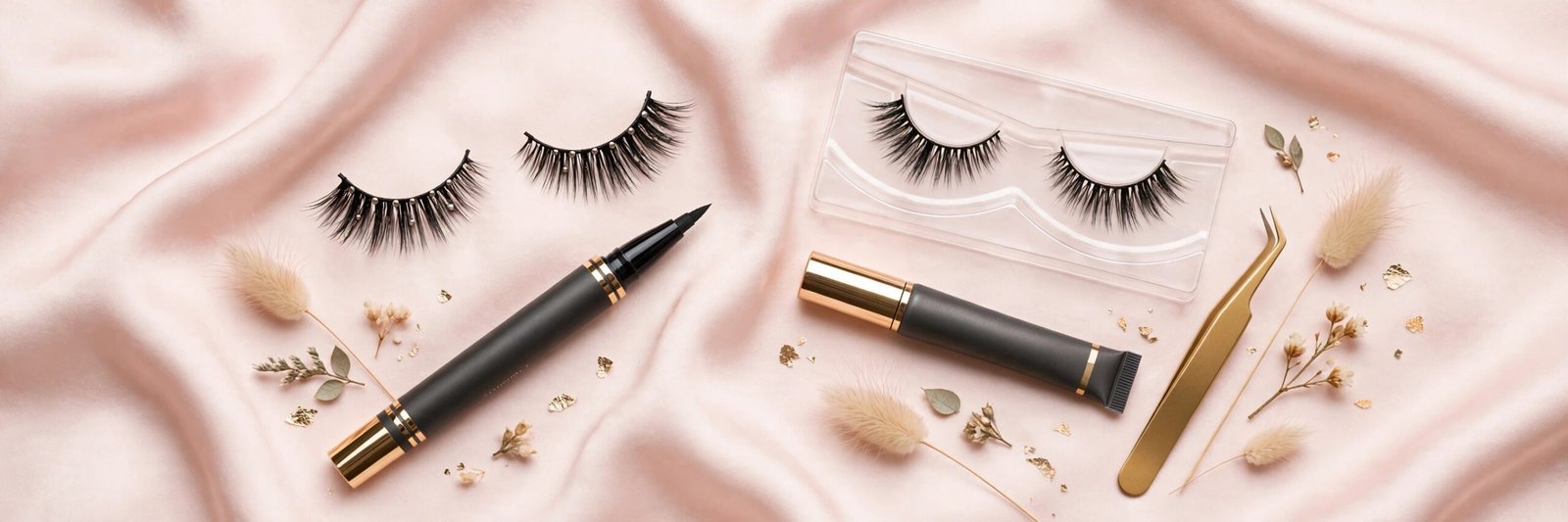
Magnetic eyeliner lashes are the more popular modern version: you draw a line of special magnetic eyeliner along your upper lash line, then lay a single strip lash — with small magnets along its band — onto the liner. The magnets grip the iron-oxide particles in the liner. This is significantly easier than the sandwich method and is what most people mean by “magnetic lashes” today. The liner doubles as your eyeliner, which conveniently hides the lash band — a nice built-in blending advantage. If you’re new to liner application generally, our eyeliner guide for beginners covers the drawing technique you’ll need.
Ease of Application: Which Is Actually Easier?
Honest answer: it depends on what you find hard about glue lashes.
If your struggle with glue lashes is the glue itself — the stickiness, the wait for tackiness, the residue — magnetic liner lashes genuinely solve that. There’s no tacky-wait, no glue on your fingers, and repositioning is easier: if the strip lands wrong, you lift it off the liner and try again without dealing with half-dried adhesive.
If your struggle is placement accuracy — getting the band exactly on the lash line, both eyes symmetrical — magnetic lashes don’t automatically fix that. You still have to land a strip precisely along your eye, and magnetic liner strips can actually be less forgiving here: the magnetic grip is weaker than good glue, so a strip placed slightly off is more likely to shift or lift during the day. The sandwich-style magnetic lashes are the hardest of all for placement, requiring you to align two strips around your natural lashes.
Verdict for beginners: magnetic liner lashes are slightly easier to learn than glue lashes if glue mess is your main obstacle. Glue lashes are easier if placement precision is your main obstacle, because the adhesive forgives small positioning errors by holding firmly once set. Most makeup artists still recommend learning glue lashes first — the skill transfers everywhere, and glue works with every lash style on the market.
Wear Time and Security
Glue lashes win on hold. A properly applied strip with good adhesive stays put for a full day — 8 to 12 hours — through blinking, humidity, wind, and watery eyes. The bond is genuinely strong; the outer corners may lift in hour 10+, but the lash isn’t going anywhere unexpectedly.
Magnetic lashes are secure but less bombproof. Magnetic liner lashes typically hold well for 6–10 hours in normal conditions, but they’re more vulnerable to specific situations: oily lids weaken the liner’s grip, watery eyes can break the magnetic hold, and rubbing your eyes is riskier. Sandwich-style magnetics can shift if the two strips aren’t perfectly aligned. For all-day events, weddings, or hot weather, glue is the safer bet. For a dinner or evening out, magnetics are perfectly adequate.
One practical note: magnetic lashes can’t get wet the way glue lashes can. If you cry at a wedding in magnetic liner lashes, the liner dissolves and the hold goes with it. Glue lashes survive tears far better (though they’re not waterproof — don’t swim in them).
Comfort and Feel
Magnetic lashes tend to feel slightly heavier on the lid because of the magnets embedded in the band — it’s a subtle difference, but sensitive eyes notice it. The band itself is often a bit stiffer to house the magnets, which can make the strip less flexible around the eye’s curve.
Glue lashes, especially cheap-to-mid-range faux-mink strips with thin bands, are generally lighter and more flexible. Once set, most wearers forget they’re wearing them. The comfort advantage goes to glue — provided the band was trimmed and fitted properly (an untrimmed band poking the inner corner is uncomfortable regardless of system).
For sensitive eyes, there’s another consideration: magnetic eyeliners contain iron oxides, which are generally safe but can irritate very sensitive eyes, and the liner must be applied as a fairly thick line to hold the magnets — more product on the lid than some sensitive eyes tolerate. Lash glue has its own irritants (formaldehyde-releasing preservatives in some formulas, latex in others), so neither system is automatically the “sensitive” choice — patch-testing matters for both.
How Natural They Look
Both systems can look natural or dramatic depending on the lash style you choose — the attachment method itself doesn’t determine the look. Two nuances:
- Magnetic liner lashes require a visible eyeliner line (the magnetic liner), so they’re poorly suited to no-makeup makeup looks where you want lashes with a bare lid. Glue lashes with a clear band and no liner can look remarkably natural.
- The slightly stiffer band of magnetic lashes can sit a touch higher off the lash line, occasionally creating a small visible gap. Glue’s flexible band hugs the lash line more closely.
Verdict: glue lashes have a slight edge for natural looks; for glam looks with eyeliner anyway, it’s a tie.
Cost Comparison
Upfront cost: similar. A starter kit of magnetic liner lashes (lashes + magnetic liner) typically runs $15–$30. A beginner glue-lash setup (lashes $5–$12 + glue $5–$10 + applicator) lands in the same range.
Cost per wear: glue lashes win significantly. A $8 pair of strip lashes worn 6 times costs ~$1.33 per wear, plus pennies of glue. Magnetic lashes are also reusable (often 15–30 wears since there’s no glue degrading the band), but the magnetic liner is the ongoing cost — it gets used up and needs replacing, and quality magnetic liners run $12–$20. Over a year of regular wear, glue is meaningfully cheaper.
Style variety: glue dominates. Thousands of strip styles exist; magnetic-compatible styles are a fraction of that. If you like experimenting with different looks, glue gives you far more options.
Lash Health: Which Is Gentler on Natural Lashes?
This is where magnetic lashes have a genuine, meaningful advantage. The most common cause of natural-lash damage from falsies isn’t the lash — it’s removal. Peeling off a glue strip pulls on natural lashes, and impatient removal (pulling dry, tugging through resistance) breaks or uproots them over time. Magnetic lashes lift off with essentially zero pulling — you just slide the strip off the liner. For daily wearers, this difference compounds.
That said, glue lashes are perfectly safe for natural lashes with proper technique: always soften adhesive with remover before peeling, peel slowly from the outer corner, and never sleep in them. Our false lash application guide covers safe removal in detail. The damage risk from glue is a technique problem, not an inherent one — but magnetic lashes remove the technique variable entirely.
One counterpoint: sandwich-style magnetic lashes clamp your natural lashes between two magnetic strips all day, and repeated clamping can stress fragile lashes. Magnetic liner lashes don’t have this issue since they sit on the liner above your lashes.
Reusability and Care
Both systems are reusable, and both last longer with proper cleaning:
- Glue lashes: 5–8+ wears for quality strips. The limiting factor is glue buildup on the band and mascara residue on the fibers. Our how to clean false lashes for reuse covers the full cleaning routine.
- Magnetic liner lashes: 15–30 wears is commonly reported, since there’s no adhesive degrading the band. Cleaning is simpler — wipe the magnets with a damp cotton swab to remove liner transfer. But the liner is consumable and needs repurchasing.
- Sandwich magnetics: similar reusability to liner magnetics, but the tiny magnets can weaken or detach over time with rough handling.
Who Should Choose Which?
Choose glue lashes if: you want the widest style selection, the most secure all-day hold, the lowest long-term cost, the most natural-looking results, or you’re learning lash skills you can use with any product. Also the right choice for events, weddings, humid climates, and watery eyes.
Choose magnetic liner lashes if: you hate dealing with glue, you have a latex allergy (most magnetic systems are latex-free by nature), you wear falsies daily and want the gentlest possible removal, or you already wear eyeliner daily anyway (the magnetic liner just replaces your regular liner step).
Try sandwich magnetics if: …honestly, most beginners should skip these. The alignment difficulty outweighs the no-glue benefit for the vast majority of learners. They’re a niche product for people who’ve tried everything else.
Consider owning both. Many regular lash wearers keep glue lashes for long days and events and magnetic liner lashes for quick everyday wear. The systems aren’t mutually exclusive, and the placement skill you learn with one transfers to the other.
Key Takeaways
- Glue lashes attach with cosmetic adhesive; magnetic lashes attach via magnets — either sandwiching natural lashes or gripping a magnetic eyeliner line.
- Magnetic liner lashes are the beginner-friendly magnetic option; sandwich-style magnetics are fiddlier than glue for most learners.
- Glue wins on hold strength (8–12+ hours), style variety, natural-looking results, and long-term cost.
- Magnetic lashes win on mess-free application, repositioning ease, and gentlest removal — a real advantage for daily wearers’ natural lash health.
- Magnetic lashes require wearing eyeliner (the magnetic line), feel slightly heavier, and hold less well on oily lids or in tears.
- For most beginners, learning glue lashes first builds transferable skill; our step-by-step lash application tutorial is the place to start.
Frequently Asked Questions
Do magnetic lashes really stay on all day?
For most people, yes through a normal day — 6 to 10 hours is typical with magnetic liner lashes. They’re less secure than glue in challenging conditions: oily eyelids, watery eyes, high humidity, or eye-rubbing can loosen the magnetic hold. For critical all-day events, glue remains the more reliable choice.
Are magnetic lashes safe?
Yes for most people. The magnets are tiny and the liners use iron oxides that are approved for cosmetic use. As with any eye product, avoid them if you have an eye infection, and discontinue use if you experience irritation. People with nickel allergies should check liner ingredient lists, as trace nickel can appear in some magnetic formulas.
Can I use regular eyeliner with magnetic lashes?
No — standard eyeliners don’t contain the magnetic particles the lash magnets grip. You need the specific magnetic eyeliner designed for the system. Some brands’ liners and lashes are cross-compatible, but staying within one brand’s system is the safest bet for hold strength.
Which is cheaper in the long run: magnetic or glue lashes?
Glue lashes. While magnetic lashes themselves last more wears per pair, the magnetic eyeliner is a consumable that needs regular replacement ($12–$20 each), which erases the reusability advantage. A glue setup’s only consumable is the glue itself, which is inexpensive and lasts months.
Can beginners really apply magnetic lashes easily?
Magnetic liner lashes: yes, most beginners find them manageable — the hardest part (glue timing) is eliminated. Sandwich-style magnetic lashes: honestly no, most beginners struggle with aligning two strips around their natural lashes. If “magnetic” appeals to you, choose the magnetic-eyeliner type specifically.
Love this? Pin it for later!