Sensitive Skin Routine for Beginners: The Complete Gentle AM/PM Guide
If your skin stings after cleansing, flushes after a warm shower, or reacts to products that everyone else seems to love, you are not imagining it. Sensitive skin is a real, measurable condition — dermatologists estimate that up to 70% of women and 60% of men report some degree of skin sensitivity. The good news is that sensitivity is one of the most manageable skin concerns, and it responds beautifully to a consistent, minimalist routine built around barrier protection.
The catch? Most beginner routines fail for sensitive skin because they include too many products, too many actives, and too many fragranced formulas. This guide takes the opposite approach: fewer steps, gentler ingredients, and a patch-testing method that prevents the trial-and-error disasters most sensitive skin beginners go through.
Whether you are building your very first routine or rebuilding after a reaction stripped your barrier down, the framework below works. It is organized into a morning routine (protect) and an evening routine (repair), plus the supporting habits — patch testing, irritant avoidance, and product introduction pacing — that make the difference between calm skin and chronic redness. For a deeper dive into each product category, this pillar connects to dedicated guides on [cleansers for sensitive skin → best-cleanser-for-sensitive-skin], [calming red irritated skin fast → how-to-calm-red-irritated-skin-fast], [fragrance-free routines → fragrance-free-skincare-routine-sensitive-skin], and [gentle vitamin C options → best-vitamin-c-serum-for-sensitive-skin].
Key Takeaways
- Sensitive skin responds best to short routines: cleanse, moisturize, protect (AM) and cleanse, treat, moisturize (PM).
- Always patch test new products for 48–72 hours on your jawline or behind the ear before full-face use.
- Fragrance (including “natural” fragrance and essential oils) is the most common cosmetic irritant — avoid it entirely.
- Introduce only one new product every 1–2 weeks so you can identify the culprit if something reacts.
- A gentle routine needs 4–6 weeks of consistency before you judge results — skin cells turn over on roughly a 28-day cycle.
- Ceramides, glycerin, squalane, and panthenol are well-tolerated ingredients that support the skin barrier.
- Sunscreen is non-negotiable: UV exposure worsens redness and reactivity in sensitive skin.
What “Sensitive Skin” Actually Means
Sensitive skin is not a clinical diagnosis — it is a descriptive term for skin with a lowered irritation threshold. It happens when the skin’s protective barrier (the outermost layer, made of lipids like ceramides) is weakened or naturally thinner, letting irritants, fragrances, and even water evaporate through more easily. The result: stinging, burning, tightness, redness, and flare-ups from things that do not bother other people.
It is worth noting that sensitive skin can coexist with other skin types. You can have sensitive oily skin, sensitive dry skin, or sensitive combination skin — the routine below works for all of them, with small adjustments to moisturizer texture and cleanser choice noted in each section. For more on how ingredients interact with the barrier, the [beginner’s guide to skincare ingredients → skincare-ingredients-guide-for-beginners] breaks down the building blocks in plain language.
The Beginner Rules of Sensitive Skin Care
Before any product picks, these four rules govern everything:
- Less is more. Every additional product is another chance for irritation. A sensitive skin routine has 3–4 steps, not 10.
- One at a time. Add a single new product every 1–2 weeks. If you start five products on Monday and your face is burning by Friday, you will have no idea which one caused it.
- Patch test everything. Even “for sensitive skin” labels are marketing, not guarantees. Apply a small amount behind the ear or on the jawline, wait 48–72 hours, and watch for delayed reactions before using a product on your whole face.
- Eliminate fragrance first. Synthetic fragrance and essential oils (lavender, tea tree, citrus oils) are the most common cosmetic sensitizers. If a routine change does not help, auditing out fragrance is the single highest-impact fix.
The Morning Routine: Protect
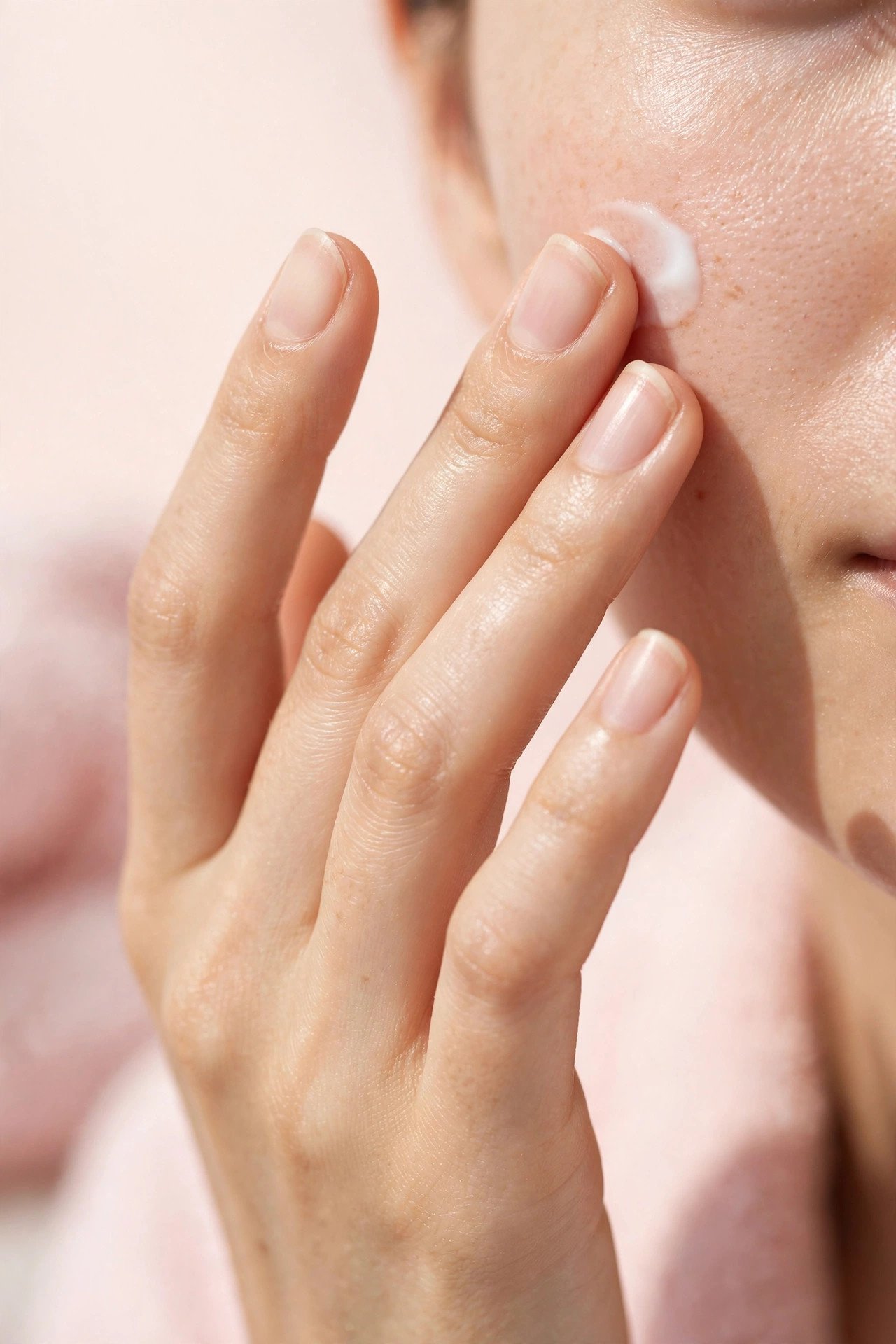
The AM routine has one job: protect your barrier against the day — UV, pollution, wind, and dry air — without stripping it. Three steps.
Step 1: Gentle cleanse (or rinse)
If your skin is dry-sensitive, plain lukewarm water is often enough in the morning. If you are oily-sensitive or used an occlusive moisturizer overnight, use a gentle, low-pH cleanser (around pH 5.5) with no fragrance. Lukewarm water only — hot water strips lipids and triggers flushing.
For product-by-product picks, see the dedicated [cleanser guide for sensitive skin → best-cleanser-for-sensitive-skin].
Step 2: Moisturize
Apply moisturizer to slightly damp skin to lock in hydration. Look for formulas with ceramides, glycerin, squalane, or panthenol, and minimal ingredient lists. A dry-sensitive skin does well with cream textures; oily-sensitive skin does better with lightweight lotions or gels. One moisturizer is enough — you do not need separate serums at this stage.
Step 3: Sunscreen
This is the most important step. UV radiation is a direct trigger for redness and reactivity, and many sensitive skin concerns (persistent flushing, uneven tone) are worsened by unprotected sun exposure. Use a broad-spectrum SPF 30 or higher. Mineral (zinc oxide/titanium dioxide) sunscreens are traditionally the gentlest option, though many modern chemical filters are well tolerated — the sunscreen you will actually wear every day is the best one. If you react to a specific formula, switching types often solves it.
The Evening Routine: Repair
The PM routine has a different job: remove the day gently and give your skin recovery ingredients to rebuild overnight.
Step 1: Cleanse
Remove sunscreen and the day’s buildup with your gentle cleanser. If you wore water-resistant sunscreen or makeup, a double cleanse can help — but use two gentle cleansers (a cleansing oil/balm followed by a water-based cleanser), never a harsh one. Massage for 30–60 seconds with lukewarm water and rinse thoroughly.
Step 2: Treat (optional, later)
Beginners should skip this step for the first month. Once your skin is calm and stable on the basics, this is where you add one treatment — for example, a gentle vitamin C serum in the morning for brightening. The guide to [vitamin C serums for sensitive skin → best-vitamin-c-serum-for-sensitive-skin] covers the gentler derivative forms (sodium ascorbyl phosphate, magnesium ascorbyl phosphate) that sensitive types tolerate far better than pure L-ascorbic acid. If redness is your main concern, niacinamide is another evidence-backed option — see [what niacinamide does for skin → what-does-niacinamide-do-for-skin].
Step 3: Moisturize
Use the same moisturizer as the morning, or a slightly richer one at night if your skin is dry-sensitive. If your barrier feels compromised (tight, flaky, stinging with products that used to be fine), layer a thin occlusive — plain petrolatum or a balm — over your moisturizer a few nights a week. This “slugging-lite” approach reduces overnight water loss dramatically.
How to Patch Test Properly
Patch testing is the single most useful habit a sensitive skin beginner can build, and it is also the most skipped. Here is the method dermatologists actually recommend:
- Choose a discreet test area: behind the ear or along the jawline.
- Apply a small amount of the product once or twice daily for 48–72 hours.
- Watch for stinging, redness, bumps, or itching — note that some reactions are delayed and appear on day two or three.
- If any irritation appears, stop and do not use the product on your face.
- Test only one product at a time, or the results are meaningless.
A related but different practice: some people confuse patch testing with the formal allergy patch testing done in dermatology clinics. The at-home version above is a repeat open application test (ROAT) — perfectly valid for screening cosmetic irritation before you commit to a full bottle.
Irritants to Avoid in a Sensitive Skin Routine
Memorize this short list and check it against every label:
- Fragrance/parfum (synthetic or natural) and essential oils — the number one irritant category. For a full routine built exclusively without it, see the [fragrance-free skincare routine → fragrance-free-skincare-routine-sensitive-skin].
- Drying alcohols (denatured alcohol, SD alcohol) high on the ingredient list — fine in tiny amounts deep in a formula, problematic in astringent toners.
- Harsh sulfates (sodium lauryl sulfate) in cleansers — most modern gentle cleansers use milder surfactants instead.
- High-strength acids and retinoids introduced too fast — they have their place, but not in month one of a beginner routine. Strong exfoliation on a reactive barrier is how redness becomes chronic.
- Witch hazel, menthol, eucalyptus, and “cooling” ingredients — often marketed as soothing, frequently irritating on reactive skin.
Note: “hypoallergenic,” “dermatologist-tested,” and “for sensitive skin” are unregulated marketing terms. They can be helpful starting filters, but they are not proof a product will suit you — hence the patch test.
When Your Skin Flares Up: Emergency Calming
Even with a good routine, flare-ups happen — a new product, stress, weather changes, or overheating. When your face is red, hot, and stinging, stop all actives immediately, strip the routine back to cleanser + moisturizer (+ sunscreen in the day), and reach for calming ingredients like centella asiatica, aloe vera, and thermal spring water. The dedicated guide to [calming red, irritated skin fast → how-to-calm-red-irritated-skin-fast] walks through a full emergency protocol including cold compress technique and which ingredients to avoid during a flare.
Building Your Routine Over Time: A Timeline
- Weeks 1–2: Cleanser + moisturizer + sunscreen only. Patch test everything first.
- Weeks 3–4: If stable, keep going — do not add anything. Stability is the goal, not speed.
- Weeks 5–6: Add one treatment if you have a specific concern (redness, dullness, dark spots). One product, patch tested, at a time.
- Month 3+: Reassess. If your barrier is calm and resilient, you can explore targeted ingredients at low concentrations.
On toner specifically — a question beginners ask constantly: most sensitive skin types do not need one. The honest breakdown is in [is toner necessary → is-toner-necessary-skincare-routine]; the short answer is that a hydrating, alcohol-free toner is optional, and an astringent one is a hard no.
7 Beginner Mistakes That Keep Sensitive Skin Reactive
Most sensitive skin struggles are not caused by the skin itself but by fixable habits. Watch for these:
- Changing products constantly. Every switch resets your skin’s adjustment clock and reintroduces unknown variables. Commit to a routine for six weeks before judging it.
- Using too much product. A pea-sized amount of moisturizer and a dime-sized amount of cleanser cover the whole face. Over-application increases irritation risk without improving results.
- Washing with hot water. It feels good and strips the barrier simultaneously. Lukewarm, always.
- Exfoliating on a schedule instead of by skin condition. “Twice a week” means nothing if your barrier is already stressed. Exfoliate only when skin is calm, and skip the week if it is not.
- Layering multiple new products the same week. The one-at-a-time rule exists because detective work is miserable when five suspects are involved.
- Skipping sunscreen because it once stung. The solution is a different sunscreen formula, not no sunscreen. UV damage worsens every sensitivity concern.
- Treating redness with more actives. Red, angry skin needs fewer ingredients, not stronger ones. When in doubt, subtract.
Adjusting Your Sensitive Skin Routine by Season
Sensitive skin is rarely static — winter dryness and summer heat shift what your barrier needs:
- Winter: Cold air and indoor heating increase water loss. Switch to a richer moisturizer, consider the thin occlusive layer nightly, and keep showers short and lukewarm. Redness from wind and temperature swings is common — a scarf over the lower face helps more than any product.
- Summer: Heat, sweat, and sunscreen reapplication dominate. A lighter moisturizer texture prevents congestion, and mineral sunscreen reapplication (powder or stick formats) avoids disturbing makeup. Rinse sweat promptly — dried sweat salts irritate reactive skin.
- Spring/Autumn transitions: These are peak flare-up seasons as humidity swings. This is the time to be most conservative: no new actives, strict fragrance-free, and the [emergency calming protocol → how-to-calm-red-irritated-skin-fast] on standby.
Frequently Asked Questions
How do I know if I have sensitive skin or just a damaged barrier?
They often look identical — redness, stinging, tightness. The difference is history: a damaged barrier usually follows over-exfoliation, harsh products, or overuse of actives, and it improves within 2–4 weeks of stripping your routine back to basics. True constitutional sensitivity persists even with gentle care. In practice, the fix is the same: simplify, protect the barrier, and reintroduce things slowly.
Can sensitive skin ever tolerate vitamin C or retinol?
Often, yes — but the form and pacing matter enormously. Gentler vitamin C derivatives (SAP, MAP) at low concentrations are tolerated by many sensitive types, while pure L-ascorbic acid at 15–20% is a common irritant. Retinol can be introduced at very low concentrations (0.1–0.3%) once or twice a week after months of a stable routine. The key is never to start either during a reactive period.
Should I wash my face twice a day if I have sensitive skin?
It depends on your skin. Dry-sensitive skin often does best with a water rinse in the morning and a proper cleanse at night. Oily-sensitive skin usually tolerates (and benefits from) a gentle cleanse twice daily. Watch your skin’s response: tightness or squeakiness after washing means the cleanser is too harsh or the water too hot.
Is “sensitive skin” just a marketing term?
No, though marketers abuse it. Dermatologists recognize sensitive skin as a genuine condition of lowered irritation threshold, sometimes called sensitive skin syndrome. What is marketing is the assumption that any product labeled “for sensitive skin” is automatically safe for you — always patch test.
How long before I see results from a gentle routine?
Expect reduced stinging and tightness within 1–2 weeks of simplifying. Visible redness reduction typically takes 4–6 weeks of consistent barrier care. Skin’s full renewal cycle is about 28 days, so judge any routine on a 6-week horizon, not a 6-day one.
Can I wear makeup with sensitive skin?
Yes, with two caveats: choose fragrance-free, non-comedogenic formulas, and never skip thorough-but-gentle removal at night — sleeping in makeup is far more irritating than the makeup itself. Mineral makeup is often well tolerated by reactive types. Introduce new makeup products with the same patch-test-and-wait discipline as skincare.
Does diet affect skin sensitivity?
The evidence is modest but real for specific triggers: alcohol and very spicy foods can worsen flushing in prone individuals, and there is no credible evidence that any single “sensitive skin diet” fixes barrier function. Focus on the proven levers — gentle routine, barrier support, sun protection — before experimenting with diet.
A calm, resilient barrier is built slowly — three gentle steps, done daily, will outperform a shelf of reactive products every time. Start with the basics, patch test everything, give your skin the weeks it needs, and expand only from a foundation of calm. Your future self, with a barrier that no longer flinches at everything, will thank you.
gentle cleansers
calm red irritated skin
fragrance-free routine
vitamin C for sensitive skin
niacinamide benefits
Love this? Pin it for later!