Why Makeup Irritates Eyes: Causes and Easy Fixes
You finish your eye makeup, step back to admire it — and within an hour your eyes are stinging, watering, or itching. It’s one of the most common beauty complaints, and it’s also one of the most fixable. Eye irritation from makeup almost always traces back to a handful of causes: particles migrating into the eye, irritating ingredients, expired products, or application habits that put product where it doesn’t belong.
The eyes are uniquely vulnerable because the skin around them is the thinnest on the face, and the tear film is easily disrupted by foreign particles and chemicals. Understanding what’s actually causing your irritation is the first step — because the fix for fallout is different from the fix for a fragrance sensitivity, and both are different from the fix for expired mascara. Let’s walk through each cause and its solution.
Key Takeaways
- The most common causes are product fallout, irritating ingredients (fragrance, glitter, certain preservatives), expired products, and waterline application.
- Fallout from powder eyeshadow, flaky mascara, and crumbly pencil liner is the top offender — switch to smooth, low-fallout formulas.
- Eye products expire faster than you think; mascara lasts about 3 months, liquid liner about 6.
- Keeping makeup off the waterline and away from the inner corner prevents most migration-related irritation.
- Patch-test new eye products on the skin near (not in) the eye before full application.
Contact lenses and eye makeup mix safely only with good hygiene. If you get persistent redness, pain, or blurred vision, remove your lenses and see an eye doctor — never push through irritation.
Cause 1: Fallout — Particles Drifting Into Your Eyes
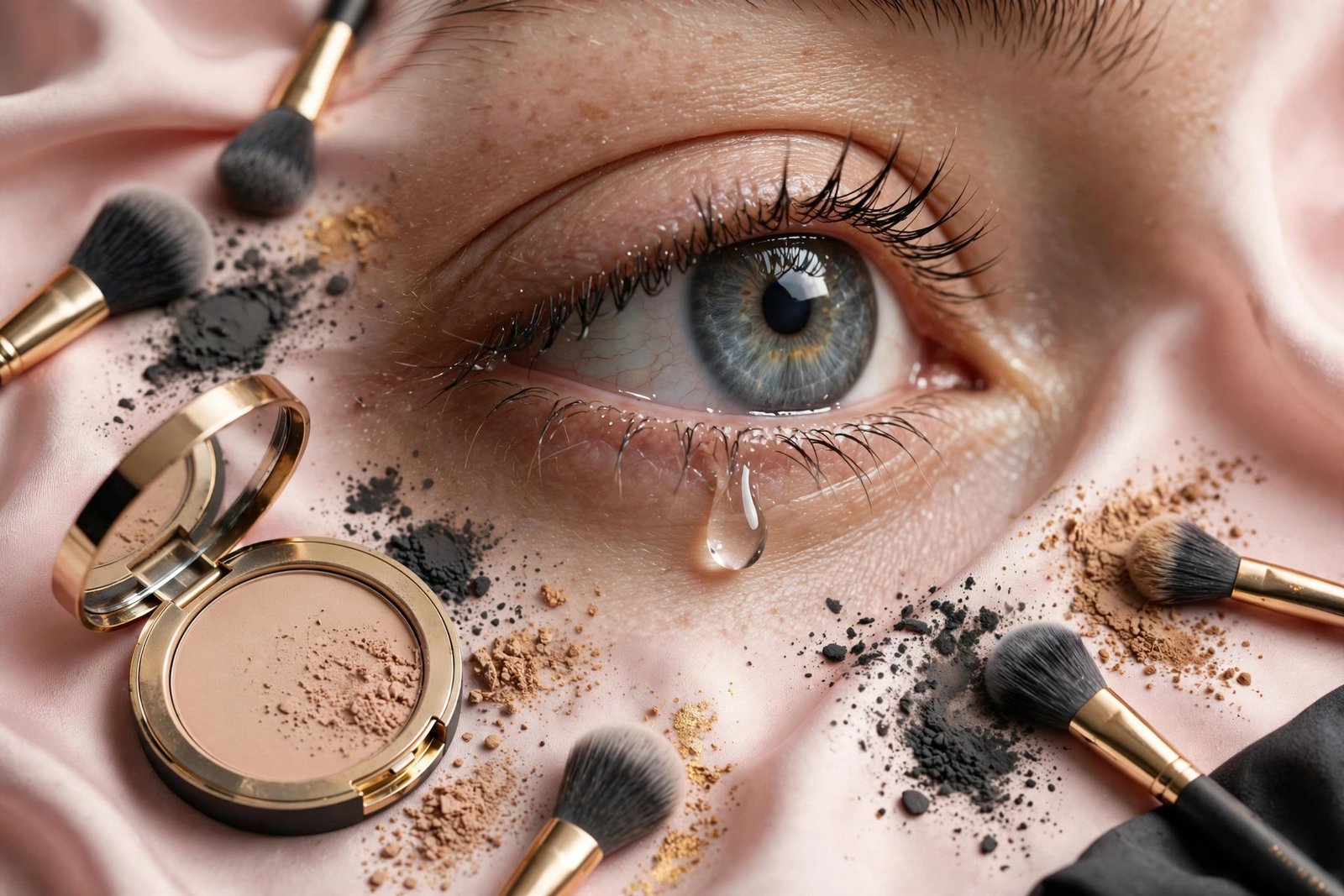
Fallout is the number-one cause of makeup-related eye irritation. Powder eyeshadow, flaky mascara, and crumbly pencil liners all shed microscopic particles that drift downward and land in the eyes with every blink. Your tear film tries to flush them out, which is why fallout so often shows up as watering and a gritty sensation.
The fix: Switch to formulas that stay put. Cream or liquid eyeshadows produce far less fallout than powder. Tubing mascaras encase each lash in a polymer sleeve that doesn’t flake — they’re one of the best upgrades a sensitive-eyed person can make. For liner, smooth waterproof pencils and gel formulas shed far less than dry kohl. Tap excess powder off your brush before applying, and apply eyeshadow before foundation so you can clean up fallout without ruining your base.
Contact lens wearers feel fallout worst, because particles land on the lens and stay there, grinding with every blink. If you wear lenses, a lens-safe makeup routine built around low-fallout products makes a dramatic difference.
Cause 2: Irritating Ingredients
Even a perfectly applied product can sting if it contains ingredients your eyes dislike. The usual suspects:
- Fragrance: Added scent in eye products serves no function and is a well-documented irritant. Dermatologists consistently recommend fragrance-free formulas for the eye area.
- Glitter and shimmer particles: Large reflective particles — especially in loose glitter — can scratch the eye’s surface. Even fine shimmer migrates more than matte formulas.
- Certain preservatives: Some preservatives used in liquid eye products cause stinging in sensitive individuals. If a product burns on application, the preservative system is a likely culprit.
- Waterproofing agents and solvents: The ingredients that make a formula waterproof can irritate on contact, especially if the product is old and the solvents have partially evaporated, concentrating the remaining chemicals.
- Essential oils: “Natural” doesn’t mean gentle near the eyes. Tea tree, peppermint, and citrus oils in eye-area products are common irritants.
The fix: Read ingredient lists and choose products labeled ophthalmologist-tested and fragrance-free for the eye area. When a product stings, stop using it — “pushing through” irritation is never the answer. A gentle mascara for sensitive eyes formulated without common irritants is a good starting point for rebuilding a comfortable eye routine.
Cause 3: Expired Products
Eye makeup expires faster than almost any other category, and old products are a major hidden cause of irritation. As preservatives break down, bacteria multiply — and the eye area is the last place you want a bacterial load. Old formulas also change texture: mascaras get clumpy and flaky, liquid liners get thick and crumbly, and cream shadows dry out and shed more.
General timelines from dermatologists:
- Mascara: about 3 months after opening — the shortest lifespan of any makeup product.
- Liquid and gel eyeliner: about 6 months.
- Pencil eyeliner: up to a year if kept sharpened (each sharpening exposes a fresh, cleaner tip).
- Cream eyeshadow: about 6 months.
- Powder eyeshadow: up to 2 years, but toss it sooner if the texture changes.
The fix: Label products with the date you opened them — a small piece of tape and a marker take seconds. If a product smells off, has changed color or texture, or irritates when it didn’t before, throw it away regardless of the timeline. Your eyes are worth more than the remaining product.
Cause 4: Waterline and Inner-Corner Application
Applying product directly on the waterline or deep in the inner corner puts makeup in direct contact with the tear film. Every blink then spreads it across the eye. Waterline liner and inner-corner highlight are the two placements most likely to cause watering and stinging, because there’s no barrier between the product and the eye.
The fix: Keep liner on the outer lash line rather than the inner rim. If you love the waterline look, restrict it to special occasions and use only waterproof, ophthalmologist-tested pencils in a single light pass. For inner-corner brightness, use a tiny amount of matte light shadow just outside the tear duct rather than shimmer directly in the corner — you get the glow with far less migration.
Cause 5: Application Habits That Backfire
Sometimes the product is fine and the technique is the problem:
- Pumping the mascara wand pushes air into the tube, drying out the formula and breeding bacteria. Twist the wand instead.
- Applying makeup before inserting contacts means fingers transfer product onto lenses. Lenses go in first, always.
- Rubbing your eyes during the day grinds whatever is on your lids into the eyes. Blot watering eyes gently with a tissue instead.
- Sleeping in eye makeup is one of the worst habits for eye health — hours of product pressed against the eye overnight causes irritation and raises infection risk.
- Sharing eye makeup or using unsanitary testers introduces other people’s bacteria to your eyes.
The fix is mostly about order and gentleness: lenses first, makeup second; makeup off first, lenses out second; press and blot instead of rubbing. Small habit changes, big comfort payoff.
Cause 6: Underlying Eye Conditions
Sometimes makeup isn’t the real problem — it’s revealing one. Dry eye syndrome makes eyes far more reactive to any product near them. Seasonal allergies leave eyes inflamed and itchy before makeup even enters the picture. Blepharitis (inflammation of the eyelid margins) causes redness and crusting that makeup aggravates. If your eyes are irritated even on makeup-free days, the makeup may be innocent.
The fix: See an eye doctor if irritation persists without makeup, or if makeup-free days feel no better than makeup days. Artificial tears can help dry eyes tolerate makeup better, but use preservative-free drops and apply them before makeup, giving them a minute to settle. Never use redness-relief “get the red out” drops as a daily crutch — they can cause rebound redness with regular use.
Cause 7: Remover That’s Too Harsh
Ironically, the product meant to take makeup off can cause as much irritation as the makeup itself. Harsh rubbing with a drying remover, alcohol-based removers, or scrubbing with rough wipes all inflame the delicate eye area. If your eyes sting most at night during removal, the remover — not the makeup — may be the culprit.
The fix: Use a gentle oil-based or dual-phase remover. Saturate a soft cotton pad, press it against the closed eye for 15–20 seconds to dissolve product, then wipe away softly. Dissolving beats scrubbing every time. Follow with a mild cleanser and lukewarm water to remove residue.
Building an Irritation-Free Eye Routine
Once you know the causes, assembling a comfortable routine is straightforward:
- Start with clean tools. Wash brushes weekly; replace sponges regularly.
- Prime lids so shadow and liner grip instead of migrating.
- Choose low-fallout, fragrance-free, ophthalmologist-tested formulas.
- Keep product off the waterline and away from the inner corner.
- Apply lenses before makeup if you’re a contact lens wearer.
- Remove gently every night — dissolve, don’t scrub.
- Respect expiry dates, especially mascara’s 3-month rule.
For glasses wearers, there’s an extra wrinkle: mascara that hits the lenses smudges and flakes back toward the eyes. The how to stop mascara smudging on glasses guide covers that specific problem, and the broader makeup guide for glasses wearers addresses how frames change eye makeup strategy.
When to See a Doctor
Most makeup irritation resolves within a day of removing the product. See an eye doctor promptly if you experience persistent redness lasting more than 24–48 hours, eye pain (not just itching), discharge, light sensitivity, blurred vision, or swelling. These can signal infection or a corneal issue that needs professional treatment — not a product swap. Contact lens wearers should remove lenses immediately at the first sign of pain or vision changes and not reinsert them until cleared.
Frequently Asked Questions
Why do my eyes water every time I wear eyeshadow?
Watering is usually the tear film flushing out fallout particles. Powder shadows are the most common cause. Try switching to cream or liquid shadows, tapping off excess powder before application, and keeping shimmer away from the inner corner. If watering happens with every formula, consider dry eye or allergies and check with an eye doctor.
Can I wear eye makeup if I have sensitive eyes?
Usually yes — sensitive eyes need the right products, not zero products. Choose fragrance-free, ophthalmologist-tested formulas, avoid glitter and waterproof-everything (save waterproof for when you truly need it), keep product off the waterline, and remove gently. Patch-test new products near the eye before committing.
Why does my mascara burn my eyes?
Burning on application often points to an irritating ingredient or an expired tube. Check the open date — if it’s past 3 months, replace it. If a fresh tube still burns, the formula likely contains something your eyes dislike, such as fragrance or a harsh preservative. Switch to a simpler, sensitive-eye formula.
Is it normal for eyes to itch after applying eyeliner?
Mild, brief itching that fades isn’t unusual, but persistent itching is a sign something’s wrong — usually fallout, an irritant ingredient, or an allergy developing to a product you’ve used for a while (sensitivities can appear suddenly, even to long-time favorites). Stop using the product and see if the itching stops; that’s your answer.
Should I stop wearing eye makeup if my eyes are red?
Take a break until the redness fully resolves — usually 24–48 hours. Wearing makeup over irritated eyes traps the irritant against the tissue and makes it harder to identify the cause. When you restart, reintroduce one product at a time so you can pinpoint the offender.
Conclusion
Eye irritation from makeup is rarely mysterious — it’s fallout, ingredients, expired products, risky placement, harsh habits, or an underlying condition, and each has a clear fix. Work through the causes one by one, starting with the easiest wins: fresher mascara, less fallout, gentler removal. Most people find their comfort improves dramatically with just two or three changes. And remember the non-negotiable rule: persistent pain, vision changes, or redness that won’t quit means a doctor’s visit, not another product experiment.
Love this? Pin it for later!