Haircuts for Face Shapes: Find Your Most Flattering Cut
There is a reason the same haircut looks effortless on one person and somehow “off” on another: face shape. The right cut works with your bone structure — it can add length where you want it, soften angles, or create width exactly where your face needs balance. The wrong one fights your natural geometry, no matter how trendy it is.
Most people walk into a salon appointment with a screenshot of a celebrity and hope for the best. Stylists recommend a better approach: start with your face shape, then pick the cut that flatters it. This guide walks you through identifying your face shape at home, explains what each shape needs from a haircut, and breaks down the most-requested styles — layers, bangs, and bobs — by how they work for different faces. By the end, you will know exactly what to ask for at your next appointment.
Key Takeaways
- Face shape matters more than trends. A flattering cut balances your proportions: adds length to round faces, width to long faces, and softness to angular faces.
- Identify your shape first with a mirror, a measuring tape, and five minutes — forehead, cheekbone, jawline, and face length are all you need.
- Round faces want length and definition: long layers, side parts, and cuts that fall below the chin.
- Long faces want width and balance: curtain bangs, waves, and volume at the sides.
- Square faces want softness: face-framing layers, curtain bangs, and textured ends that blur a strong jawline.
- Oval faces are the most versatile — nearly every cut works, so choose based on hair texture and lifestyle instead.
- The butterfly haircut can be adapted to every face shape with the right layer placement.
- Curtain bangs are the most face-shape-friendly fringe.
How to Identify Your Face Shape at Home
Before anything else, figure out what you are working with. Stylists use a simple method that takes about five minutes. Pull your hair back off your face completely (a headband or tight ponytail works), stand in good lighting, and look straight into a mirror.
The measuring method
Grab a flexible measuring tape and take four measurements:
- Forehead width: from the peak of one eyebrow arch to the other.
- Cheekbone width: from the highest point of one cheekbone to the other — this is usually the widest part of most faces.
- Jawline width: from the tip of your chin to just below one ear, then double it.
- Face length: from the center of your hairline to the tip of your chin.
Now match the pattern:
- Oval: face length is greater than the width of your cheekbones, forehead slightly wider than the jaw, chin softly rounded. Length is roughly one-and-a-half times the cheekbone width.
- Round: cheekbones are the widest measurement and face length is close to cheekbone width. Jaw is soft and rounded, with few visible angles.
- Square: forehead, cheekbones, and jaw are all roughly equal, and the jaw has defined corners.
- Long (oblong): face length is clearly the largest measurement, with forehead, cheekbones, and jawline fairly similar in width.
- Heart: forehead is the widest measurement, narrowing down to a narrower, pointed chin. Cheekbones may be high and wide.
- Diamond: cheekbones are the widest point, with both forehead and jawline narrower. Chin is often pointed.
If you fall between two shapes, that is completely normal — most people do. In that case, choose the cut guidance for whichever traits bother you most. A face that is “round-ish but with a slightly square jaw” should follow the round-face lengthening advice while borrowing the softening layers from the square-face playbook.
A quicker shortcut
No tape measure handy? Take a selfie straight-on, hold a ruler to your phone screen, and compare widths. Or trace your face outline on the mirror with a dry-erase marker and look at the shape from arm’s length. Neither method is as precise, but both are good enough to land you in the right category.
What Each Face Shape Needs From a Haircut
Once you know your shape, the logic of flattering haircuts becomes simple. Every recommendation in this guide follows one principle: a great cut balances your proportions.
Round faces: create length and definition
Round faces read as soft and youthful, but one-length cuts that end at the cheek or chin can emphasize width. The goal is elongation. Long layers that start below the chin draw the eye downward. Side parts break up symmetry in a way that slims. Asymmetrical cuts and deep side-swept bangs create diagonal lines, which visually stretch the face. The full rundown — including the cuts to avoid — is covered in this guide to the best haircuts for round faces.
Long faces: create width and balance
When the face is longer than it is wide, very long straight hair can drag it down further. The fix is horizontal movement: bangs (curtain bangs especially) visually shorten the forehead, waves and curls add width at the cheeks, and layered cuts with volume through the mid-lengths keep everything balanced. Chin-to-shoulder lengths are particularly flattering. Get the complete playbook in this guide to the best haircuts for long faces.
Square faces: soften the angles
Strong jawlines are striking, but blunt cuts that hit exactly at the jaw can box the face in. Softening is the move — face-framing layers that start at the cheekbones, curtain bangs that melt into the sides, and textured or wispy ends instead of hard blunt lines. Side parts and diagonal movement break up the symmetry that emphasizes angularity. Everything is laid out in this guide to the best haircuts for square faces.
Oval faces: the versatile shape
Oval faces have balanced proportions, which means the job is already mostly done. Nearly every length, layer pattern, and fringe works. Stylists recommend choosing based on hair texture, density, and how much styling time you actually have. One caution: extremely long, flat, one-length hair can drag an oval face down and make it look longer than it is — add layers or movement to keep things lively.
Heart faces: balance a wider forehead
Heart-shaped faces pair a wider forehead with a narrower chin. The most flattering cuts add fullness at the jawline to balance the top: chin-length bobs, lob cuts, and waves that start around the chin. Side-swept bangs and curtain bangs soften a wide forehead without hiding it. Avoid excessive volume at the crown, which can make the forehead look wider.
Diamond faces: soften cheekbones, add width at forehead and chin
Diamond faces are widest at the cheekbones, so the goal is gentle fullness at the forehead and jawline. Chin-length bobs with tucked-under ends, layered cuts with volume at the crown, and side-swept bangs all work well. Pull-back styles that fully expose the cheekbones tend to emphasize them, so keep some face-framing pieces down.
Layers: The Universal Flattener
If there is one cutting technique that works for every face shape, it is layers — because layers can be placed wherever your face needs them. The mistake most people make is asking for “layers” without specifying where they should start and how dramatic they should be.
Long layers
Long, blended layers that start at the collarbone or below are the safest option for round faces — they add movement without adding width at the cheeks. For long faces, layers that start higher (around the chin or cheekbones) create the side volume that balances length.
Face-framing layers
These are the shorter pieces cut around the face specifically. For square faces, face-framing layers that begin at the cheekbone soften the jawline. For round faces, they should start at or below the chin to avoid adding cheek width. For heart faces, face-framing pieces that hit at the jawline fill in the narrower lower face beautifully.
The butterfly cut
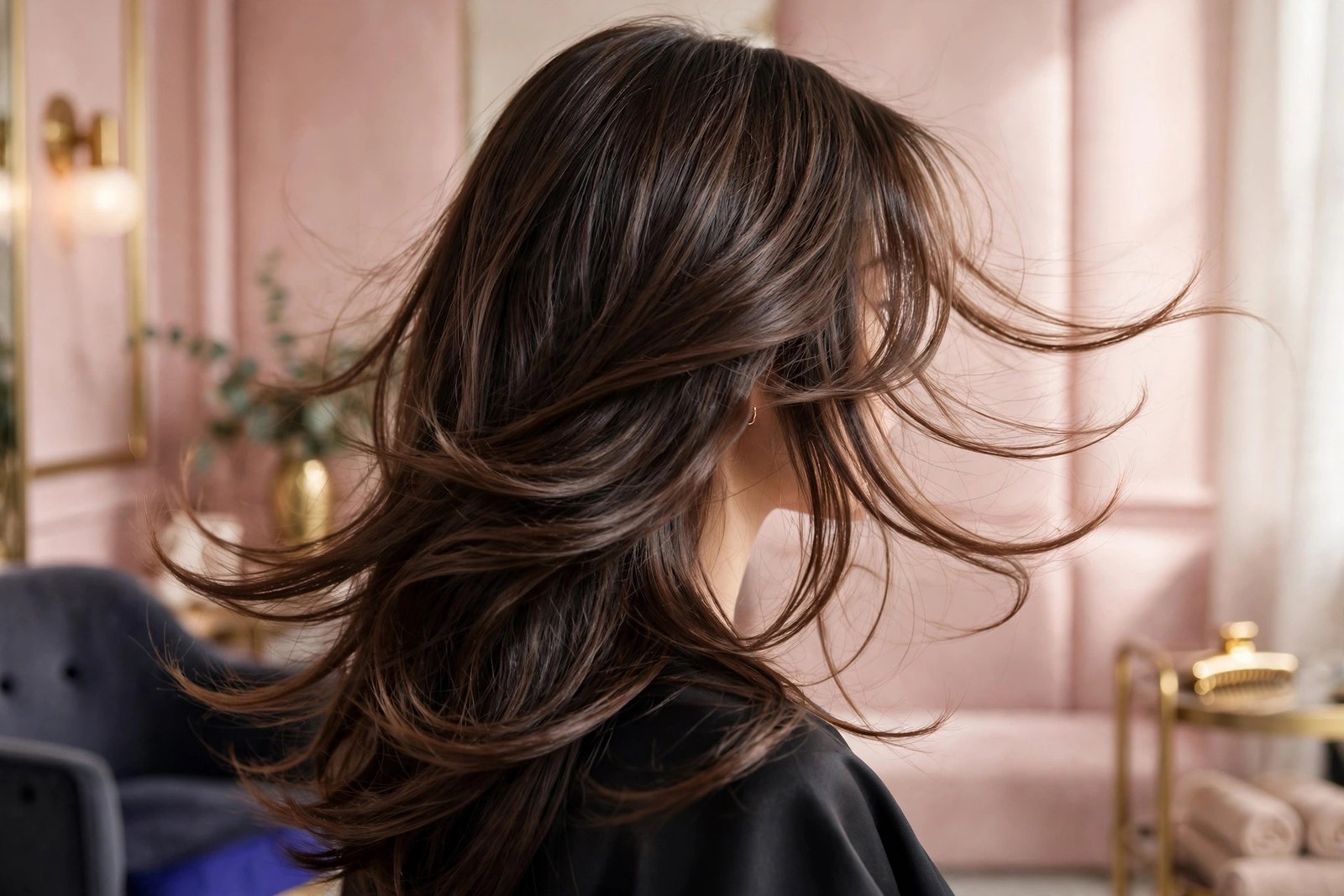
The viral butterfly haircut is essentially a layered cut with two distinct zones: shorter, bouncy layers around the crown and face, plus long layers through the ends. The genius of it for face shapes is adaptability — your stylist can place the shorter face-framing pieces wherever your shape needs them. Round faces benefit from longer butterfly layers that start below the chin; long faces suit shorter, cheekbone-grazing pieces that add width; square faces get softened with curved, jaw-skimming layers.
Bangs by Face Shape
Bangs change a face more than almost any other single decision. Here is how the main fringe types interact with different shapes.
Curtain bangs
The most universally flattering option. Curtain bangs — parted in the middle and swept to each side — frame the face diagonally, which slims round faces, adds width to long faces, and softens square jawlines. They grow out gracefully and work with nearly every length. Once you have them, here is how to style curtain bangs so they sit right.
Side-swept bangs
A diagonal fringe is slimming on round faces and softening on square ones. It draws attention to the eyes and cheekbones while breaking up a wide forehead on heart-shaped faces. Works best at medium to long lengths rather than short and choppy.
Straight-across bangs
Blunt, full bangs visually shorten a long face — this is the classic fix for oblong shapes. They can work on oval faces too. On round faces, heavy straight bangs can emphasize width, so a wispy or textured version is the safer play. On square faces, blunt bangs can reinforce angularity unless paired with soft, textured lengths.
Wispy and micro bangs
Wispy bangs are a lighter commitment that suits most shapes. Micro bangs (very short, above the brow) are the riskiest — they tend to flatter oval and heart faces most, and can look harsh on square or round faces unless the rest of the cut is very soft.
Bobs and Lobs by Face Shape
The bob
A chin-length bob adds fullness at the jawline, which makes it ideal for heart-shaped faces that need lower-face width. For square faces, the key is texture — a blunt bob hitting exactly at a strong jawline can look severe, but a tousled, layered bob with softened ends looks fantastic. Round faces should be careful with bobs that end at the cheek — that width-on-width placement is the least flattering option. A longer bob (lob) that clears the chin is the safer round-face choice.
The lob (long bob)
The lob — falling between the chin and collarbone — is the most face-shape-versatile cut in existence. It gives round faces the below-chin length they need, gives long faces a balanced mid-length, and gives square faces room for softening layers. When in doubt, the lob is rarely wrong.
The shag and wolf cut
Textured, heavily layered cuts like the shag add volume and movement. They suit long faces (width at the sides) and square faces (softening texture) especially well. On round faces, keep the layers long and avoid too much volume at the cheeks.
Length Guidelines: A Quick Reference
| Face shape | Most flattering lengths | Lengths to be careful with |
|---|---|---|
| Round | Below the chin to long; long layers | Chin-length bobs, cheek-grazing cuts |
| Long | Chin to shoulder; bangs + waves | Very long, pin-straight one-length hair |
| Square | Shoulder-length and longer; textured lobs | Blunt cuts ending exactly at the jawline |
| Oval | Nearly everything | Extremely long, flat one-length hair |
| Heart | Chin-length bobs, shoulder length | Excess crown volume, very short pixies with no fringe |
| Diamond | Chin-length bobs, layered medium cuts | Slicked-back styles that expose cheekbones fully |
These are guidelines, not rules. Hair texture, density, and personal style matter enormously — a thick-haired round face can carry a bob that a fine-haired round face cannot.
What to Tell Your Stylist
Walking in with face-shape language gets you a better cut than walking in with just a photo. Stylists recommend saying something like: “I have a round face, so I want length below the chin and layers that slim rather than widen — what would you suggest?” That gives them your goal plus room for professional judgment.
Bring reference photos, but choose photos of people with a similar face shape to yours — that is the detail most people skip. A curtain-bang photo on an oval-faced model will not tell your stylist how those bangs behave on a square face.
Ask three questions before the scissors come out:
1. “Where will the shortest layer sit on my face?” (Placement is everything.)
2. “How will this grow out over eight weeks?” (Good cuts grow out gracefully.)
3. “What does daily styling actually require?” (Honest answer prevents regret.)
Common Mistakes to Avoid
- Choosing by trend alone. The butterfly cut is gorgeous, but placed wrong for your shape it can add width exactly where you do not want it.
- Ignoring your part. A center part emphasizes symmetry and width; a side part slims and softens. Your part is free to change — use it.
- One-length cuts at the widest point. Wherever your face is widest (cheeks for round, jaw for square), avoid a blunt horizontal line ending exactly there.
- Forgetting texture. Fine hair and thick hair behave completely differently in the same cut. Tell your stylist your real texture and density.
- Skipping the grow-out plan. The most flattering cut on day one can become the least flattering by week six if the shape collapses. Ask for a cut with a good grow-out.
Frequently Asked Questions
How do I know my face shape for sure?
Measure four points — forehead, cheekbones, jawline, and face length — and compare the ratios as described above. If you are between shapes, most people are, and you should follow the guidance for whichever features you most want to balance. When in doubt, ask your stylist at your next appointment; they assess face shapes all day.
What is the most flattering haircut for all face shapes?
The lob (long bob) with soft layers is the closest thing to a universal cut — it clears the chin, which helps round faces; it is not so long it drags, which helps long faces; and it leaves room for softening layers, which helps square faces. Add curtain bangs and it suits nearly everyone.
Do bangs make your face look fatter or thinner?
It depends entirely on the type. Diagonal bangs — side-swept or curtain — tend to slim and elongate because of their diagonal lines. Heavy straight-across bangs can make a round face look wider. The direction of the lines matters more than the bangs themselves.
What haircut makes a round face look slimmer?
Long layers starting below the chin, a deep side part, and length that falls past the shoulders. Asymmetrical cuts and curtain bangs also create slimming diagonal lines.
What haircut makes a long face look shorter?
Curtain bangs or a soft fringe to visually shorten the forehead, waves or curls for side width, and chin-to-shoulder lengths. Avoid very long, straight, one-length hair.
Should I get layers or a blunt cut?
Layers add movement and can be placed to flatter your face shape; blunt cuts give a sleek, polished look but create strong horizontal lines. Round and square faces usually do better with layers or textured ends, while oval and long faces can carry blunt cuts well — long faces especially benefit from the width a blunt bob creates.
How often should I get a haircut to keep the shape?
Most cuts hold their face-flattering shape for 6–8 weeks. Bobs and bangs need trims every 4–6 weeks. Long layered cuts can stretch to 10–12 weeks if the grow-out was planned well.
The Bottom Line
Your face shape is the single most useful piece of information you can bring to a haircut decision. Measure once, learn what your shape needs — length for round faces, width for long faces, softness for square faces — and then choose the layers, bangs, and lengths that deliver it. Trends come and go, but bone structure is forever. Start with the shape-specific guides: flattering cuts for round faces, balanced cuts for long faces, and softening cuts for square faces — then bring your stylist a plan, not just a photo.
Love this? Pin it for later!