Thin, Fine Hair Volume Guide: Look Thicker Today
Thin, fine hair is one of the most common hair complaints — and one of the most misunderstood. First, the terminology: “fine” describes the diameter of each strand (thin strands), while “thin” describes density (fewer strands per square inch). You can have fine hair that’s dense, thick strands that are sparse, or — the most common frustration — fine strands and low density together. This guide covers all of it, because the volume strategies overlap heavily.
Here’s the reassuring truth: hair doesn’t need to be thick to look thick. With the right cut, the right products (used correctly), and a few styling techniques, fine hair can hold impressive, lasting volume. This is the complete guide — the science of why fine hair falls flat, the cuts that create the illusion of density, the product routine that works, the styling tricks that actually last past noon, and the camouflage fixes for visible scalp.
Key Takeaways
- Fine = strand diameter; thin = density. Different problems, overlapping solutions — this guide covers both.
- Fine hair falls flat because each strand has less structural support, not because you’re doing something wrong.
- The biggest volume wins come from cut (blunt ends, strategic layers), product discipline (less is more), and root-lift technique.
- Heavy products are the #1 volume killer — lightweight mousses, root sprays, and dry textures beat rich creams and oils.
- Scalp visibility has instant fixes: fibers, strategic parting, and root powders.
Why Fine Hair Falls Flat: The Science
Understanding the “why” makes every technique in this guide make sense. Each fine strand has less keratin mass than a coarse strand, which means less structural rigidity — fine hair simply can’t hold itself up against gravity as well. It also has a smaller surface area for styling products to grip, and it gets weighed down faster by its own natural oils, since sebum travels down fine, straight strands quickly.
Low density compounds the problem: fewer strands means each one carries more visual responsibility, and gaps between strands reveal scalp more easily. Density is largely genetic, but it can decrease with age, hormonal shifts, postpartum changes, and certain kinds of hair loss — if you’re noticing a real change in density rather than a lifelong trait, the guide to complete hair fall control helps distinguish normal shedding from something worth addressing.
The good news in all this: volume is mostly an illusion, and illusions are learnable. Every strategy below works by either increasing the space between strands, lifting at the root, or reducing the weight that pulls hair down.
The Haircut: Your Foundation for Volume
No product overcomes a bad cut for fine hair. The haircut is the single highest-leverage volume decision you make — it lasts months and affects every styling session.
What works
- Blunt ends: A clean, blunt perimeter makes ends look thicker because the hair ends at the same point, creating a solid line of density. Wispy, razor-thinned ends do the opposite.
- Strategic layers: Long layers through the mid-lengths and ends create movement and the appearance of fullness, but they must be minimal — over-layering removes the very weight that gives fine hair its shape. One to two long layers is usually the sweet spot.
- Shorter lengths: Shoulder-length and above almost always looks fuller on fine hair than very long lengths. Long fine hair pulls itself flat under its own weight. A lob or bob is the classic volume cut for a reason.
- Face-framing pieces: Shorter pieces around the face create the impression of fullness where people look most, and they add movement without thinning the overall shape.
- Curtain bangs or soft fringe: Adds density around the face and forehead, and gives styling something to work with at the front.
What to avoid
- Excessive thinning/texturizing: Removing bulk from fine hair is working against yourself. If a stylist reaches for thinning shears aggressively, that’s a red flag for fine hair.
- One-length very long hair with no layers: Reads as stringy and flat, especially on low-density hair.
- Heavy, blunt bangs on very fine hair: Can look sparse and separated rather than full — curtain bangs or a soft, piece-y fringe usually work better.
Ask your stylist specifically for “a cut that maximizes the appearance of density” and mention that you want minimal texturizing. The right words get the right cut.
The Product Routine: Less Is More
Fine hair is easily overwhelmed. The golden rule: lightweight formulas, applied sparingly, concentrated where they matter.
Shampoo and conditioner
- Shampoo twice on wash days: the first cleanse removes oil, the second actually cleans the scalp. Fine hair gets oily faster, and a clean scalp is the foundation of root lift.
- Conditioner on mid-lengths and ends only — never on the roots. Roots don’t need conditioning; they need lift, and conditioner at the roots is a direct volume killer.
- Consider a volumizing shampoo with lightweight cleansing agents, but don’t expect miracles from shampoo alone — the real volume work happens in styling products.
- For a full rundown of the best lightweight options, see the best volumizing products for fine hair.
Leave-in and pre-styling
If you use leave-in conditioner, use a spray or a pea-sized amount of a lightweight formula, mid-lengths to ends only. Heavy leave-ins and oils near the roots flatten everything before styling even starts. Heat protectant is still non-negotiable before hot tools — choose a lightweight spray formula.
The styling products that actually create volume
Listed in order of impact:
- Mousse: The #1 volume product for fine hair. Applied to damp roots, it gives each strand grip and body. Use a golf-ball-sized amount for medium hair, less for short hair — and apply it to the roots, not the ends.
- Root-lifting spray: Applied directly to damp roots before blow-drying, these create targeted lift exactly where flatness starts.
- Texturizing/dry texture spray: Applied to dry hair, these add grip and separation between strands, making hair look fuller. The modern secret weapon for fine hair.
- Volumizing powder: A pinch at the roots on dry hair creates instant lift and absorbs oil. Excellent for second-day volume refreshes.
- Lightweight hairspray: A flexible-hold spray locks in volume without the helmet effect. Heavy, sticky sprays defeat the purpose.
Products to avoid (or use with extreme caution)
- Heavy oils and butters near the roots
- Rich, creamy leave-in conditioners in large amounts
- Silicone-heavy serums (a tiny amount on ends only is fine)
- “Smoothing” or “anti-frizz” products marketed for thick hair — they’re designed to weigh hair down, which is the opposite of what fine hair needs
Blow-Drying for Volume: The Technique That Matters Most
Product without technique gives you 20% of the possible result. Blow-drying is where fine hair volume is actually built — it sets the direction and lift that products alone can’t create.
The volume blow-dry, step by step
- Rough-dry to 70–80% dry with your head flipped upside down. This builds foundational lift at the roots before any brush touches the hair.
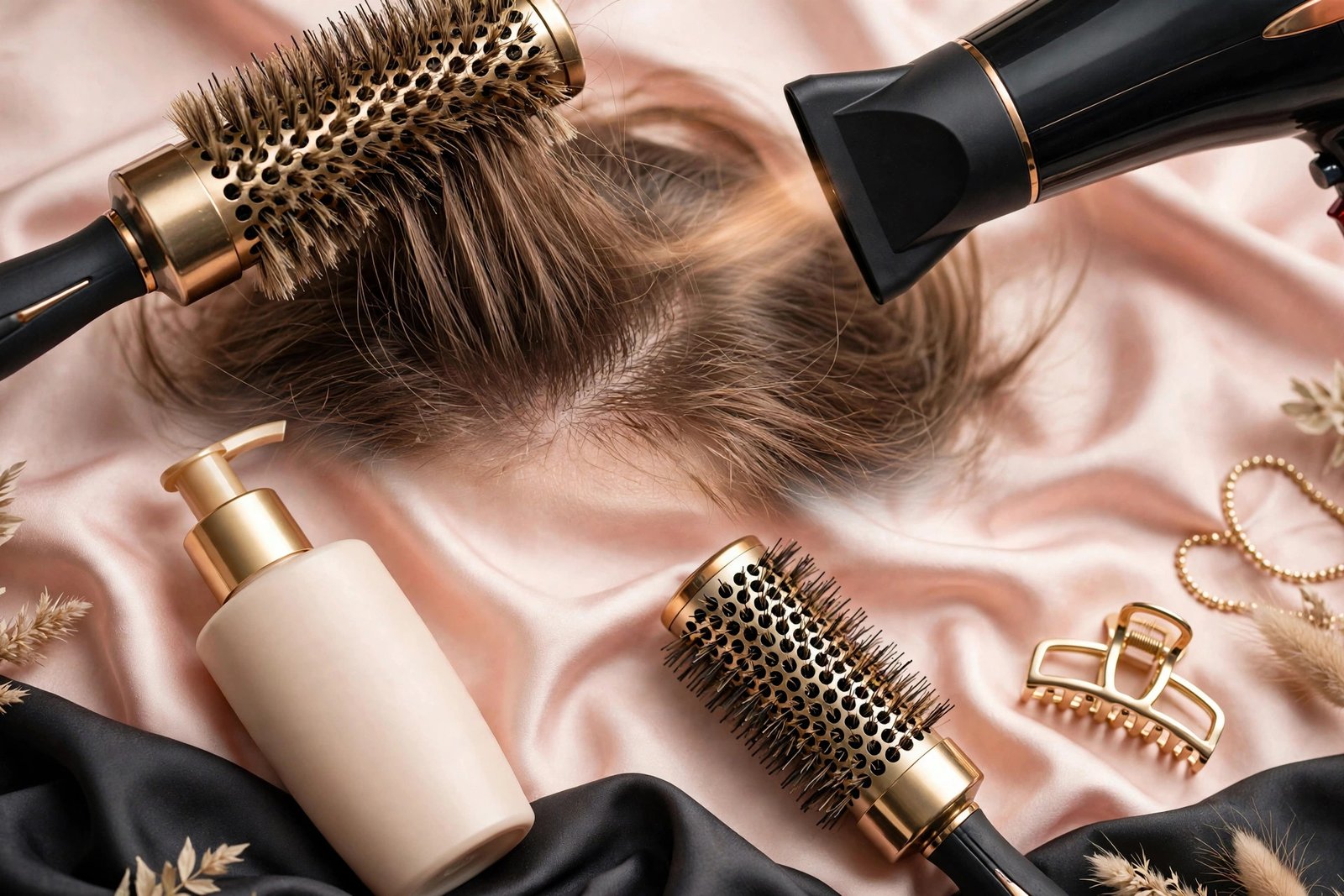
- Section and lift: Work in sections, directing each section up and away from the scalp with a round brush or your fingers. The key is drying the roots in the opposite direction of how they’ll fall — this “overdirection” is what creates lasting lift.
- Cool shot to set: Once a section is dry and lifted, hit it with the cool shot button for 5–10 seconds. Heat shapes, cool sets. Skipping the cool shot is why volume collapses by lunchtime.
- Finish with the head flipped for the final cool-down, then flip back and arrange.
Tools and settings
- A blow dryer with a nozzle attachment concentrates airflow for better root control.
- Medium heat, high speed is better than max heat — fine hair is more heat-sensitive, and scorching it doesn’t add volume.
- A large round brush (for longer hair) or a vented brush (for shorter hair) works; the technique matters more than the brush.
For the full collection of daily styling tricks beyond the blow-dry — overnight methods, part-switching, roller sets, and more — 11 tricks to add volume to fine hair goes deeper.
Everyday Volume Tricks That Last Past Noon
The blow-dry builds volume; these habits keep it alive through the day:
| Trick | How it works | Best for |
|---|---|---|
| Switch your part | Hair trained in one part lies flat; flipping it creates instant lift at the root | Second-day hair, quick refresh |
| Dry shampoo at the roots (night before) | Applied before bed, it absorbs oil overnight so you wake up with grip and lift | Oily scalps, extending wash day |
| Velcro rollers at the crown | 10–15 minutes on dry hair while you do makeup | Special events, extra crown height |
| Teasing (done gently) | Backcombing 2–3 strokes at the root of crown sections | Updos, dramatic volume |
| Sleeping in a loose top bun | Preserves root lift overnight | Next-day volume |
| Root powder touch-up | Midday lift without rewashing | Office/afternoon refresh |
The part-switch trick deserves emphasis: most people part their hair the same way for years, and the roots “learn” to lie flat in that direction. Simply switching your part to the other side — or from middle to side — creates immediate, visible lift. It costs nothing and takes five seconds.
Teasing, done right: Use a fine-tooth comb, take small sections at the crown, and backcomb only the bottom 2–3 strokes near the root — never the visible top layer. Smooth the top layer over the teased sections. Done gently, it doesn’t damage hair; done aggressively and daily, it can cause breakage in fine strands.
Coloring Fine Hair for the Illusion of Thickness
Color is an underused volume tool. Strategic color creates visual depth that reads as density:
- Dimensional color (highlights/lowlights): Multiple tones create the illusion of depth and fullness. Flat, single-process color on fine hair can look one-dimensional and therefore thinner.
- Root shadow or lived-in color: A slightly deeper root with lighter ends makes the root area look denser — this is why balayage and root melts flatter fine hair so well.
- Avoid going too dark all over: Very dark single-process color on fine, low-density hair can increase scalp contrast and make sparseness more visible. Dimension is the fix.
Scalp Visibility: Instant Fixes
Seeing scalp through your hair — at the part, the crown, or the hairline — is the most distressing part of thin hair for many people. The fixes range from 30-second tricks to longer-term strategies.
Immediate (today):
– Hair fibers: Keratin-based fibers cling to existing strands via static and instantly make hair look denser. They wash out with shampoo and are undetectable when matched to your color. The honest guide to hair thickening fibers covers how they work, application tricks, and their limits.
– Strategic parting: A zigzag part breaks up the straight line where scalp shows most. A deep side part covers thinning at the crown better than a middle part.
– Root touch-up powder or eyeshadow: A powder matching your hair color pressed along the part line camouflages scalp instantly. This is the same trick used in photo shoots.
– Hairstyle choice: Loose waves and texture disguise scalp far better than sleek, straight styles. Updos with pulled-out face-framing pieces also hide thinning at the hairline.
Longer-term:
– Addressing actual hair fall with targeted strategies if density is decreasing rather than stable.
– Scalp care: a healthy scalp supports the hair you have. Gentle exfoliation and avoiding heavy buildup at the follicle help existing strands look their best.
– Professional options (PRP, minoxidil, etc.) exist for diagnosed thinning — worth discussing with a dermatologist if the change is significant.
For the complete set of camouflage techniques, 7 instant fixes to hide scalp visibility walks through each method in detail.
The Habits That Quietly Kill Volume
Some of these are counterintuitive:
- Washing with heavy, “moisturizing” shampoo marketed for dry/thick hair — fine hair needs lightweight cleansing, not extra oils.
- Conditioning the roots — mentioned above, worth repeating: roots need lift, not moisture.
- Too much product — three lightweight products beat one heavy one. Layer thin.
- Touching your hair all day — hands transfer oil directly to strands, and oil is the enemy of volume.
- Sleeping on cotton pillowcases — friction flattens and tangles; silk or satin preserves style and reduces breakage.
- Skipping regular trims — fine hair shows split ends faster, and damaged ends look thinner. Every 8–10 weeks keeps ends solid.
- Air-drying completely flat — if you air-dry, at least flip your part or clip roots up while drying so they don’t set flat against the scalp.
Fine Hair vs. Thinning Hair: Know Which You Have
This distinction changes the strategy. Lifelong fine hair is a hair type — you manage it with the cut, product, and styling techniques in this guide. Actively thinning hair is a change — and it deserves investigation.
Signs it’s thinning rather than just fine: more shedding than your normal (consistently over ~100 hairs/day), a widening part, visible scalp where there wasn’t any before, or a ponytail that measures noticeably smaller than it used to. The causes range from temporary (postpartum, stress, seasonal shedding, nutritional gaps) to ongoing (hormonal, genetic, medical). The guide to complete hair fall control helps you identify which category you’re in and what to do about each.
Building Your Volume Routine: A Sample Day
Wash day (2–3x per week):
– Double shampoo, lightweight formula
– Conditioner mid-lengths to ends only, rinse thoroughly
– Pea-sized lightweight leave-in on ends if needed
– Mousse on damp roots + root-lifting spray
– Upside-down rough dry, then sectioned overdirected blow-dry with cool shot
– Light dry texture spray, flexible hairspray to set
Non-wash days:
– Dry shampoo at roots (or volumizing powder)
– Flip part or refresh crown with fingers + cool dryer air
– Root powder touch-up if needed
Weekly:
– Clarifying wash if you use a lot of styling product (follow with deep conditioner on ends)
– Scalp exfoliation or scrub to keep follicles clear
Frequently Asked Questions
Can fine hair ever look thick?
Yes — “looking thick” and “being thick” are different things. Blunt cuts, dimensional color, root-lift technique, and texture products create a convincing illusion of density that holds up in real life, not just photos — the blow-dry and daily-tricks sections above are all proven in daily wear.
What’s the best haircut for thin, fine hair?
A blunt bob or lob with minimal long layers is the highest-impact choice — blunt ends read as density, and shorter lengths don’t pull themselves flat. Your stylist should avoid heavy texturizing. Face-framing layers and curtain bangs add fullness where it counts.
Why does my fine hair go flat by afternoon?
Usually a combination of oil traveling down the strands, product that’s too heavy, and roots that were dried flat. The fixes: dry shampoo or volumizing powder at the roots in the morning, a proper overdirected blow-dry with a cool shot to set, and switching your part. Touching your hair during the day accelerates the collapse.
Do volumizing products actually work, or is it marketing?
They work, but with realistic expectations — they create the appearance and feel of more body; they don’t grow new hair. Mousse and root-lifting sprays have the most visible effect because they change how each strand behaves. For honest product recommendations, the best volumizing products for fine hair reviews lightweight options that won’t weigh hair down.
Should I wash fine hair every day?
Most fine-haired people do better washing every other day or 2–3 times per week, using dry shampoo or volumizing powder between washes. Daily washing is fine if your scalp truly needs it — just use lightweight products and never skip the root-lift styling step, since air-dried fine hair sets flat.
Are hair thickening fibers noticeable or messy?
When matched to your hair color and applied to dry hair, quality fibers are essentially undetectable — they bind to existing strands and just look like more hair. They can transfer slightly in heavy rain or sweat, and they wash out with normal shampooing.
Will layers make my fine hair look thinner?
Too many layers, yes — over-layering removes the weight that gives fine hair shape. But one or two long layers add movement and the appearance of fullness without sacrificing density. The key word with your stylist is “minimal” layering, and no aggressive thinning or texturizing.
Conclusion
Thin, fine hair isn’t a flaw to fix — it’s a hair type to work with. The formula is straightforward: a density-maximizing cut with blunt ends and minimal layers, a disciplined lightweight product routine, a proper root-lift blow-dry, and a few daily tricks to keep volume alive past noon. Add dimensional color and scalp-camouflage techniques where needed, and address actual hair fall separately if density is changing. None of this requires expensive products or salon visits every two weeks — it requires the right techniques, applied consistently. Start with the cut and the blow-dry; those two changes alone transform how fine hair looks, starting today.
Love this? Pin it for later!