Eyeliner for Glasses Wearers: Styles That Stand Out
Eyeliner is the fastest way to define your eyes — unless you wear glasses, in which case it sometimes feels like your carefully drawn line vanishes the moment your frames go on. Lenses magnify or shrink your eyes depending on your prescription, frames visually crop your eye area, and liner that looks bold in the mirror can read as barely-there behind glass. But this isn’t a reason to skip eyeliner; it’s a reason to adjust your approach. With the right thickness, placement, and formula for your frames, eyeliner becomes the single most impactful step in a glasses wearer’s routine.
Key Takeaways
- Match your liner thickness to your frame size: bold frames need bolder liner, thin frames need a lighter touch.
- Minus (nearsighted) prescriptions shrink the eyes behind lenses — go slightly thicker and darker than feels natural.
- Plus (farsighted) prescriptions magnify the eyes — keep liner precise and clean, since every wobble shows.
- Waterproof and smudge-proof formulas are essential near the frames; pencil smudges transfer to lenses fastest.
- Winged liner, tightlining, and bold graphic lines are the most glasses-friendly styles; thin, pale liner disappears.
How Glasses Change Your Eyeliner
Before choosing a style, it helps to understand the three ways glasses alter how eyeliner reads.
Prescription distortion
Concave lenses (for nearsightedness) make eyes look smaller, which means your eyeliner shrinks too — a medium line can look thin and timid. Convex lenses (for farsightedness) magnify the eyes, making liner look thicker and every imperfection more visible. Knowing your prescription direction tells you whether to scale your liner up or refine it down.
Frame cropping
Frames act like a picture frame around your eye area, and thick, dark frames visually “eat” some of the definition around your eyes. Your eyeliner is competing with the frame itself for visual attention. This is why the same liner look can seem bold without glasses and washed-out with them — the frame is absorbing some of the impact.
Distance and glass
There’s simply a layer of glass between your eyes and the viewer, which softens and slightly dims everything. Subtle makeup gets muted; deliberate, defined makeup survives. The guiding principle for glasses wearers: go a touch bolder than you think you need.
For the bigger picture of adapting your whole eye look to frames, the complete makeup guide for glasses wearers covers how liner, shadow, and mascara work together behind lenses.
Matching Liner Thickness to Your Frames
This is the core skill of eyeliner for glasses wearers. A simple rule: your liner should roughly match the visual weight of your frames.
- Bold, thick frames: Go bold with your liner. A thick wing, a smoky diffused line, or a strong graphic shape holds its own against heavy frames. Thin liner disappears next to chunky acetate.
- Medium frames: A classic medium wing or a defined tightline-plus-liner combo hits the sweet spot.
- Thin wire or rimless frames: Lighter liner works here — a precise thin wing or a soft tightline. But “lighter” doesn’t mean invisible; you still need enough definition to read through the glass.
Frame color matters too. Black and tortoiseshell frames pair naturally with black or deep brown liner. Colored frames (blues, reds, jewel tones) look striking with liner in a complementary or matching tone — a navy liner with blue frames, for instance, creates a cohesive, intentional look.
The Best Eyeliner Styles for Glasses Wearers
The classic wing (slightly thicker than usual)
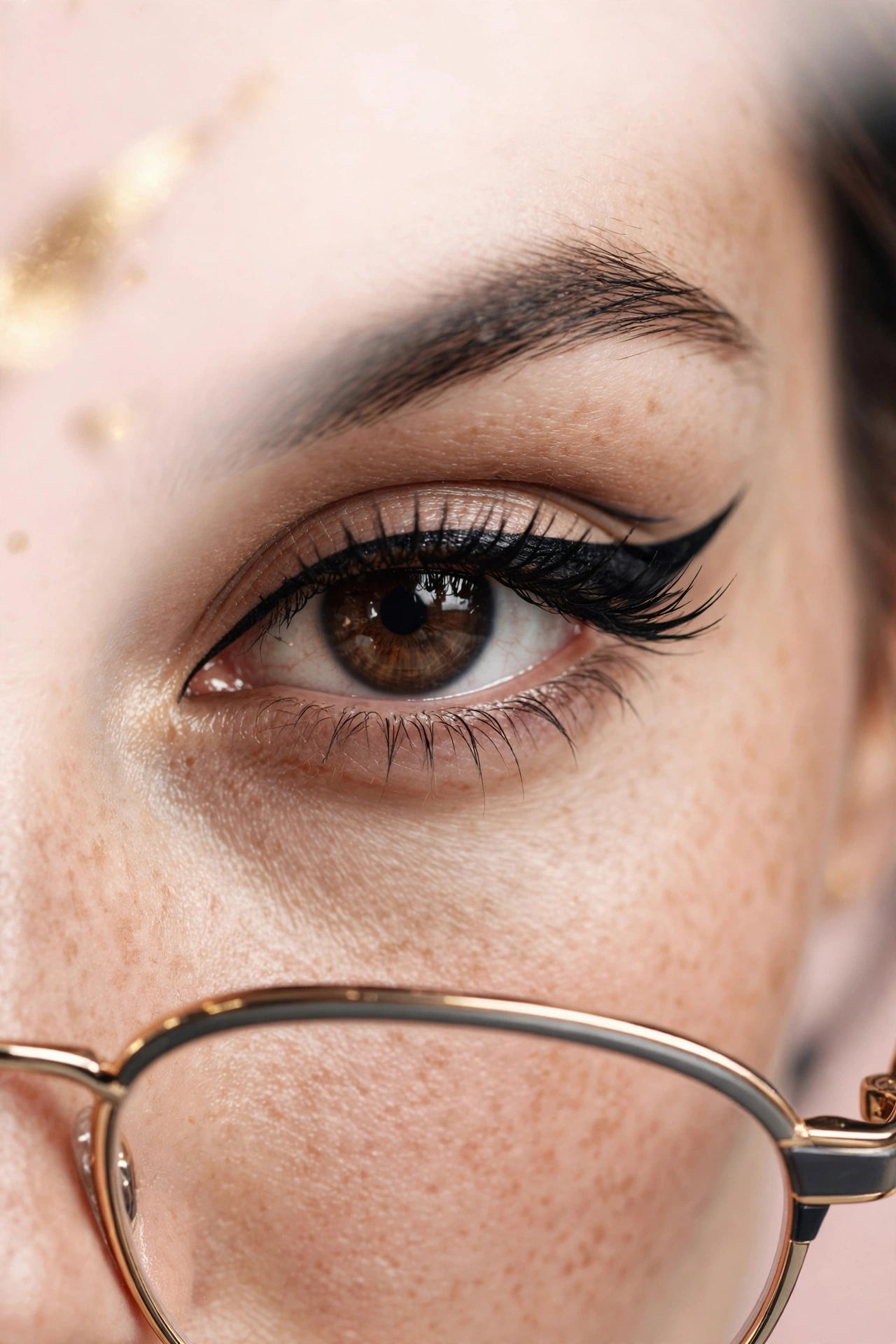
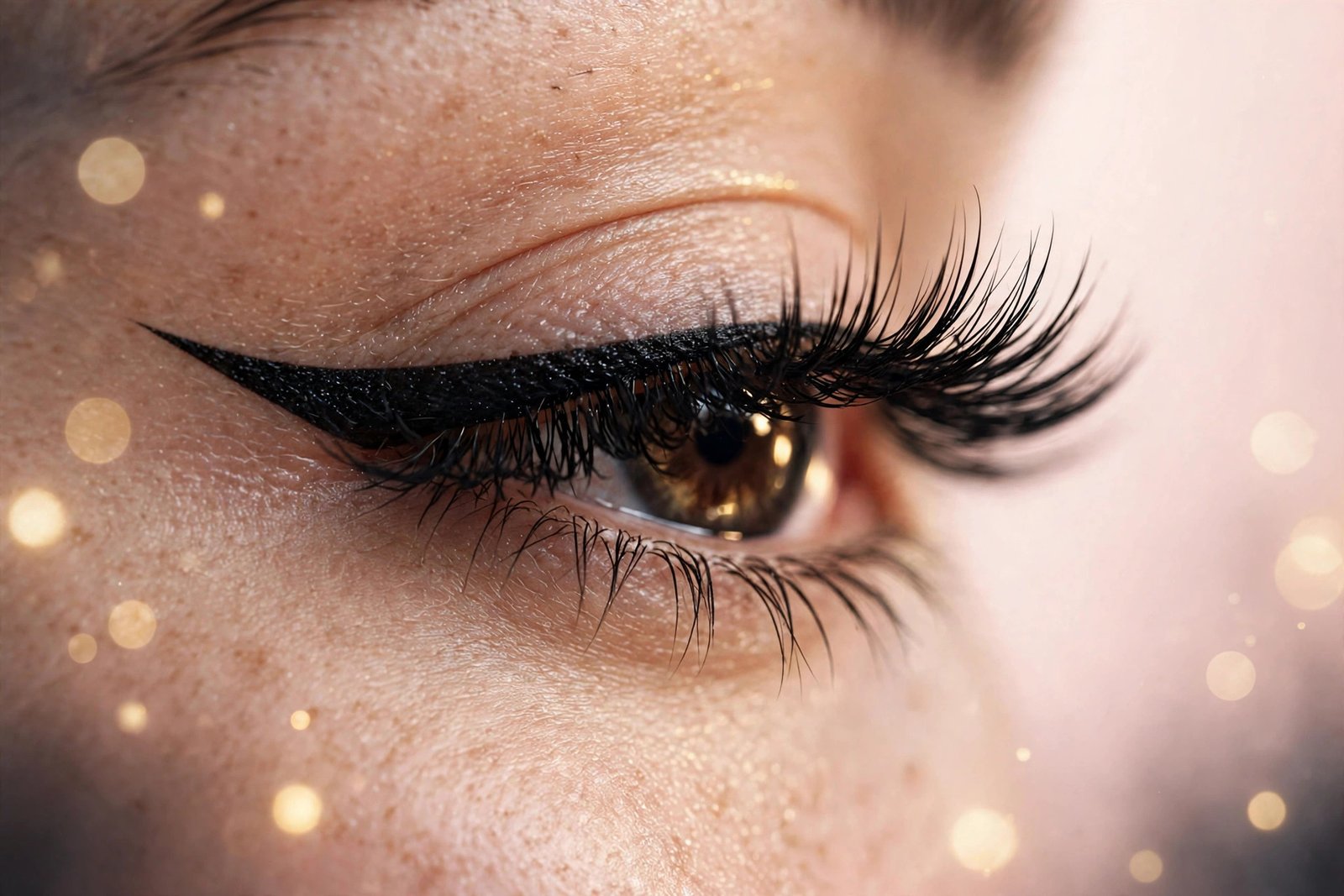
The wing is the glasses wearer’s best friend. Its upward flick extends beyond the frame’s lower edge, creating definition that reads clearly even through lenses. The key adjustment: draw it slightly thicker and longer than you would without glasses. What looks dramatic in the hand mirror reads as “just right” once the frames go on. If you’re new to wings, the beginner’s guide to applying winged eyeliner breaks the technique into manageable steps.
Tightlining
Tightlining — lining the upper waterline and the base of the lashes — creates the illusion of thicker, darker lashes without a visible line that competes with your frames. It’s the most glasses-proof eyeliner technique there is: nothing sits on the lid to smudge, transfer, or get visually swallowed by the frame. For minimalist looks or small frames, tightlining alone is often enough.
Bold graphic liner
If you wear statement frames, lean into the drama. Graphic liner — bold shapes, double wings, floating crease lines — turns your eye makeup into a deliberate style choice that plays with the frames rather than hiding behind them. Because graphic liner is intentionally bold, it survives prescription distortion and frame cropping better than any subtle look.
Smoky, diffused liner
A smudged, smoky line along the upper lashes gives definition with a softer edge — flattering for everyday wear and forgiving for shaky hands, since there’s no crisp edge to perfect. Smoky liner also photographs beautifully through lenses. Just be sure to set it well (more on that below), because diffused edges are the first to migrate in heat.
The lower-lash accent
A touch of liner on the outer third of the lower lash line opens up the eyes and balances a strong upper line. Keep it to the outer corner and blend well — full lower liner can look heavy behind glasses, especially with magnifying prescriptions. A waterproof pencil or a shadow applied with an angled brush works best here, since the lower lash line is a high-smudge zone.
Smudge-Proof Formulas: What Actually Lasts
Eyeliner near glasses faces the same enemies as the rest of your eye makeup: oil, humidity, blinking against lenses, and fingers adjusting frames. Formula choice is what separates liner that lasts from liner that migrates.
- Waterproof liquid liners are the gold standard for wings and defined lines. The film-forming formula locks in place and resists the oil and moisture that cause transfer.
- Gel liners in pots, set with a matching eyeshadow, offer the intensity of liquid with a softer finish — excellent for smoky looks.
- Waterproof pencils work for tightlining and the waterline, where liquids can’t go. Look for ones specifically labeled waterproof or long-wear, not just “soft” or “creamy.”
- Eyeshadow as liner (applied damp with an angled brush) gives the softest look and essentially zero transfer risk, since powder can’t smudge the way cream can.
Whatever formula you choose, set it: a light dusting of translucent powder over the liner, or a matching eyeshadow pressed on top, dramatically extends wear. And avoid traditional creamy kohl pencils on the upper lid — they’re the fastest to smudge and the most likely to end up on your lenses.
Pair your liner with a complementary eye look using the guide to eyeshadow colors and techniques for glasses wearers, which covers how to keep shadow from creasing behind frames.
Prescription-Specific Adjustments
Nearsighted (minus) prescriptions: scale up
Your eyes look smaller behind the lenses, so your liner needs to work harder. Go one step thicker and darker than your instinct suggests — a medium wing instead of a thin one, black instead of brown. Focus definition on the outer corners and the lash line, where it has the most visual impact. Avoid very thin, precise lines; they shrink into near-invisibility.
Farsighted (plus) prescriptions: refine and clean up
Your eyes are magnified, so every detail shows — including wobbles, uneven thickness, and smudges. Precision matters more than boldness here. Use a fine-tipped liquid liner, keep lines clean and even, and always clean up edges with a cotton swab and micellar water. Because the magnification does some of the work for you, you can go slightly thinner than a nearsighted wearer would.
Astigmatism and progressive lenses
These prescriptions can distort at the edges of the lens, which sometimes makes the outer corners of eyeliner look slightly warped to an observer. The fix is simple: keep the most precise part of your liner (the wing tip, the inner corner) toward the center of the lens, and let the outer edges be a little softer and more diffused.
Common Mistakes to Avoid
- Liner that’s too thin for your frames. The number one issue. If your liner disappears when your glasses go on, it’s not the wrong style — it’s the wrong scale.
- Skipping the set step. Unset liner migrates, especially on oily lids or in humidity. Powder or shadow over the top takes five seconds.
- Waterline liner that runs. Lower waterline liner is the fastest-fading eyeliner placement there is, and behind glasses the smudging shows on the lenses too. If you love the look, use a truly waterproof formula and accept that it needs a midday check.
- Matching liner exactly to frame color. Complementary is better than identical — navy liner with black frames, bronze with tortoiseshell. Exact matches can look flat.
- Forgetting the gap. Leave a tiny bit of space between a thick liner line and very thick frames; liner that visually merges with the frame edge can make eyes look smaller rather than more defined.
Frequently Asked Questions
What eyeliner is best for glasses wearers?
Waterproof liquid liner for defined looks, waterproof pencil for tightlining, and gel liner for smoky styles. The common thread is water-resistance: anything that resists oil and moisture will resist the smudging that glasses and blinking cause. Avoid traditional creamy kohls on the upper lids.
Should eyeliner be thicker if I wear glasses?
Generally, yes — slightly. The glass layer, frame cropping, and (for nearsighted wearers) prescription shrinkage all mute your liner’s impact. Going one step bolder than your no-glasses instinct usually lands in the right place. Rimless and thin-frame wearers can stay closer to their natural preference.
How do I stop my eyeliner from smudging onto my glasses?
Use waterproof formulas, set liner with powder or matching shadow, keep the lash line oil-free with primer, and avoid heavy lower-lash liner near the bottom rim of your frames. If transfer persists, the culprit is often oily lids — an eyeshadow primer on the lids solves most smudging at the source.
Does winged eyeliner look good with glasses?
It looks excellent — it’s arguably the most glasses-friendly liner style. The wing extends definition beyond the frame edge and reads clearly through lenses. Just draw it slightly thicker and longer than you would without glasses, since frames and glass soften its impact.
Can I wear colorful eyeliner with glasses?
Absolutely, and it can look stunning. Colored liner that complements your frame color (navy with blue frames, plum with tortoiseshell, emerald with gold frames) creates a cohesive, fashion-forward look. Keep the application precise — color draws attention, so clean lines matter even more.
Conclusion
Eyeliner for glasses wearers isn’t about different rules — it’s about scaling the rules you already know. Match your liner’s boldness to your frames, adjust for your prescription direction, choose smudge-proof formulas, and always set your work. Do that, and your eyeliner stops disappearing behind your glasses and starts doing what it’s meant to do: define your eyes, frame your gaze, and pull your whole look together. Your glasses are an accessory; your eyeliner should be one too — make them work as a pair instead of competing with each other.
Love this? Pin it for later!