Going Gray Gracefully: The Gray Hair Transition Guide
At some point, many people look at their color appointment calendar — every three weeks, forever — and wonder what life looks like on the other side of the dye bottle. Going gray is having a genuine cultural moment: silver hair is celebrated on runways and social feeds, and more people than ever are choosing to grow out their natural color. But “just stop dyeing” is easier said than done. The transition involves months of two-toned hair, texture changes you didn’t expect, and a learning curve around products. This guide walks through the whole journey honestly: the decision, the methods, the awkward middle stage, and how to care for the silver once it arrives. If you’re still weighing whether to keep coloring, the pillar guide to covering gray at home pillar lays out every alternative.

Key Takeaways
- Going gray is a 6–18 month process depending on hair length and method — patience is the main requirement.
- The main transition methods are cold-turkey grow-out, the big chop, salon blending, and gradual demi-permanent fading.
- The “awkward stage” (a visible line between dyed hair and gray roots) is the hardest part, but styling tricks and blending can disguise it.
- Gray hair has a different texture — often coarser and drier — so your product routine will need to change.
- Purple/silver shampoo, deep conditioning, and shine products are the core toolkit for beautiful gray.
- Blending with highlights is the most graceful bridge between dyed hair and natural silver.
First: Is Going Gray Right for You?
Before committing, it’s worth being honest with yourself about motivations and expectations. Good reasons to go gray: you’re tired of the maintenance treadmill, you like how your natural silver looks, you want to reduce chemical exposure, or you’re simply curious. Less reliable reasons: a bad salon experience (fixable), a temporary budget crunch (the transition still costs money in cuts and products), or pressure from someone else.
Consider the practical factors:
- Your gray pattern. Some people grow in a striking silver-white; others get a salt-and-pepper mix; some get yellowish or dull gray that needs more product support to look good. You won’t fully know until several inches grow in.
- Your hair length. Shoulder-length or longer hair means a longer transition (12–18 months for full grow-out). Short hair can transition in 6–9 months, and pixie cuts in as little as 3–4.
- Your lifestyle. If your work or social life makes you self-conscious about two-toned hair, plan a blending strategy rather than going cold turkey.
- Your skin tone. Contrary to the myth that gray washes everyone out, most skin tones look great with silver — but you may need to adjust makeup (slightly deeper blush, defined brows) as your hair lightens. Gray hair is a frame change, not a flaw.
There’s no wrong answer. Some people transition and love it; others try it for six months and go back to color with zero shame. Both are valid. The goal is an informed choice, not a moral one.
The Main Transition Methods
Method 1: Cold turkey (just grow it out)
The simplest method: stop coloring and let nature take over. It costs nothing and involves zero chemicals. The catch is the demarcation line — a sharp boundary between dyed lengths and gray roots that travels downward for months. On long hair, you’ll see two distinct colors for a year or more.
Best for: Patient people, those on a tight budget, and anyone whose dyed color is already close to their natural gray (light browns and blondes transition far more gracefully than dark dye).
Survival tips: Strategic partings, headbands, hats, and root-blending products disguise the line. Regular trims gradually remove dyed lengths, shortening the timeline.
Method 2: The big chop
Cut off the dyed hair — sometimes all at once into a pixie or bob, sometimes in stages. It’s the fastest route to 100% natural gray: one dramatic haircut can erase years of dye in an afternoon.
Best for: People ready for short hair, those with significant damage from years of dye, and anyone who wants the transition over quickly.
The reality check: A pixie is a big aesthetic change beyond just the color. Make sure you actually want short hair, not just fast results. A staged approach — cutting to a bob, then shorter every few months — is a gentler version.
Method 3: Salon blending with highlights
The most graceful method, and the one colorists recommend most often. As described in the guide to blending gray with highlights, the colorist weaves silver and ash tones through the dyed lengths so the growing gray roots melt into the pattern instead of clashing with it. Over 2–4 appointments, the dyed color is progressively lifted and blended until the line disappears.
Best for: People who want to look polished throughout the transition, those with long hair, and anyone whose dyed color is dramatically darker than their natural gray.
Cost note: This is the most expensive method upfront — several highlight appointments — but many find it worth every penny for skipping the awkward stage entirely.
Method 4: Gradual fading with demi-permanent color
Instead of permanent dye (which creates a hard regrowth line), switch to demi-permanent color in a shade close to your natural gray. Demi-permanent fades gradually over 4–6 weeks rather than growing out with a line, so each application softens the boundary a little more. Over several months, the dyed lengths fade toward your natural tone.
Best for: A middle path between cold turkey and salon blending — lower cost than full highlight blending, more graceful than an abrupt stop.
Method 5: The “gray blending” toner approach
Some colorists apply an all-over silver or gray toner to the dyed lengths, shifting them toward the incoming gray tone. It doesn’t remove the dye, but it narrows the contrast so the grow-out looks intentional. This works best when the dyed color is medium brown or lighter; very dark dye won’t shift enough with toner alone.
Surviving the Awkward Stage
Whatever method you choose (except the big chop), there will be weeks or months where your hair is visibly two-toned. This is the phase where most people quit — so plan for it:
- Change your part. A deep side part or zigzag part breaks up the demarcation line visually.
- Texture is your friend. Curls, waves, and volume disguise color boundaries far better than sleek straight styles. A wavy blowout or heatless curls can make two-toned hair look deliberately dimensional.
- Root-blending products. A silver-toned root powder along the demarcation line softens the contrast on days you need it. The roundup of root touch-up products covers options that work for this.
- Accessories. Headbands, scarves, hats, and clips aren’t surrender — they’re strategy.
- Frequent trims. Every 8–10 weeks, take off as much dyed length as you can tolerate. Each trim shortens the timeline.
- Document it. Photos every month help on days you feel stuck — you’ll see progress your mirror doesn’t show.
The awkward stage typically lasts 3–6 months for short hair and 6–12 months for long hair. Knowing the timeline in advance makes it bearable; most people who quit do so because they expected it to be over sooner.
Products That Ease the Transition
Your product shelf will change during the transition because you’re essentially caring for two different heads of hair at once:
- Purple or silver shampoo. The single most important product. Both natural gray and fading dye can turn yellow or brassy; a purple shampoo used 1–2 times weekly keeps tones cool and bright. This applies whether you’re avoiding dye entirely — see covering gray without dye for the full no-dye toolkit.
- Deep conditioning mask, weekly. Gray hair is naturally drier and coarser, and dyed lengths are chemically stressed. A weekly mask keeps both textures manageable.
- Leave-in conditioner. Daily moisture is the difference between soft silver and wiry gray. Gray hair’s raised cuticle loses moisture fast.
- Shine serum or oil. Gray hair scatters light differently and can look dull. A lightweight silicone serum or argan oil smooths the cuticle and adds the reflective shine that makes silver look luminous instead of flat.
- Heat protectant. Non-negotiable if you heat-style, since both gray and transitioning hair are more damage-prone.
- Clarifying shampoo, monthly. Product buildup dulls gray faster than pigmented hair. A monthly clarifying wash resets everything — just follow with a deep conditioner.
Caring for Gray Hair Once It’s Grown Out
Congratulations — the dye is gone. Now the real relationship with your silver begins, because natural gray has needs that pigmented hair doesn’t:
Fight the yellow
Gray hair yellows from sun exposure, heat styling, hard-water minerals, and even some products. Beyond purple shampoo, consider a shower filter if your water is hard, wear a hat in strong sun, and keep heat tools at moderate temperatures. If yellowing persists, a salon silver gloss every couple of months resets the tone.
Moisture, moisture, moisture
Gray hair produces less natural oil and has a coarser cuticle, which is why it often feels wiry or dry. This isn’t damage — it’s structure. The fix is consistent moisture: hydrating shampoo, rich conditioner every wash, leave-in daily, and a weekly mask. If dryness is extreme, the guide to dry brittle hair causes covers the underlying causes and fixes in depth.
Embrace (or manage) the texture change
Many people find their gray grows in with a different texture — curlier, coarser, or more wiry than their pigmented hair was. This is normal: the follicle changes as pigment production stops. Work with it rather than fighting it daily. If your hair turned wavy, learn wavy styling; if it’s coarser, richer products. Constant flat-ironing of resistant gray just creates damage and frustration.
Get the right haircut
Gray hair shows shape more honestly than dyed hair — there’s no color dimension to hide behind. A great cut matters more now: layers for movement, blunt ends for thickness, or whatever suits your texture. Many people find they need trims slightly more often, since gray ends can look frayed faster.
Styling Your Silver
Gray hair is a statement — style it like one:
- Shine is everything. The difference between “stunning silver” and “washed out” is almost always shine. Gloss treatments, shine sprays, and smooth blowouts make gray look intentional and expensive.
- Contrast with your wardrobe. Silver hair pops against rich colors — jewel tones, black, navy, deep red. All-beige outfits can wash out against gray hair; bolder colors create the contrast that makes silver striking.
- Update your makeup. As hair lightens, features can look less defined. Slightly stronger brows, a bit more blush, and a lip color with some pigment keep your face from disappearing next to bright silver hair.
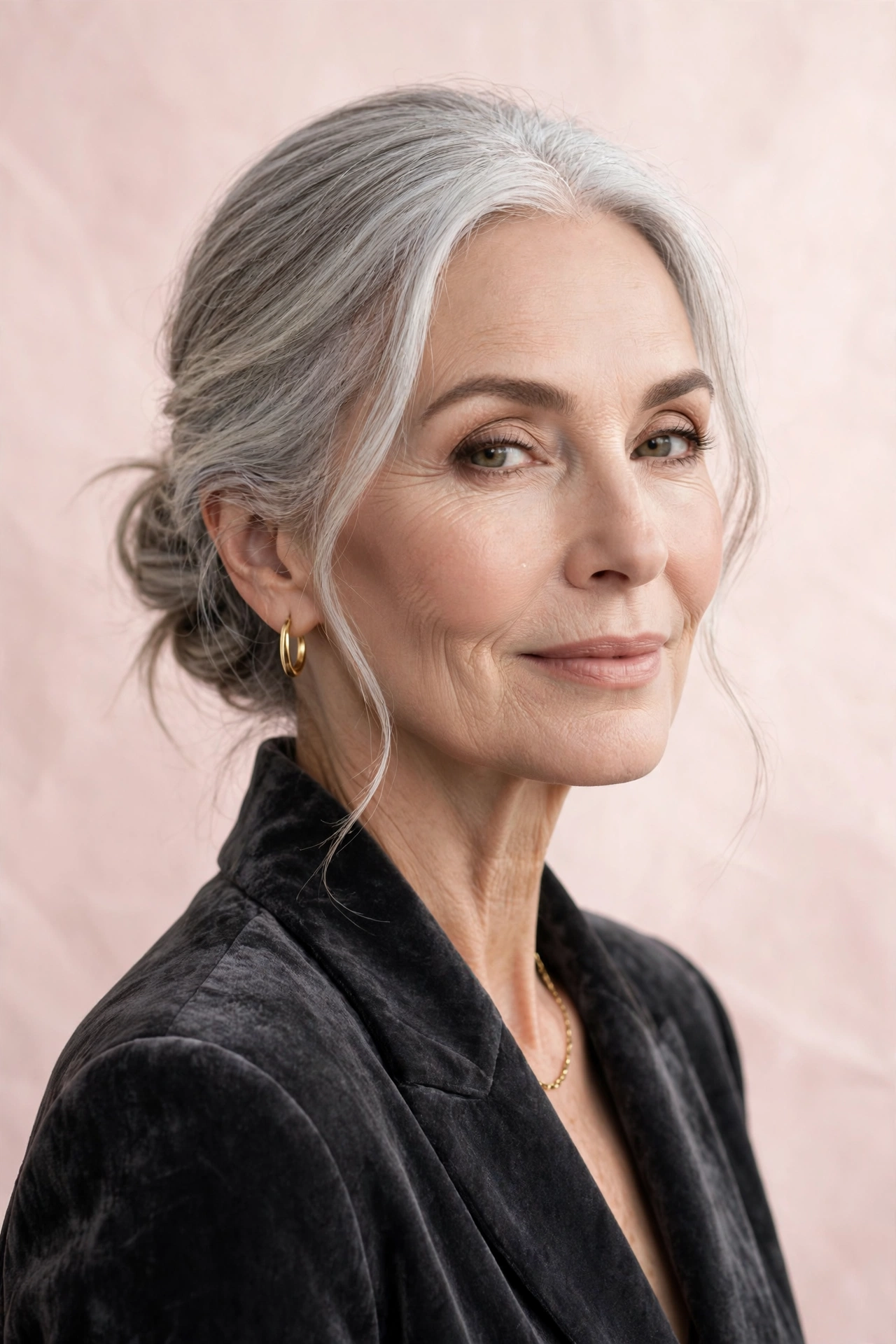
- Try styles that show it off. Sleek buns, silver braids, and blunt bobs all showcase gray beautifully. Gray hair photographs gorgeously in natural light — don’t hide it.
Frequently Asked Questions
How long does it take to fully transition to gray hair?
It depends on hair length and method. A pixie cut can transition in 3–4 months; a bob in 6–9 months; long hair takes 12–18 months for a full cold-turkey grow-out. Salon blending doesn’t shorten the biological timeline, but it makes the in-between months look intentional.
Will my gray hair look yellow?
It can, especially with sun exposure, heat styling, or hard water. Regular use of purple or silver shampoo (1–2 times weekly), heat protectant, and occasional salon glosses keep gray bright and cool-toned. Yellowing is manageable — it’s not a reason to abandon the transition.
Is gray hair really coarser?
Often, yes — but it’s not damage. As follicles stop producing pigment, the hair shaft structure changes: the cuticle can become more raised and the strand more wiry. Consistent moisture and the right products make it soft and manageable; it’s a different texture to learn, not a problem to fix.
Can I change my mind and go back to dye?
Absolutely. Many people transition for a year, then decide they prefer color — or vice versa. If you go back to dye, note that virgin gray can be resistant to color (it may need a slightly longer processing time), so tell your colorist it’s previously uncolored hair. There’s no rule that says the decision is permanent.
Do I need different products forever?
Your core routine shifts permanently toward moisture and tone maintenance — hydrating formulas, purple shampoo, and shine products become staples. But it’s not a burden; it’s just a different shelf. Most people find the gray routine simpler than the dye-maintenance treadmill they left behind.
What if my incoming gray is patchy or uneven?
Very common — gray rarely arrives uniformly. Patchiness evens out as more grows in, and in the meantime, strategic highlights or lowlights can balance the distribution. Give it at least 4–6 inches of growth before judging the final pattern; early patchiness often resolves into beautiful dimension.
Conclusion
Going gray gracefully isn’t about a single decision — it’s a season of intentional choices: picking the transition method that fits your life, planning for the awkward stage instead of fearing it, and learning to care for hair with a completely different texture and tone needs. The reward is freedom from the dye treadmill and hair that’s authentically yours, often more striking than the color you were maintaining. Whether you go cold turkey, book the big chop, or invest in salon blending, the throughline is the same: patience, moisture, and tone management. Your silver has been waiting under that dye for years — give it the graceful entrance it deserves. And if along the way you decide you’d rather keep some color in the mix, dyeing hair at home remains a perfectly good option. There’s no wrong way to wear your hair — only the way that feels like you.
Love this? Pin it for later!