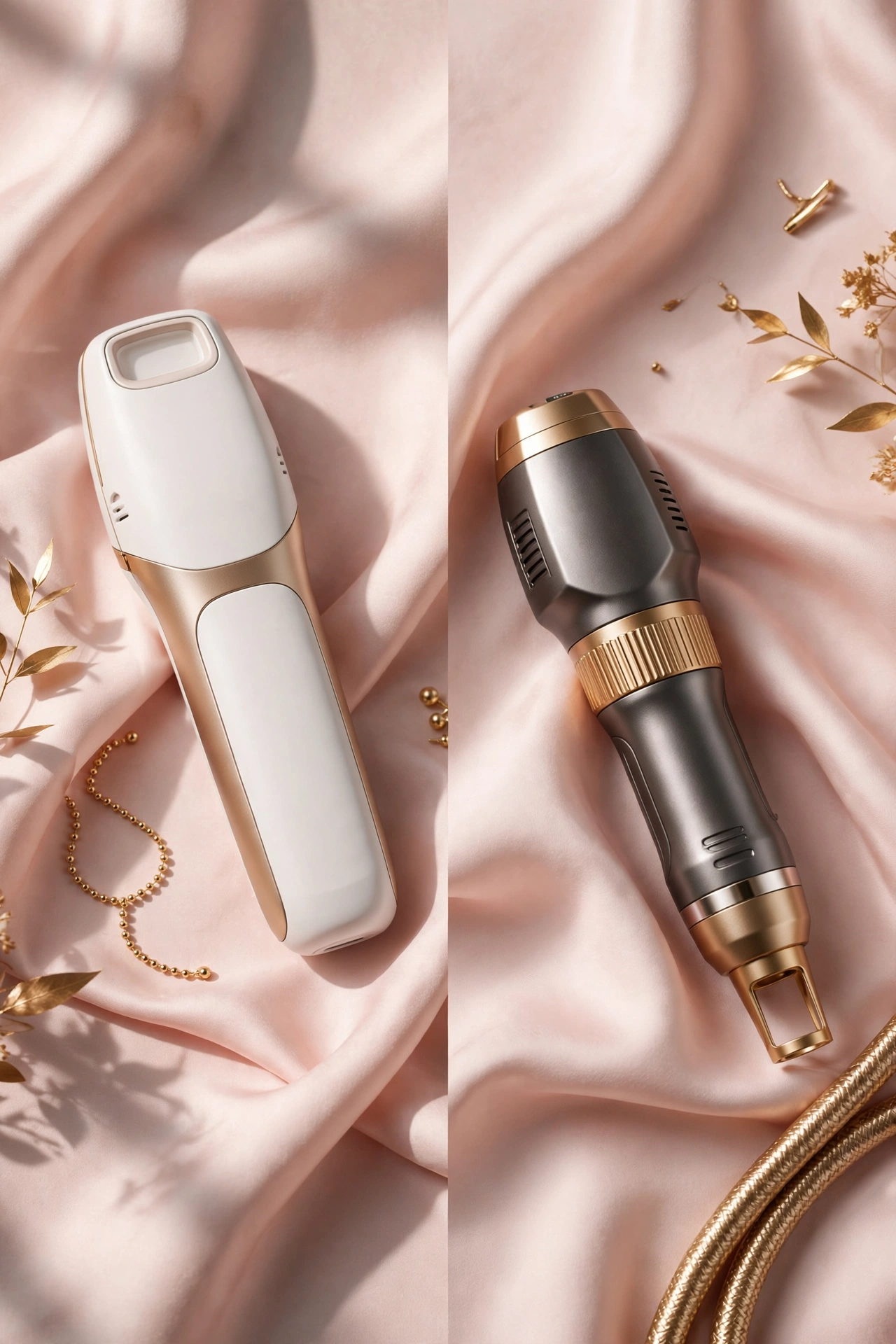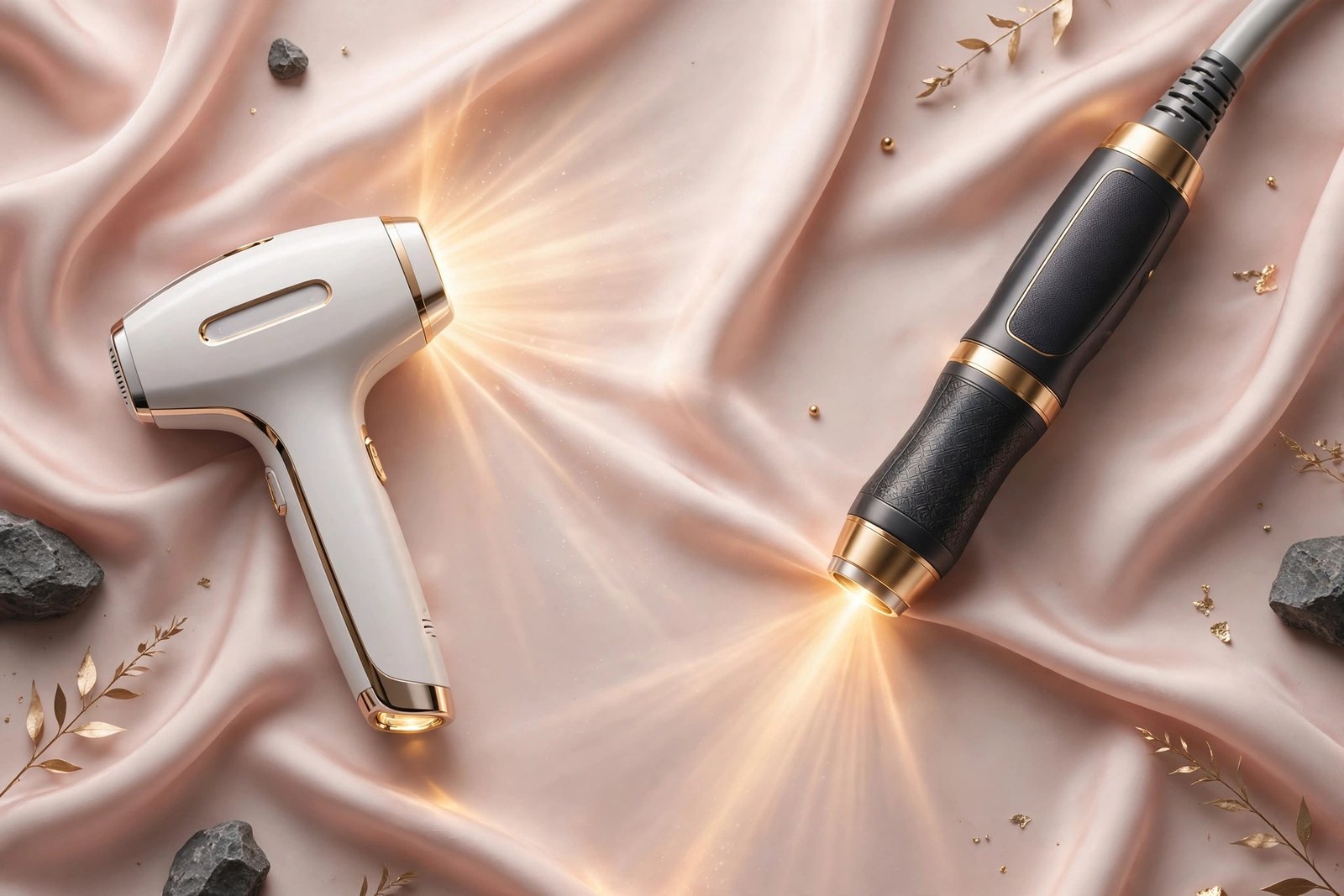
IPL vs Laser Hair Removal: Which Is Better?
If you’re ready to ditch daily shaving, you’ve probably come across two big options: IPL and laser hair removal. They’re often mentioned in the same breath, and both use light energy to reduce hair growth — but they are not the same thing. Understanding how each one works is the key to choosing the method that suits your skin tone, hair color, budget, and pain tolerance. This guide breaks down the real differences so you can decide with confidence.

Key Takeaways
- IPL uses a broad spectrum of light; laser uses a single, focused wavelength — which makes laser more precise and IPL more forgiving over large areas.
- Laser hair removal is performed in a clinic with professional-grade machines; IPL devices are commonly sold for safe at-home use.
- Both methods work best on the same combination: lighter skin with darker hair. Neither is effective on blonde, gray, or red hair.
- Professional laser typically needs fewer sessions (6–8) than at-home IPL (8–12+), but at-home IPL costs far less upfront.
- Neither option is permanent in the strictest sense — both deliver long-term hair reduction, and maintenance touch-ups are normal.
- IPL has stricter skin-tone limits for at-home devices: very dark skin should avoid it. This is not medical advice — consult a dermatologist before starting any light-based hair removal.
How IPL Works
IPL stands for intense pulsed light. Despite the name, it’s technically not a laser at all. An IPL device emits a broad spectrum of light across multiple wavelengths — think of it like a camera flash — that the pigment (melanin) in your hair absorbs. That absorbed light converts to heat, which damages the hair follicle and discourages future growth.
Because the light is scattered across wavelengths, it’s less concentrated than a laser. Dermatologists describe IPL as effective for hair reduction, but generally needing more sessions to reach the same result a laser can achieve. The upside is that this gentler profile is exactly what makes IPL devices safe for home use: at-home devices operate at lower energy levels than professional machines, which keeps them within a safety range a beginner can handle.
Most at-home IPL devices offer adjustable intensity levels and a built-in skin-tone sensor that prevents the device from flashing if your skin is too dark for safe treatment. If you’re considering the at-home route, start with the complete beginner’s guide to at-home IPL hair removal for the full picture of what to expect.
How Laser Hair Removal Works
Laser hair removal uses a single, concentrated wavelength of light aimed directly at the hair follicle. Common laser types include diode, alexandrite, and Nd:YAG — each tuned to different skin tones and hair types. Because the beam is focused, more energy reaches each follicle in a single pulse, which is why laser treatments are typically more powerful per session than IPL.
Laser hair removal is a professional treatment, performed in clinics and med spas. A trained practitioner assesses your skin and hair, selects the right laser and settings, and can adjust on the spot. The Nd:YAG laser in particular is considered safer for darker skin tones than most IPL devices, because its longer wavelength bypasses surface melanin more effectively — though even laser requires a careful skin assessment for darker complexions.
One practical note: “permanent hair removal” is marketing language. The FDA clears these devices for “permanent hair reduction,” meaning long-term, stable reduction in hair count — not the permanent eradication of every hair.
IPL vs Laser: Head-to-Head Comparison
| Factor | At-Home IPL | Professional Laser |
|---|---|---|
| Technology | Broad-spectrum pulsed light | Single focused wavelength |
| Where it’s done | At home | Clinic / med spa |
| Sessions needed | 8–12+ initial sessions | 6–8 initial sessions |
| Session time | 15–45 min per area | 10–30 min per area |
| Upfront cost | $200–$500 device (unlimited use) | $200–$500 per session |
| Total cost (legs, e.g.) | One device, multiple areas | $1,200–$4,000+ total |
| Pain level | Mild warmth / rubber-band snap | Moderate; numbing cream optional |
| Best for | Light skin + dark hair | Wider skin-tone range (Nd:YAG) |
| Effectiveness | Long-term hair reduction | Long-term hair reduction, often faster |
| Maintenance | Touch-ups every 1–3 months | Touch-ups 1–2x per year |
Which One Is Better for Your Situation?
Choose at-home IPL if…
- You have light to medium skin and dark hair — the combination IPL handles best.
- You want a budget-friendly option: one device covers unlimited sessions on multiple body areas.
- You prefer the privacy and convenience of treating yourself at home, on your own schedule.
- Your hair-removal needs are moderate (legs, underarms, bikini line) rather than large-area or heavy growth.
Choose professional laser if…
- You have a darker skin tone — a dermatologist can select an Nd:YAG laser, which is safer for melanin-rich skin than at-home IPL.
- You want faster results with fewer total appointments.
- You have hormonal or coarse hair growth (like PCOS-related facial hair) that may need professional assessment and stronger settings.
- You’d rather have a trained practitioner handle the technology and monitor your skin’s response.
Consider neither (for now) if…
- Your hair is blonde, red, gray, or white — both methods need dark melanin in the hair shaft to work. Neither IPL nor laser is effective on very light hair.
- You’re pregnant or breastfeeding — light-based hair removal hasn’t been studied enough in pregnancy, and dermatologists generally advise waiting.
- You have an active skin condition (eczema flare, psoriasis, infection, open wounds) or are taking photosensitizing medications such as isotretinoin. For a full breakdown, read who should not use IPL hair removal.
Safety First: What You Must Know
Both IPL and at-home laser devices are regulated as safe for consumer use, but “safe” depends entirely on using them correctly and honestly assessing whether they’re right for you.
Skin-tone limits matter most. IPL targets melanin, and it cannot tell the difference between the melanin in your hair and the melanin in your skin. On very dark skin, the light can be absorbed by the surrounding skin instead, risking burns, blistering, and hyperpigmentation. Reputable devices include a skin-tone sensor that blocks treatment on unsuitable tones — never bypass it. Professional laser has more options for darker skin, but even then, an experienced practitioner is essential.
Contraindications include pregnancy, breastfeeding, active skin conditions (eczema, psoriasis, infections, sunburn), a recent tan or sun exposure, tattoos or moles in the treatment area, and certain medications — particularly isotretinoin (acne medication), which makes skin extremely light-sensitive, and antibiotics or other photosensitizing drugs. If you take any prescription medication, check with your doctor first.
Always patch test. Before your first full session, do a small test patch on a discreet area and wait 24–48 hours to check for adverse reactions. Follow the manufacturer’s instructions exactly for prep, settings, and aftercare — details covered in how to use an IPL device safely at home, step by step.
This article is for informational purposes only and is not medical advice. Light-based hair removal affects your skin, and everyone’s skin is different — consult a dermatologist before starting, especially if you have a darker skin tone, a medical condition, or are taking any medication.
Cost Breakdown: What You’ll Actually Pay
At-home IPL: A quality device costs roughly $200–$500 upfront. That’s it — no per-session fees, and you can treat as many body areas as you like. If results hold for a year with occasional touch-ups, the per-session cost becomes trivially small. The trade-off is time: you’ll do the sessions yourself over several months.
Professional laser: Expect $200–$500 per session per area, with 6–8 sessions needed — so roughly $1,200–$4,000+ per body area. Multiple areas multiply the cost. Many clinics offer package deals. The trade-off is speed and precision: a practitioner with a medical-grade machine typically gets you results in fewer visits.
Waxing as a comparison: Professional waxing runs $50–$100 per session every 4–6 weeks — indefinitely. Over two years, waxing often costs more than an at-home IPL device, which is why many people switch. Curious about waxing instead? See hard wax vs soft wax — which is better for you.
Frequently Asked Questions
Is IPL as effective as laser?
Laser is generally considered more powerful per session because of its focused wavelength, so it usually delivers results in fewer sessions. But at-home IPL can achieve comparable long-term hair reduction if you complete the full treatment schedule and maintain it. The “best” option depends more on your skin tone, budget, and patience than on the technology alone.
Which hurts more, IPL or laser?
Most people find at-home IPL gentler — the sensation is often described as a warm snap, like a rubber band. Professional laser can be more intense, especially on sensitive areas like the bikini line, though clinics can use cooling systems or numbing cream. Pain varies by individual, body area, and hair coarseness.
Can I do laser at home?
True laser devices for home use exist but are rare and less powerful than clinic machines; most “at-home laser” marketing actually refers to IPL. The home light-based hair removal market is dominated by IPL for good reason — it’s the safer profile for unsupervised use.
Does hair grow back after IPL or laser?
Both methods give long-term hair reduction, not absolute permanent removal. Hormonal changes, age, and individual biology mean some regrowth is normal. Most people maintain results with occasional touch-up sessions — every month or two for IPL, once or twice a year after laser.
Can dark skin use IPL or laser safely?
At-home IPL is generally not recommended for very dark skin (Fitzpatrick types V–VI) because of burn risk — check your device’s skin-tone chart honestly. Professional laser with an Nd:YAG wavelength is considered the safer clinical option for darker skin, performed by an experienced dermatologist or practitioner.
How long do results take with each method?
At-home IPL users typically notice reduced regrowth after 3–4 sessions (roughly 4–6 weeks in), with significant reduction by 8–12 sessions. Professional laser clients often see noticeable change after 2–3 sessions and substantial reduction by 6–8. Both need touch-ups for maintenance.
The Bottom Line
There’s no universal winner between IPL and laser — only the better fit for your skin, hair, budget, and lifestyle. If you have light-to-medium skin, dark hair, and want an affordable, private option, at-home IPL is a sensible starting point. If you have darker skin, want faster results, or have complex hair growth, a consultation with a dermatologist about professional laser is the smarter move. And whichever you choose, respect the safety rules: patch test, avoid sun exposure around sessions, and be honest about your skin tone. Your skin will thank you for it.
Love this? Pin it for later!