How to Use Hyaluronic Acid Serum Correctly (Without Drying Your Skin)
Hyaluronic acid is one of the most popular skincare ingredients in the world — and one of the most misunderstood. Famous for holding up to 1,000 times its weight in water, it sounds like a guaranteed glow in a bottle. But here is the twist many people learn the hard way: used the wrong way, hyaluronic acid serum can leave your skin feeling drier and tighter than before.
That is not a flaw in the ingredient — it is a flaw in the technique. Hyaluronic acid is a humectant: it pulls moisture toward itself, and if there is no moisture on your skin’s surface for it to grab, it can pull water up from deeper layers instead. The result is the opposite of what you wanted.
The good news: one simple rule fixes this completely. This guide covers exactly how to use hyaluronic acid serum — when to apply it, where it fits in your routine, what to layer it with, the mistakes that cause dryness, and how it compares to other hydrators.
What Hyaluronic Acid Actually Does
Hyaluronic acid (HA) is a substance your body already makes. It is found naturally in your skin, eyes, and joints, where it helps keep tissues lubricated and cushioned. Production declines with age, which is one reason skin tends to look less plump over time.
In skincare, hyaluronic acid works as a humectant — an ingredient that attracts water and holds it against the skin. Think of it less like a drink of water and more like a magnet for moisture that is already around. When conditions are right, it draws water into the upper layers of the skin, making it look plumper and smoother. Fine dehydration lines often look softer within minutes of proper application.
A few things worth knowing:
- It needs water to work with. A humectant does not create moisture; it moves it. No available water means nothing to attract.
- Molecular weight matters. Many serums blend multiple weights: larger molecules hydrate the surface, smaller ones reach slightly deeper. “Multi-weight” on a label is generally a good sign.
- It suits most skin types. Oily, dry, combination, and sensitive skin can all use it, because it hydrates without adding oil or heaviness.
- It is a hydrator, not a seal. Hyaluronic acid brings water in but does not stop it from escaping. That job belongs to your moisturizer.
Why Hyaluronic Acid Can Dry Your Skin Out
This is the part almost nobody explains on the label. Because hyaluronic acid pulls moisture toward itself, it pulls from wherever moisture is most abundant. In a humid bathroom after a shower, that means the damp air and the water on your skin — ideal. But in dry environments — winter air, air conditioning, airplane cabins, arid climates — there is little moisture in the air. The serum can then draw water upward from deeper skin layers toward the surface, where it evaporates. On your face, that feels like tightness or flakiness an hour after applying.
This leads to the single most important rule of hyaluronic acid use:
Always apply hyaluronic acid serum to damp — not dry, not dripping — skin, and seal it with moisturizer immediately after.
Damp skin gives the humectant surface water to pull from instead of stealing it from below. Moisturizer then acts as a lid, slowing evaporation so the hydration stays put. Skip either step and you work against the ingredient. If your skin has ever felt drier after hyaluronic acid, this is almost certainly why.
How to Apply Hyaluronic Acid Serum: Step by Step
Here is the exact sequence that gets the best results:
Step 1: Cleanse as usual. Start with freshly cleansed skin so nothing blocks absorption.
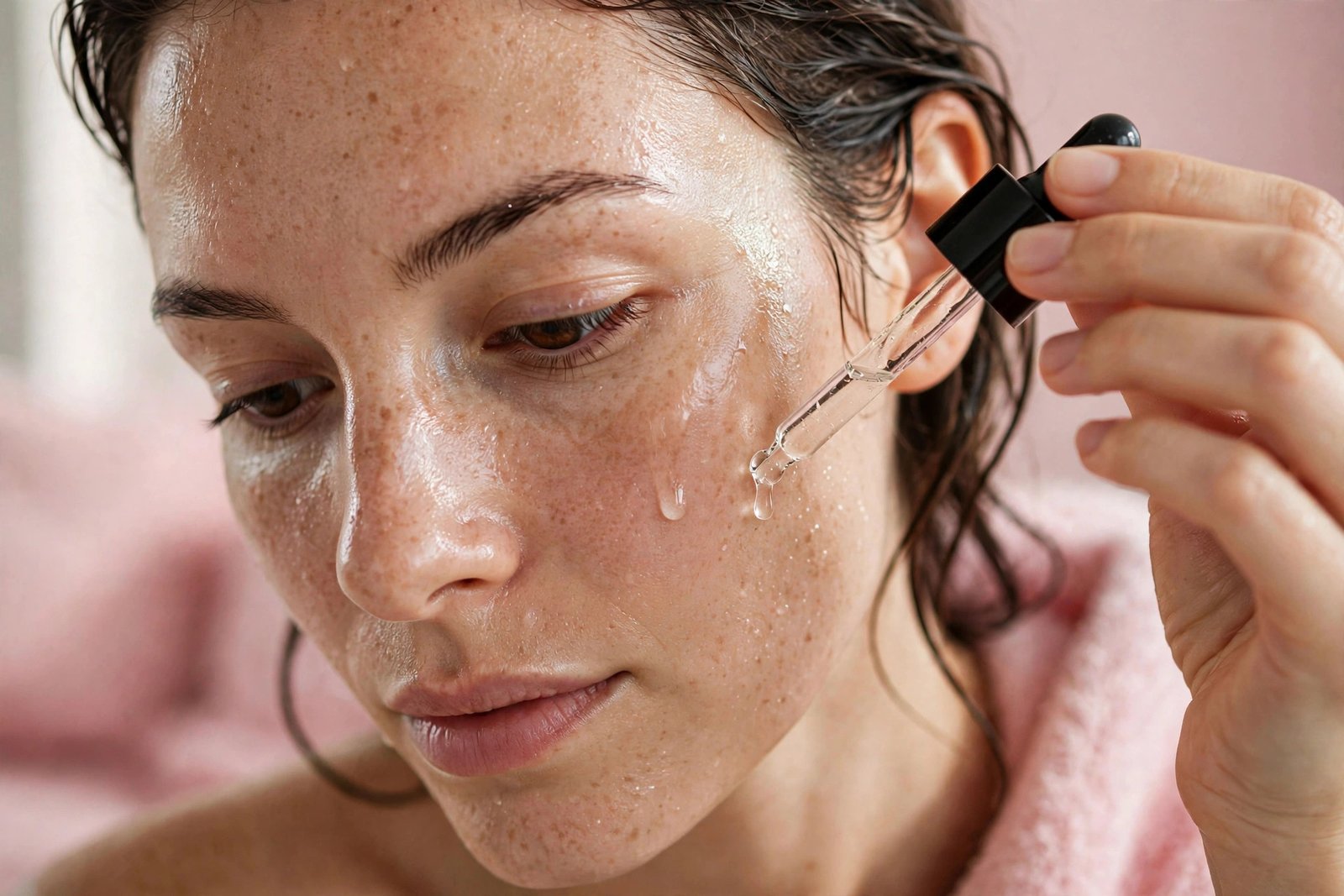
Step 2: Leave skin damp. Do not towel-dry completely — pat lightly or mist with water or hydrating toner. Damp means slightly dewy to the touch: not dripping (which dilutes the serum) and not dry (which defeats the purpose).
Step 3: Apply a small amount. You need far less than you think: 2–3 drops or a pea-sized amount for the whole face. A thin, even layer absorbs better; over-applying leaves a sticky film.
Step 4: Press, don’t rub. Gently press in with your palms for a few seconds. Rubbing creates friction and can pill the product under later layers.
Step 5: Moisturize immediately. Within a minute — don’t wait for the serum to dry down — apply moisturizer over the top. Non-negotiable, especially in dry or heated air.
Step 6 (morning): Finish with sunscreen. Sunscreen always goes last in a morning routine, over moisturizer.
That is the whole technique. Damp skin, thin layer, seal it in. Everything else is fine-tuning.
Where Hyaluronic Acid Fits in Your Routine
Hyaluronic acid serum is a water-based treatment, so it follows the classic thinnest-to-thickest layering order:
Morning: Cleanser → (toner, optional) → hyaluronic acid serum → treatment serums → moisturizer → sunscreen
Evening: Cleanser → (toner, optional) → hyaluronic acid serum → treatment serums → moisturizer (and facial oil last, if you use one)
A common question is whether it goes before or after other serums. As a rule, apply water-based serums before richer or oil-based ones; among water-based serums, go thinnest to thickest. Hyaluronic acid plays well with most actives — more on that in the FAQ.
You can use it twice daily, morning and night. No cycling or breaks needed — it is not an exfoliant or retinoid. Consistency matters more than quantity.
If you are still figuring out the full order — where toner, treatments, moisturizer, and SPF each belong — our step-by-step beginner skincare routine walks through the complete sequence so every product lands in the right slot.
7 Common Hyaluronic Acid Mistakes
1. Applying it to dry skin. The number-one mistake and the main cause of that tight feeling. Damp skin first — always.
2. Skipping moisturizer afterward. Hyaluronic acid hydrates; it does not seal. Without moisturizer on top, the attracted water evaporates and takes your skin’s own moisture with it.
3. Using too much product. More serum does not mean more hydration. Excess sits on the surface, feels tacky, and pills under makeup or sunscreen.
4. Layering in the wrong order. A thick cream or facial oil applied first blocks the serum. Water-based always goes before oil-based.
5. Expecting it to fix dryness alone. Chronically dry, flaky, or stinging skin may signal a damaged skin barrier, which needs ceramides and a simplified routine — not more humectants.
6. Applying once and giving up. One application gives temporary plumping; consistent daily use is what keeps skin comfortably hydrated over time.
7. Ignoring your environment. In very dry climates or air-conditioned rooms, be extra strict about the damp-skin-plus-moisturizer combo, or layer the serum under a richer cream than usual.
Hyaluronic Acid vs Other Hydrators
Hyaluronic acid is not the only way to hydrate skin. Here is how it compares to the other common options:
Hyaluronic acid vs glycerin. Glycerin is another humectant — one of the oldest and most proven. It works on the same principle and is very effective, often at a lower price. Hyaluronic acid tends to feel more elegant and less sticky in serums, which is why it dominates the category, but glycerin in a good moisturizer is excellent too.
Hyaluronic acid vs niacinamide. Different jobs that complement each other: niacinamide (vitamin B3) supports the barrier, helps regulate oil, and improves uneven tone — it is not primarily a hydrator. Layering the two is popular: hyaluronic acid brings in water, niacinamide strengthens the barrier that keeps it there. The same thinnest-to-thickest logic in our guide on how to layer vitamin C and niacinamide applies when you add hyaluronic acid into the mix.
Hyaluronic acid vs ceramides. Ceramides are lipids that reinforce your skin’s natural barrier; they are not humectants. Think of it this way: hyaluronic acid supplies the water, ceramides fix the container. Dry or compromised skin usually benefits most from both.
Hyaluronic acid vs squalane. Squalane is an emollient and light occlusive. It softens skin and slows water loss but does not attract water itself — it works beautifully over hyaluronic acid as part of the sealing step.
You do not need to choose just one. A solid routine often pairs a humectant (hyaluronic acid or glycerin) with barrier support (ceramides, niacinamide) and a seal (moisturizer, squalane).
Frequently Asked Questions
Can I use hyaluronic acid serum every day?
Yes — morning and night. Unlike exfoliating acids or retinoids, it does not increase sun sensitivity and needs no cycling.
Should hyaluronic acid go before or after moisturizer?
Before. Apply it to damp skin right after cleansing (and toner, if you use one), then apply moisturizer over the top to seal it in.
Can I use hyaluronic acid with niacinamide?
Yes — they layer well together. Apply the thinner formula first. Both are well tolerated, and the combination covers hydration plus barrier support.
Can I use hyaluronic acid with vitamin C?
Generally yes. With a low-pH L-ascorbic acid formula, apply vitamin C first, let it absorb a minute, then follow with hyaluronic acid. If you get stinging, use them at different times of day.
Can I use hyaluronic acid with retinol?
Yes — many find it cushions retinol dryness. Apply hyaluronic acid (damp skin, sealed with moisturizer) before retinol, and introduce retinol slowly regardless.
Why does my skin feel tight after hyaluronic acid?
Almost always: applied to dry skin, or skipped moisturizer. Fix the technique before blaming the product.
Does hyaluronic acid work in dry climates?
It can, but damp-skin-plus-moisturizer becomes essential rather than optional. In arid conditions, use a richer moisturizer on top.
Key Takeaways
- Damp skin is the golden rule. Apply hyaluronic acid to slightly damp skin so it pulls water from the surface, not from deep in your skin.
- Always seal it in. Follow with moisturizer within a minute — hyaluronic acid hydrates, but only an occlusive layer keeps that hydration from evaporating.
- Less is more. Two to three drops or a pea-sized amount is enough; over-applying causes tackiness and pilling.
- Order matters. It goes after cleansing (and toner), before heavier serums, moisturizer, and sunscreen.
- It plays well with others. Hyaluronic acid layers safely with niacinamide, vitamin C, and retinol when applied in the right order.
- Pair it with barrier support. For lasting results, combine this humectant with barrier-friendly ingredients like ceramides and niacinamide rather than relying on it alone.
Love this? Pin it for later!