Eczema Skincare Guide: Soothe Flare-Ups for Good
Eczema is one of the most misunderstood skin conditions — and one of the most common. The itching that wakes you at 2 a.m. The patches that crack no matter how much lotion you apply. The cycle of calm weeks followed by flare-ups that seem to come from nowhere. If any of this sounds familiar, you’re far from alone: eczema affects roughly 1 in 10 people, and for many, the standard skincare advice simply doesn’t work.
That’s because eczema-prone skin isn’t just “dry skin” or “sensitive skin.” It’s skin with a fundamentally compromised barrier — one that loses moisture faster, lets irritants in more easily, and overreacts to things normal skin shrugs off. Treating it like ordinary dry skin misses the point. This guide covers what eczema actually is, the routine framework dermatologists recommend, how to handle flare-ups, which ingredients genuinely help, and when it’s time to get professional help.
Key Takeaways
- Eczema is a barrier dysfunction: the skin loses moisture too fast and lets irritants in too easily. Every part of the routine should support barrier repair.
- The soak-and-seal method (lukewarm bath or shower, then moisturizer within 3 minutes) is the single most effective daily habit for eczema-prone skin.
- Ointments and thick creams outperform lotions for eczema — the thicker the product, the better it seals in moisture.
- Fragrance, harsh surfactants, and drying alcohols are the most common product triggers to eliminate first.
- Flare-ups need a different approach than maintenance: simplify, soothe, protect — and see a dermatologist if a flare doesn’t improve within 1–2 weeks.
This article is for informational purposes only and is not medical advice. Skin conditions vary — see a dermatologist for diagnosis and treatment.
What Is Eczema, Really?
“Eczema” is an umbrella term, but most of the time people mean atopic dermatitis — a chronic inflammatory condition where the skin barrier doesn’t function properly. In healthy skin, the outermost layer (the stratum corneum) works like a brick wall: skin cells are the bricks, and lipids (fats like ceramides) are the mortar holding them together. In eczema-prone skin, the mortar is faulty. Gaps in the wall let moisture escape and allow irritants, allergens, and microbes to penetrate — triggering the immune system to overreact.
The result is the familiar cycle: dryness leads to itching, itching leads to scratching, scratching damages the barrier further, and the damaged barrier causes more dryness. Dermatologists call this the itch-scratch cycle, and breaking it is the entire goal of eczema skincare.
Eczema looks different depending on age and skin tone. In infants it often appears on the cheeks and scalp; in children and adults it favors the creases — inner elbows, behind the knees, wrists, ankles, neck. On darker skin tones, eczema may appear as brown, purple, or grayish patches rather than bright red, and it’s frequently underdiagnosed as a result. Severity ranges from mild dry patches to widespread, weeping, intensely itchy inflammation.
It’s worth knowing that eczema isn’t one single thing. There are several related conditions that get confused with it — including perioral dermatitis, which causes stubborn red bumps specifically around the mouth and has different triggers and treatments (see this perioral dermatitis guide if your breakouts are concentrated around the mouth and nose). And if you’re unsure whether you’re dealing with eczema or psoriasis — another condition with scaly patches — this comparison of psoriasis vs eczema breaks down the differences.
The Foundation: The Soak-and-Seal Method
If you take one technique from this entire guide, make it this one. Dermatologists consistently recommend the soak-and-seal method as the backbone of eczema care, and it’s beautifully simple:
- Soak: Take a lukewarm (not hot) bath or shower for 5–10 minutes. The water hydrates the skin — yes, water moisturizes from the outside in during the soak.
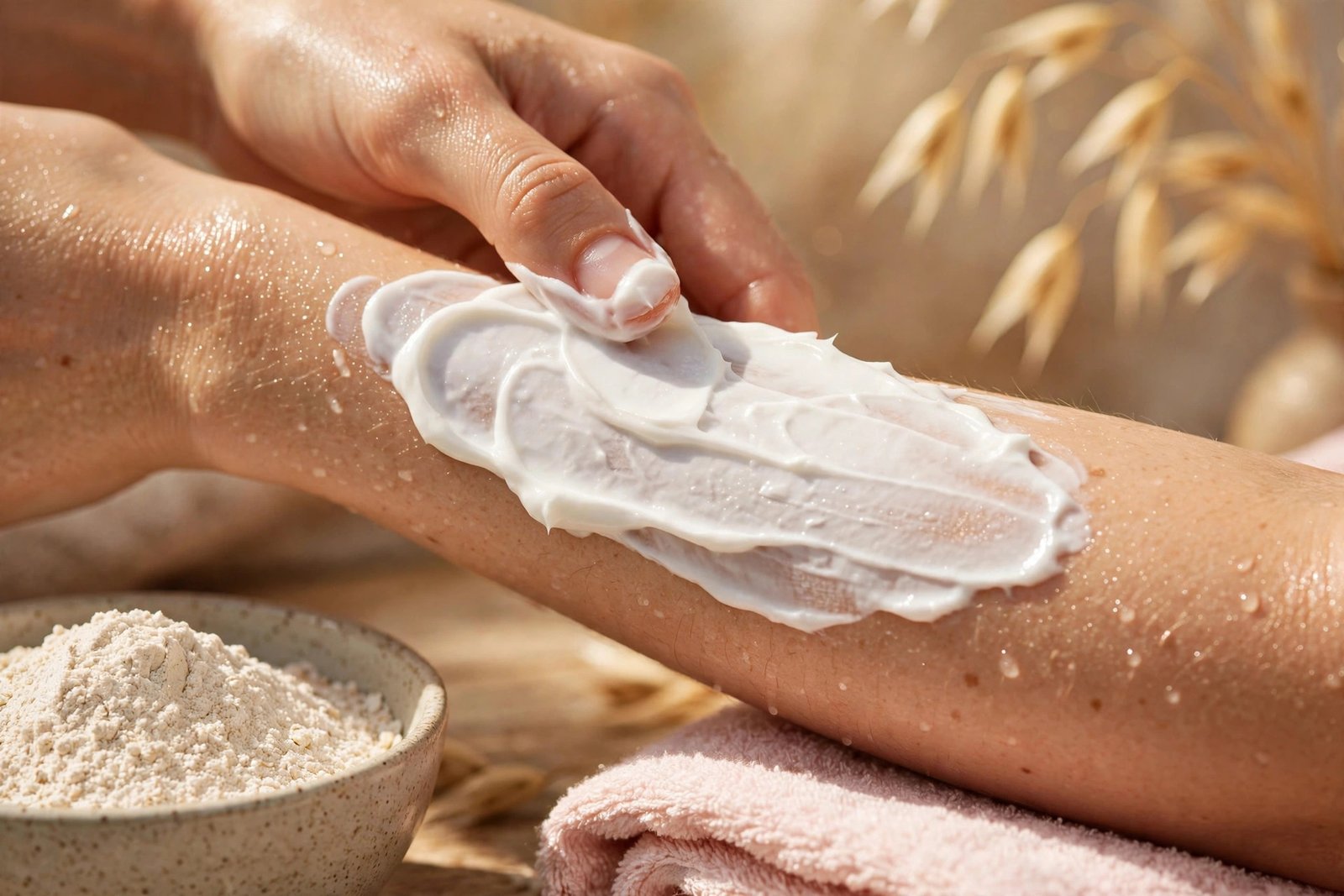
- Seal: Within 3 minutes of getting out, while skin is still damp, apply a thick moisturizer to the entire body. This traps the water in before it evaporates.
That 3-minute window matters more than the specific product. Water left on the skin evaporates quickly, and evaporation pulls moisture out of the skin with it — the opposite of what you want. Sealing damp skin is the difference between a bath that helps and a bath that makes dryness worse.
A few soak details that matter:
- Keep it lukewarm. Hot water feels soothing in the moment but strips natural oils and dilates blood vessels, worsening inflammation and itching afterward.
- Keep it short. 5–10 minutes is the sweet spot. Long soaks start to break down the skin’s natural lipids.
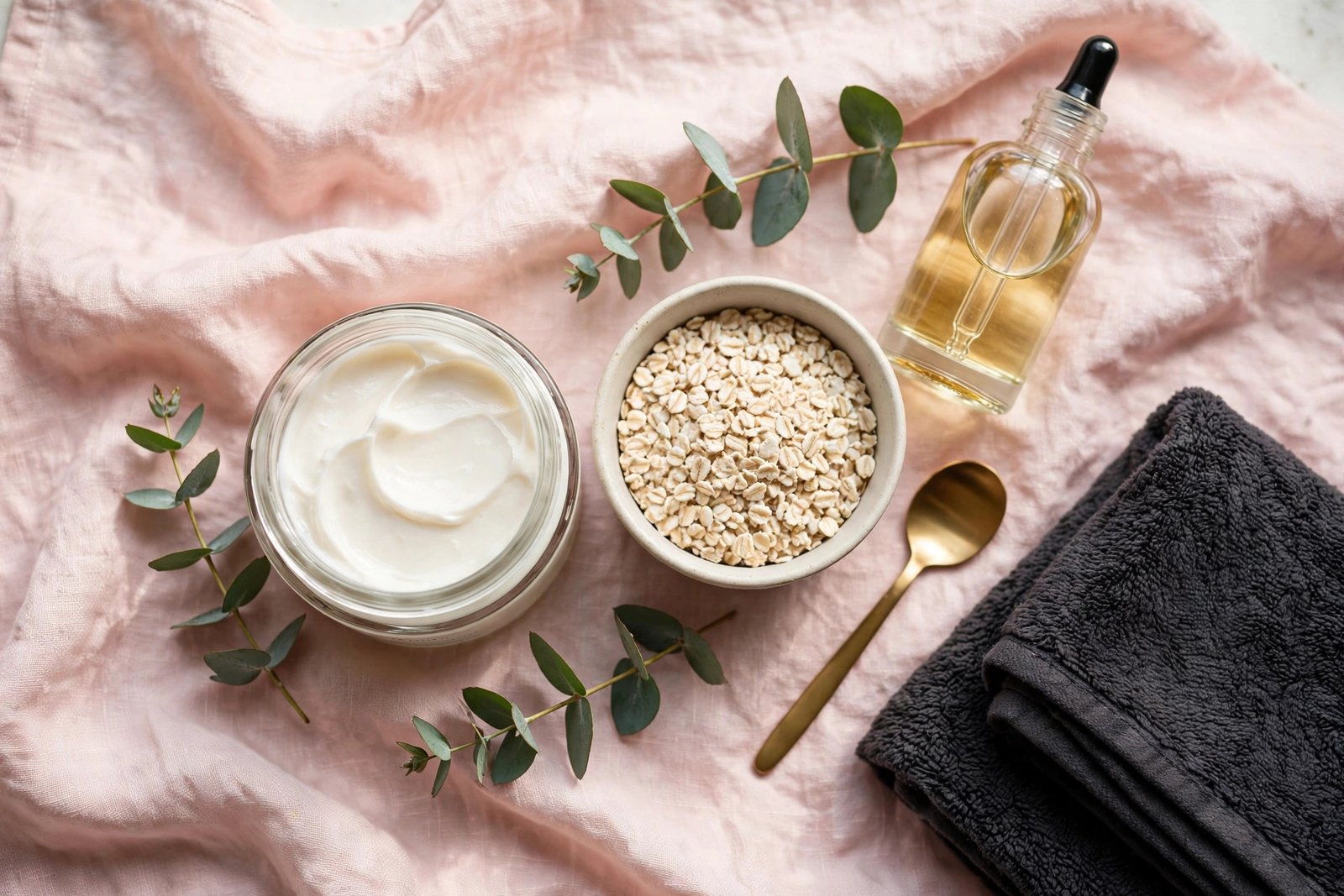
- Add colloidal oatmeal to baths. It’s one of the few bath additives with genuine evidence for calming eczema itching. Plain lukewarm water works fine too — don’t overcomplicate it.
- Skip the bubble bath. Fragranced bath products are a common flare trigger. If a bath product has a scent you can smell, it doesn’t belong in an eczema routine.
Cleansing for Eczema-Prone Skin
Cleansing is where many eczema routines quietly go wrong. The wrong cleanser undoes everything the moisturizer is trying to do.
What to Use
Look for cleansers labeled fragrance-free (not “unscented” — that can mean masking fragrance was added), with gentle surfactants. Cream cleansers, cleansing oils, and soap-free washes are generally the safest formats. The cleanser should leave your skin feeling comfortable — not tight, squeaky, or “clean” in that stripped sense. Tightness after cleansing is a sign the product is too harsh, full stop.
For the body, you don’t need to soap your entire body every shower. Focus cleanser on the areas that actually need it (underarms, groin, feet) and let water do the rest. This one change reduces overall surfactant exposure dramatically.
What to Avoid
- Fragrance and parfum in any form — the single most common cosmetic trigger for eczema flares.
- Sodium lauryl sulfate (SLS) and other harsh sulfates that strip the barrier.
- Antibacterial soaps — unnecessarily harsh and disruptive to the skin’s microbiome.
- Exfoliating cleansers with acids or scrubbing beads on eczema-prone areas.
- “Natural” doesn’t mean safe. Essential oils like tea tree, lavender, and citrus oils are frequent irritants on compromised skin.
If your current routine includes several fragranced products, simplifying to a gentle baseline first makes everything else easier — this sensitive skin routine guide is a good template for that reset.
Moisturizing: The Most Important Step in Eczema Care
If cleansing is where routines go wrong, moisturizing is where they succeed. For eczema-prone skin, moisturizer isn’t a finishing touch — it’s treatment. Consistent, generous moisturizing is the closest thing to a universal eczema recommendation that exists.
Ointments Beat Creams, Creams Beat Lotions
This is the hierarchy dermatologists teach, and it’s about one thing: occlusivity — how well the product seals moisture in.
- Ointments (like plain petrolatum) are the most occlusive. They’re greasy, and that’s the point — they create the strongest moisture seal. Best for very dry areas, nighttime use, and active flares.
- Creams are the practical daily workhorse. Thick, rich creams in tubs or tubes (not pumps — pump packaging usually means a thinner formula) offer strong protection without the full grease factor of ointments.
- Lotions are mostly water, evaporate quickly, and often contain more preservatives and fragrance. They’re generally the least effective option for eczema.
The rule of thumb: if you tip the container upside down and the product doesn’t move, it’s probably thick enough. Choosing the right one matters enough that there’s a dedicated breakdown — see this guide to the best moisturizers for eczema-prone skin for what to look for and how different formulas compare.
How to Apply (Technique Matters)
- Apply to damp skin — always within that 3-minute post-bath window, and after washing hands or face during the day.
- Be generous. Most people under-apply. For eczema-prone skin, a visible layer that takes a minute to absorb is about right.
- Stroke in the direction of hair growth, using smooth downward motions. Rubbing in circles can irritate follicles and trigger itching.
- Reapply through the day. Twice daily is the minimum; during dry weather or flares, three to four times is common. Keep a tube at your desk, in your bag, by your bed.
- Hands deserve special attention. They’re washed constantly, which strips them relentlessly. Moisturize after every hand wash — no exceptions during a flare.
Ingredients That Genuinely Help
- Petrolatum — the gold standard occlusive. Hypoallergenic, minimally irritating, and remarkably effective. Don’t let the “petroleum” name put you off; in skincare it’s highly refined and dermatologist-trusted.
- Ceramides — the “mortar” lipids that eczema-prone skin is missing. Ceramide-containing moisturizers help rebuild the barrier directly.
- Colloidal oatmeal — anti-itch and anti-inflammatory, with real evidence behind it. Available in creams, bath soaks, and cleansers.
- Glycerin and hyaluronic acid — humectants that draw water into the skin. They work best sealed under an occlusive layer.
- Squalane — a lightweight, well-tolerated emollient that softens without heaviness.
- Niacinamide — supports barrier function and calms inflammation at modest concentrations.
Ingredients to Avoid
- Fragrance/parfum — worth repeating because it’s the most common avoidable trigger.
- Drying alcohols (alcohol denat., SD alcohol) — not to be confused with fatty alcohols like cetyl alcohol, which are fine and moisturizing.
- Harsh preservatives like methylisothiazolinone (MI) in leave-on products.
- High-concentration acids (glycolic, salicylic) on active eczema — they sting compromised skin and worsen inflammation.
- Retinoids during flares — too irritating for broken barrier skin; only reintroduce on fully healed skin and with professional guidance.
Flare-Up Care: What to Do When Eczema Flares
Maintenance keeps things calm; flare care is damage control. A flare — increased redness, itching, swelling, cracking, or weeping — needs a simplified, soothing approach:
- Strip the routine back. During a flare, use only the gentlest cleanser and your thickest, simplest moisturizer. Drop every active, every new product, every “maybe this will help” experiment. Now is not the time.
- Moisturize more often. Increase to 3–4 times daily on flaring areas. Layer an ointment over your cream on the worst spots for extra sealing.
- Cool it down. Cool (not ice-cold) damp compresses for 10–15 minutes can calm itching and reduce the urge to scratch. Wet wrap therapy — damp bandages or clothing over moisturized skin, covered with a dry layer — is a dermatologist-recommended technique for moderate flares.
- Manage the itch without scratching. Keep nails short. At night, cotton gloves or socks over the hands prevent unconscious scratching. Antihistamines may help with nighttime itching for some people — discuss with a doctor or pharmacist.
- Avoid known triggers. Heat, sweat, wool, fragranced laundry products, stress — whatever your personal triggers are, minimize them during a flare.
- Watch for infection. Increased pain, yellow crusting, pus, rapidly spreading redness, or fever can signal a skin infection, which needs prompt medical attention — not more moisturizer.
If a flare doesn’t start improving within 1–2 weeks of diligent home care, or if it’s severe, widespread, weeping, or infected, see a dermatologist. Prescription options — topical corticosteroids, calcineurin inhibitors, and newer treatments — exist precisely for flares that home care can’t control. There’s no prize for suffering through a severe flare without help.
Eczema on the Face: Special Considerations
Facial eczema deserves its own mention because the stakes feel higher — it’s visible, the skin is thinner, and the usual heavy-duty body products can feel wrong on the face. The principles are the same (gentle cleanse, rich moisturize, protect the barrier), but the execution is gentler: lighter layers, extra caution around the eyes and lips, and absolutely no harsh actives on flaring facial skin.
Facial flares also have specific triggers worth knowing — from lip products migrating to the surrounding skin to the particular sensitivity of the eyelids. For a detailed walkthrough of treating facial eczema specifically, including what to avoid near the eyes and mouth, see this eczema on the face treatment guide.
Lifestyle Triggers Worth Tracking
Skincare is only part of the picture. Eczema flares often have triggers beyond the bathroom shelf, and identifying yours is genuinely life-changing:
- Fabrics: Wool and rough synthetics irritate; soft cotton and bamboo are usually safest. Wash new clothes before wearing.
- Laundry: Fragranced detergents and dryer sheets leave residue on everything you wear and sleep on. Switch to fragrance-free detergent and skip the softener.
- Heat and sweat: Both are classic flare triggers. Dress in breathable layers, shower after heavy sweating, and keep bedrooms cool at night.
- Dry air: Winter heating and air conditioning dry the air, which dries the skin. A humidifier in the bedroom helps many people significantly.
- Stress: The stress-eczema connection is well documented. Stress doesn’t cause eczema, but it reliably worsens it. Sleep, in particular, matters — itching disrupts sleep, and poor sleep worsens inflammation.
- Allergens: Dust mites, pet dander, and pollen can trigger flares in some people. Encasements for pillows and mattresses help with dust mite sensitivity.
- Food: True food-triggered eczema exists but is less common than the internet suggests, and it’s most relevant in young children. Don’t embark on major elimination diets without medical guidance — the nutritional risks are real.
A trigger diary — noting flares alongside weather, products, foods, stress, and fabrics — is the most practical tool for finding your personal pattern. Two weeks of notes often reveals connections you’d never have guessed.
When to See a Dermatologist
Home care handles mild to moderate eczema well, but some situations need professional help — and recognizing them early prevents months of unnecessary suffering:
- Flares that don’t improve after 1–2 weeks of consistent home care
- Eczema that covers large areas of the body or significantly disrupts sleep
- Signs of infection: yellow crusts, pus, increasing pain, spreading redness, fever
- Eczema on the eyelids or genitals, where skin is thinnest and self-treatment is riskiest
- Any situation where you’re unsure of the diagnosis — several conditions mimic eczema
Modern dermatology has more eczema tools than ever: prescription topicals of varying strengths, wet-wrap protocols, phototherapy, and systemic treatments for severe cases. Seeing a dermatologist isn’t an admission of failure — it’s how you access options that over-the-counter products can’t provide.
Frequently Asked Questions
What’s the difference between eczema and dermatitis?
They’re largely overlapping terms. “Dermatitis” means inflammation of the skin generally; “eczema” is often used for the same thing, and “atopic dermatitis” is the specific chronic condition most people mean. In practice, the skincare approach is similar regardless of which label applies.
Can eczema be cured?
There’s no permanent cure for atopic dermatitis, but that’s not the bleak statement it sounds like. Many children outgrow it, and many adults manage it to the point of long symptom-free stretches. The realistic goal is control: fewer flares, milder flares, and skin that feels normal most of the time. Consistent barrier care genuinely achieves this for most people with mild to moderate eczema.
Is eczema contagious?
No. You can’t catch eczema from someone or give it to someone else, regardless of how it looks. It’s an immune and barrier condition, not an infection.
Should I exfoliate eczema-prone skin?
Generally, no — at least not during flares or on active patches. Exfoliation (physical or chemical) disrupts an already compromised barrier. Once skin is fully calm, some people tolerate very gentle exfoliation on non-eczema areas, but the eczema-prone zones themselves are best left alone.
Does diet affect eczema?
For most adults, the effect is modest and highly individual. Commonly blamed foods (dairy, gluten, sugar) trigger flares in some people and do nothing in others. If you suspect a food trigger, track it in a diary first — and talk to a doctor before eliminating major food groups, since unnecessary restriction causes its own problems.
Can adults develop eczema for the first time?
Yes. While eczema most often starts in childhood, adult-onset eczema is real and not uncommon. New patches in adulthood deserve a dermatologist’s look, partly to confirm the diagnosis — several adult skin conditions can resemble eczema at first glance.
What’s the best fabric for eczema-prone skin?
Soft, smooth, breathable fabrics: cotton, bamboo, and silk are the usual recommendations. Avoid wool directly against the skin and rough synthetics. Also wash new clothing before first wear to remove manufacturing finishes and excess dye.
Conclusion
Eczema skincare isn’t complicated, but it is specific. The whole approach rests on one insight: your skin barrier needs support, not stimulation. Soak and seal to lock in moisture. Cleanse gently and rarely overdo it. Moisturize with thick, fragrance-free products — generously and often. During flares, simplify ruthlessly and protect the skin while it recovers. Track your triggers. And get professional help when home care isn’t enough, without guilt and without delay.
Eczema is a long game, but it’s a winnable one. Most people who commit to consistent barrier care see real, lasting improvement — calmer skin, less itching, fewer flares, better sleep. Start with the basics in this guide, explore the linked deep-dives for your specific situation — whether that’s facial eczema treatment, choosing the right moisturizer, or understanding how eczema differs from psoriasis — and give the routine time to work. Your barrier didn’t break overnight, and it won’t rebuild overnight either. But it will rebuild.
Love this? Pin it for later!